It started with a Slack message.
After an internal session in which Sagar (Our SEO analyst) walked the team through using n8n with live tool building for SEO automation, our founder, Nitin Manchanda, posted a question to the company channel: What if we did this for real? What if everyone pitched the tool they wished existed, formed teams, and had a weekend to build it?
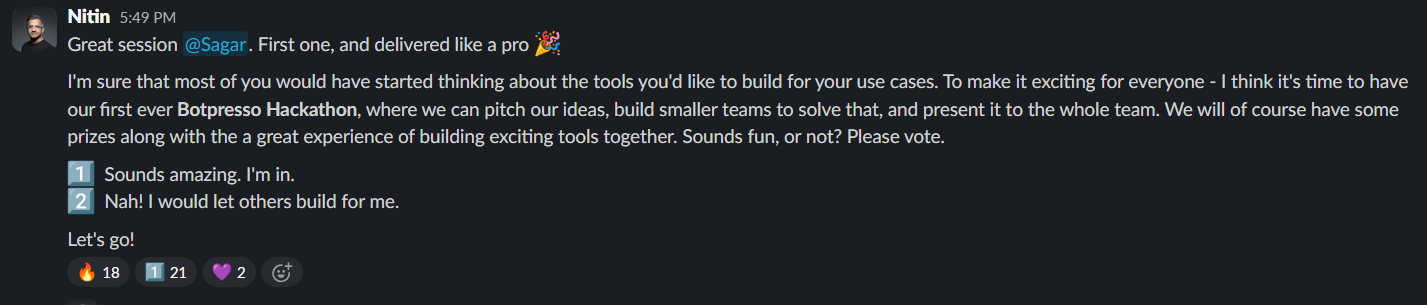
Eighteen fire emojis and twenty-one “1” emojis later, Season 1 of the Botpresso Hackathon was on.
Why a hackathon, why now?
Botpresso has always been a team of “problem solvers with a bot-like mentality,” that’s not just marketing copy, it’s how the work actually gets done.
Every SEO has a running list of repetitive tasks they wish a tool would handle: weekly reports, sitemap audits, indexing checks, and competitor monitoring. The kind of work that needs doing but never gets prioritised over client deliverables.
The hackathon was a permission slip.
For two weeks of run-up and one intense weekend of building, those backlog ideas got to be the work.
The format
The structure was simple: Everyone got 2 minutes to pitch their idea, interesting pitches got shortlisted, teams of 4–5 formed, and the teams started building to ship a working prototype. Roughly 67 hours, start to finish. Demo day on one fine afternoon, judged 50% by the jury and 50% by everyone in the room. The top three teams took home some exciting prizes along with a wonderful experience, of course.
The seven shortlisted pitches
After the votes were tallied, seven pitches made it through to the build weekend. Here’s a sneak peek at what each team built.
1. Sitemap Radar by Nabil Ali
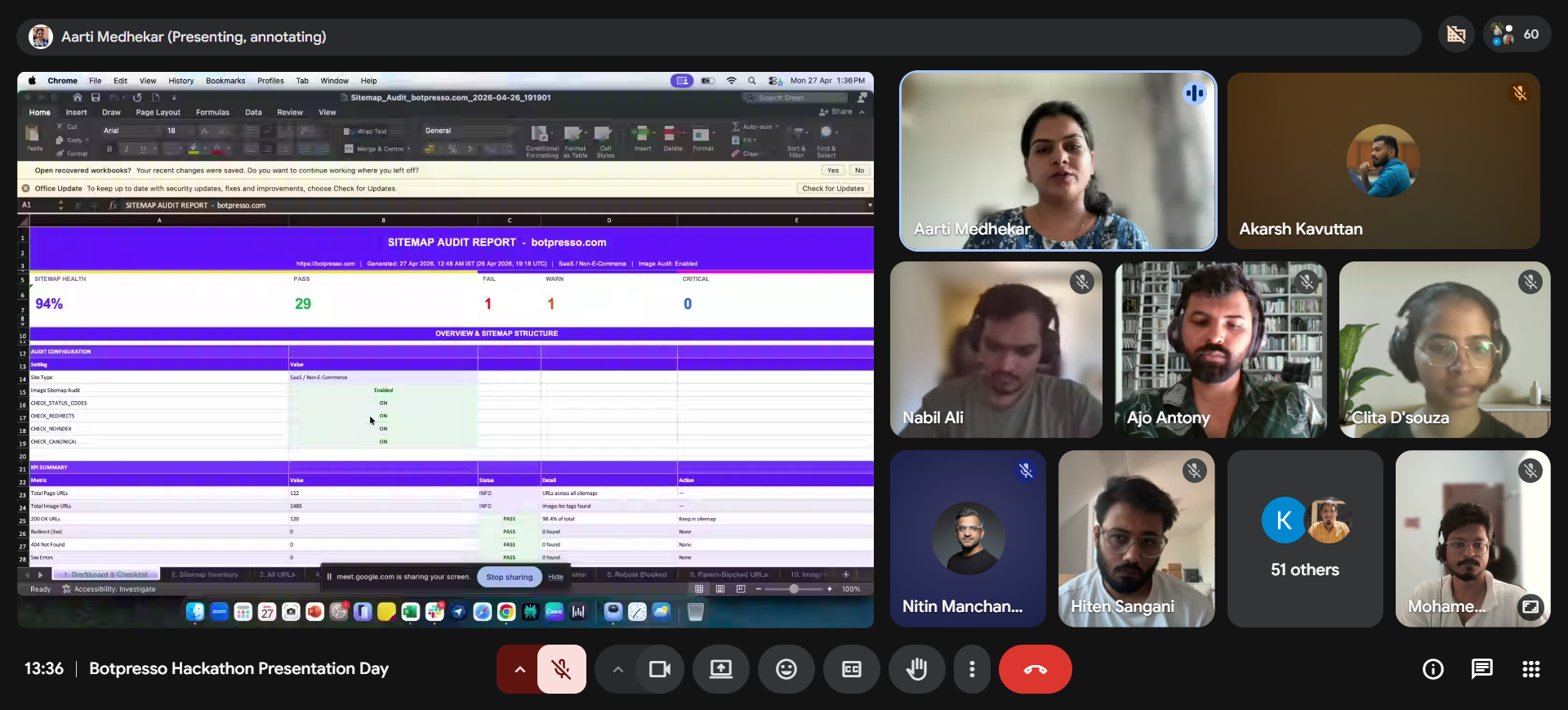
Sitemap audits – checking indexing, canonicals, status codes, crawl issues across hundreds of URLs – are one of the most repetitive jobs in technical SEO, and Nabil does them. So his team built a free, lightweight auditor that runs more than 30 technical checks from a single pasted URL, classifies every issue as Pass / Fail / Critical, and outputs a Sitemap Health Score that works on production and staging environments.
What had been a half-day exercise now takes a few minutes. “I learned many new things, worked with the team, and improved my problem-solving skills,” Nabil says of the experience. “It helped me gain more confidence.”
2. SEO Report Automation by Sagar Kumar
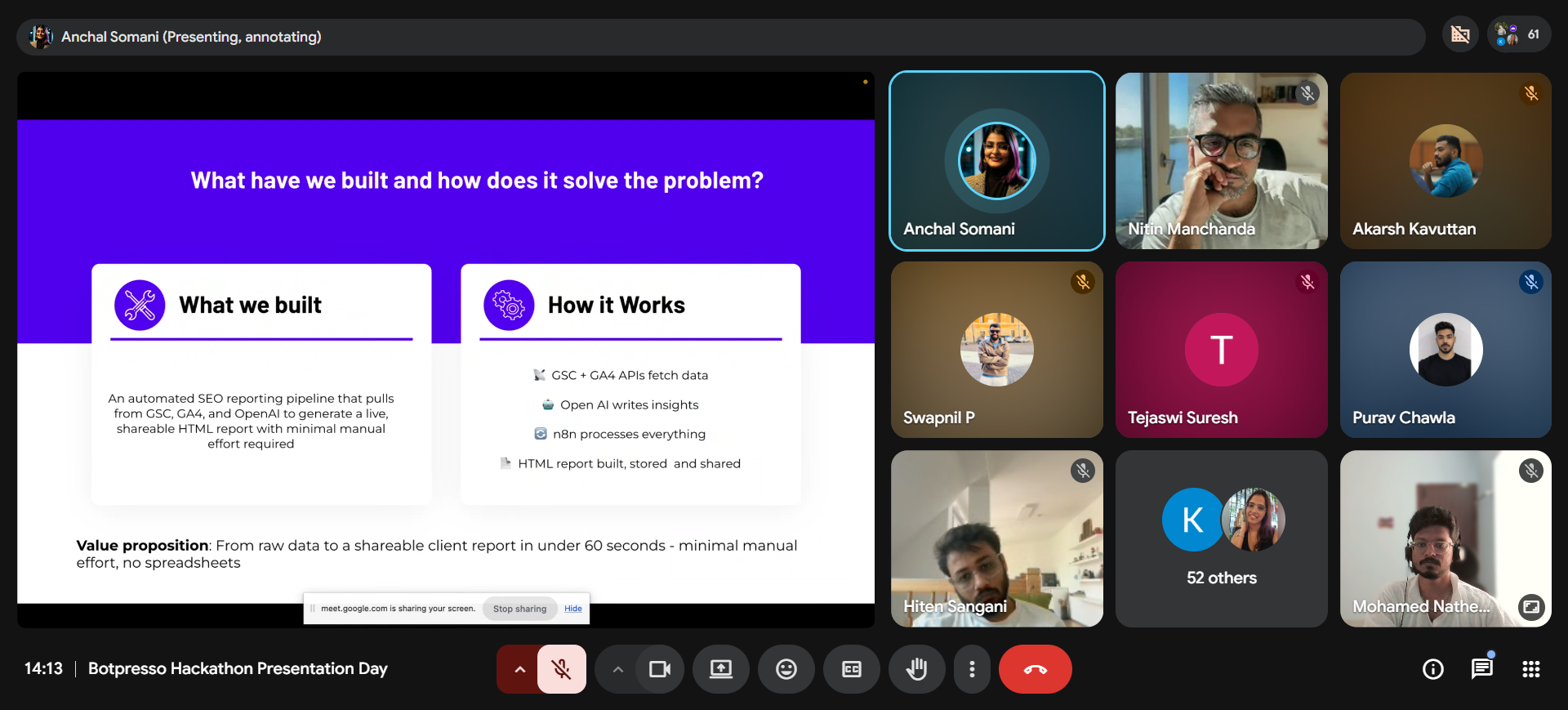
The Traffic Times, the team built around Sagar’s pitch, took on the monthly reporting, the universal agency curse of pulling from GSC and GA4, building charts, copying into slides, writing the summary, and doing it again next month, for every client.
Their answer was an n8n-powered pipeline that pulls the data via APIs, updates Google Sheets, generates Slides, and writes the summary using OpenAI on a weekly or monthly trigger. The analyst’s job becomes reviewing the report, not assembling it. The number Sagar’s team pencilled in was one to two hours saved per client per cycle – for an agency with twenty clients, an analyst’s full week reclaimed every month.
For Sagar, who’d kicked off the whole thing with his n8n session and now found himself leading a four-person team, the meta-moment wasn’t lost. “It was my first experience of this kind, and one I will always remember,” he says. “I had only built small tools for my personal use cases before. But working with a team gave me the opportunity to understand how a product manager works and how we can build something meaningful, not just for ourselves, but for everyone.”
3. Competitor Topic Discovery Engine by Purav Chawla
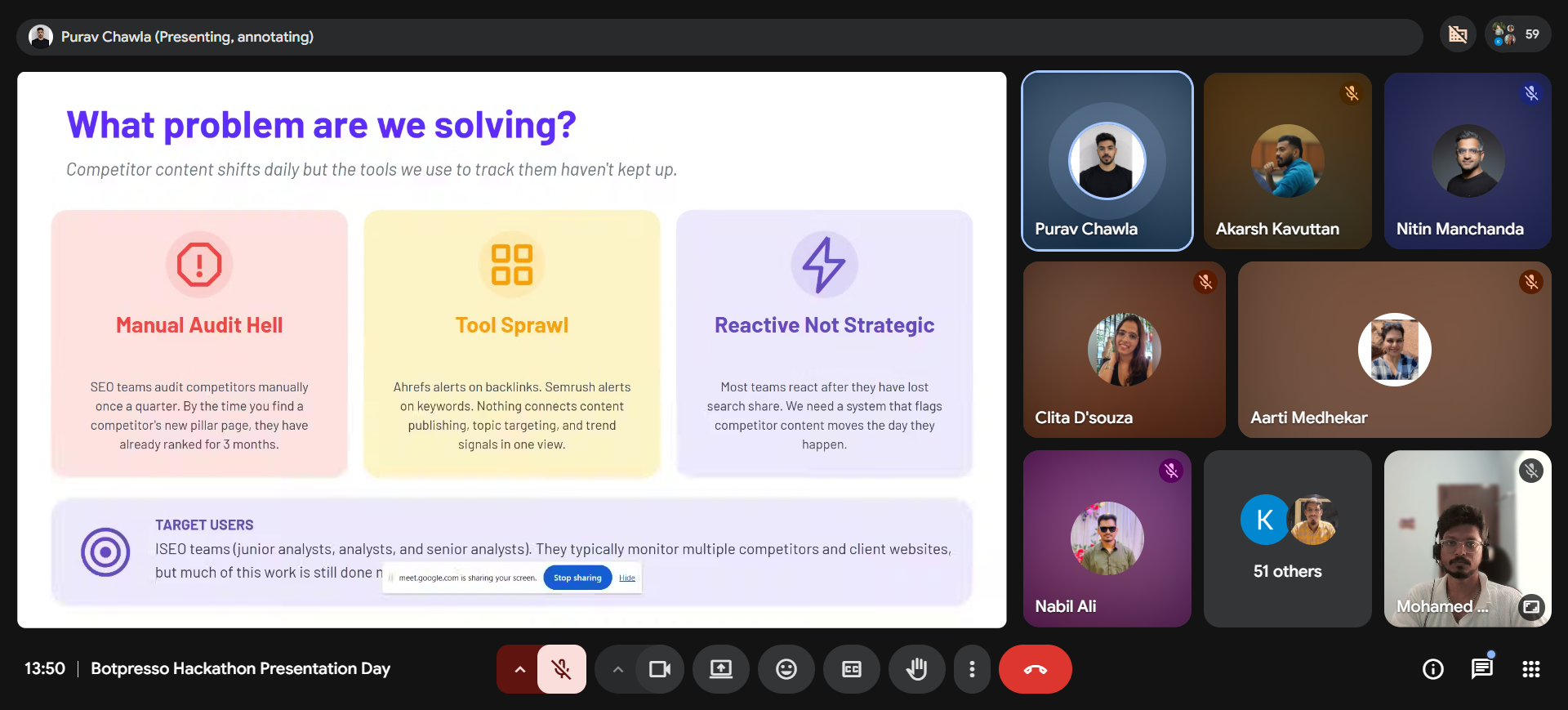
They built a workflow that watches each competitor’s blog folder daily, detects genuinely new articles and meaningful updates (not just date changes), and ships a ranked Monday 9 AM digest enriched with GPT-summarised changes and Keyword Planner search volumes. Estimated saving: three to four hours per analyst per week. Cost to run: about $2 a month.
“The hackathon was really fun and challenging at the same time. Learned many new things, worked late nights together, solved problems, and shared lots of jokes and laughs along the way. It also helped us think creatively under pressure and gain confidence by turning our ideas into a real project within a short time,” says Purav.
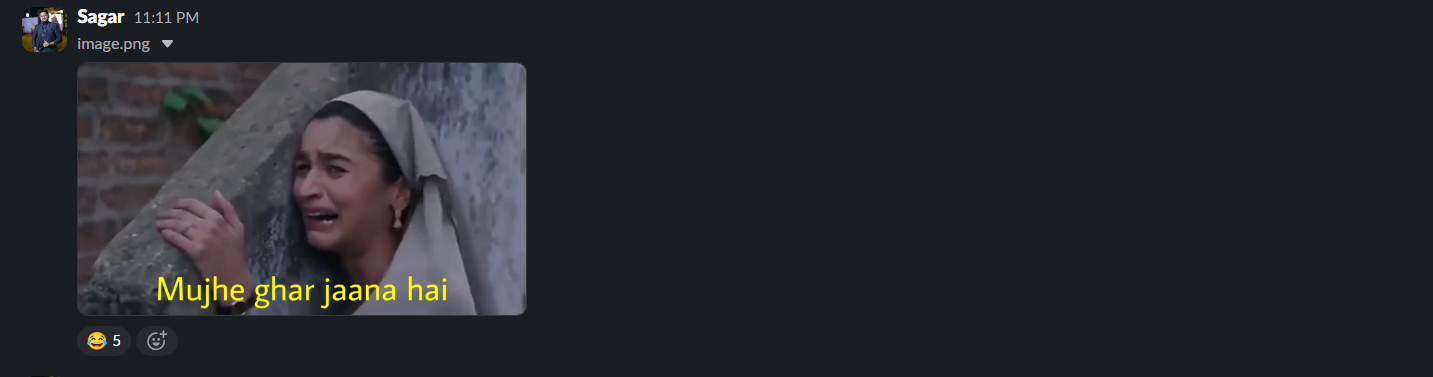
Purav isn’t kidding when he said, “Work late nights together.”
4. The Ghost Team by Atharva Tuljapurkar
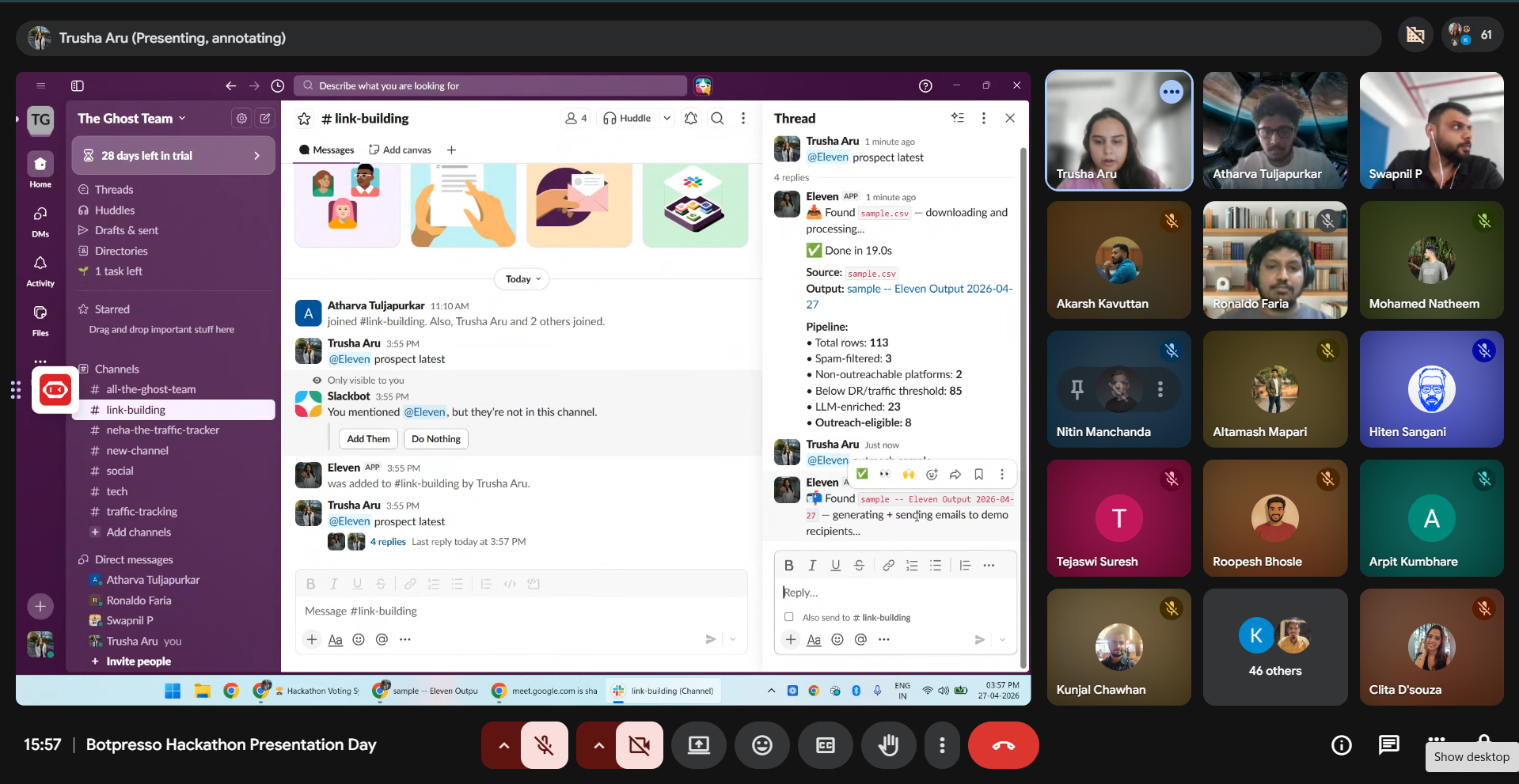
The team built something more ambitious: a set of specialist AI agents that live inside Slack. An SEO Manager agent. An SEO Analyst agent. A Link Building / Digital PR agent. Each is summonable from any channel, each built on the Claude API with custom skills for its role.
The pitch wasn’t to replace SEOs but to handle the long tail of “I just need someone to look at this for two minutes.” For Trusha, who joined the pitch, the appeal was the chance to push past the boundaries of her usual work. “I got to learn and explore a lot about tech and AI beyond the scope of my usual work,” she says. “It was a great learning experience overall.”
5. SEO Case Studies by Altamash Mapari
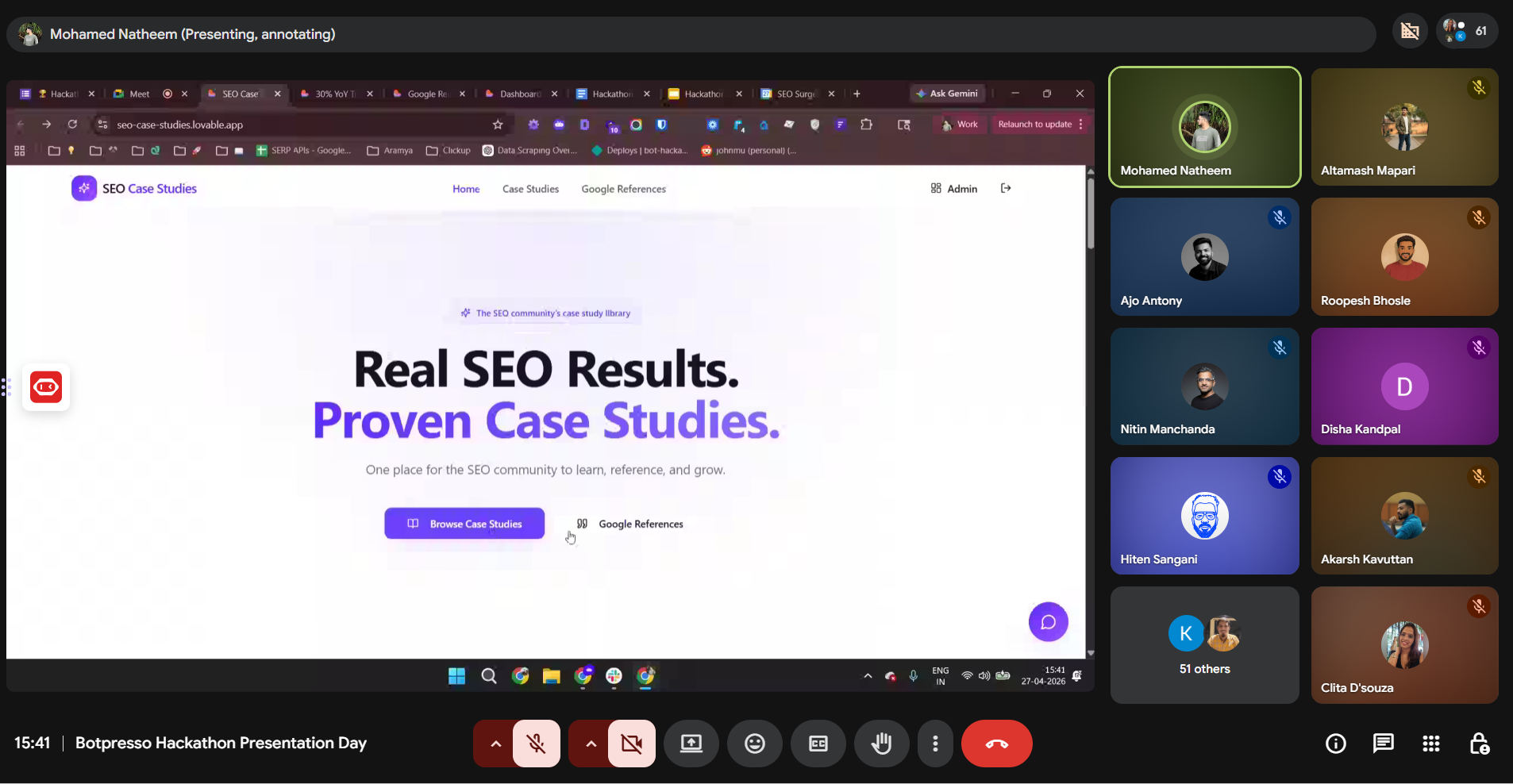
The argument: SEO knowledge today is scattered, anecdotal, and noisy. Practitioners hunt through Twitter threads, podcast clips, Reddit posts, and gated agency reports. There’s no single, structured, searchable home for real case studies, and the things Google itself has actually said about ranking, indexing, and quality are buried across dozens of conference talks and blog posts.
What Altamash’s team built is SEOCaseStudies, a community-driven web platform with two core libraries. The first: vetted SEO case studies, complete with industry, tactic, results, timeline, etc. The second: direct Google references and quotes, cited verbatim, source-linked, and dated.
On top of that, a moderation queue, rich-text authoring, upvotes, comments, and an AI assistant trained on the platform’s own content that lets a user ask things like “What worked for SaaS link building in the last year?” and get a grounded, cited answer.
6. Content Brief Agent Tool by Disha Kandpal
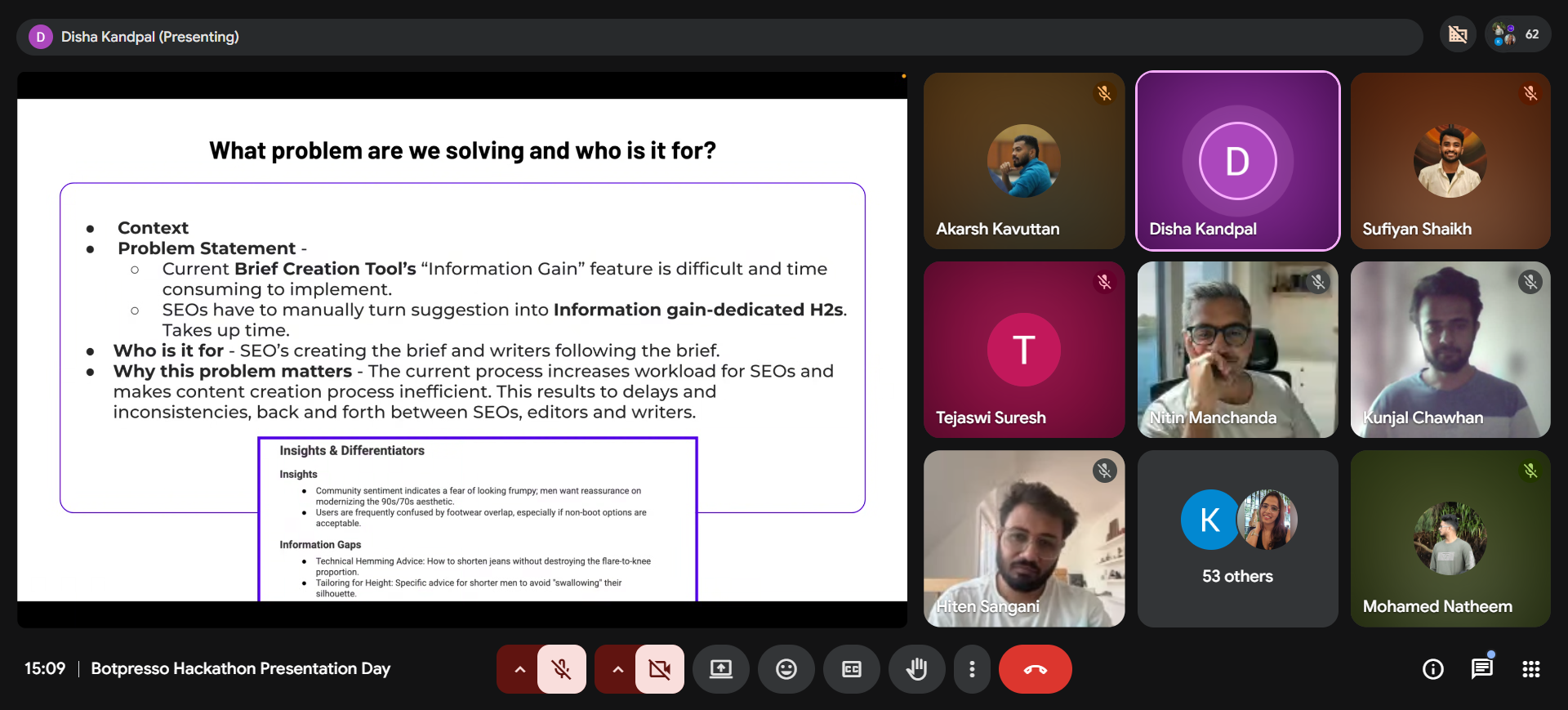
The team took a more surgical approach: it upgraded an existing internal Brief Creation Agent. Disha’s team added an “Information Gain” feature into the briefing tool: every brief now ships with a Differentiation Score (overlap percentage versus the SERP), section-level directives spelling out exactly which subheadings to add and what to write under them, and tailored rewrite suggestions for weak sections. The internal upside is less back-and-forth between SEOs, writers, and editors. The external upside is that the tool is the kind of thing you could productize and sell.
“It was super thrilling. From developing an idea to executing and working together with team members made stressful moments feel less heavy. Truly felt like we were breaking the rules of what’s acceptable in the industry and trying to do something totally out of the box,” says Disha.
7. GSC Indexing Analyzer by Sufiyan Shaikh
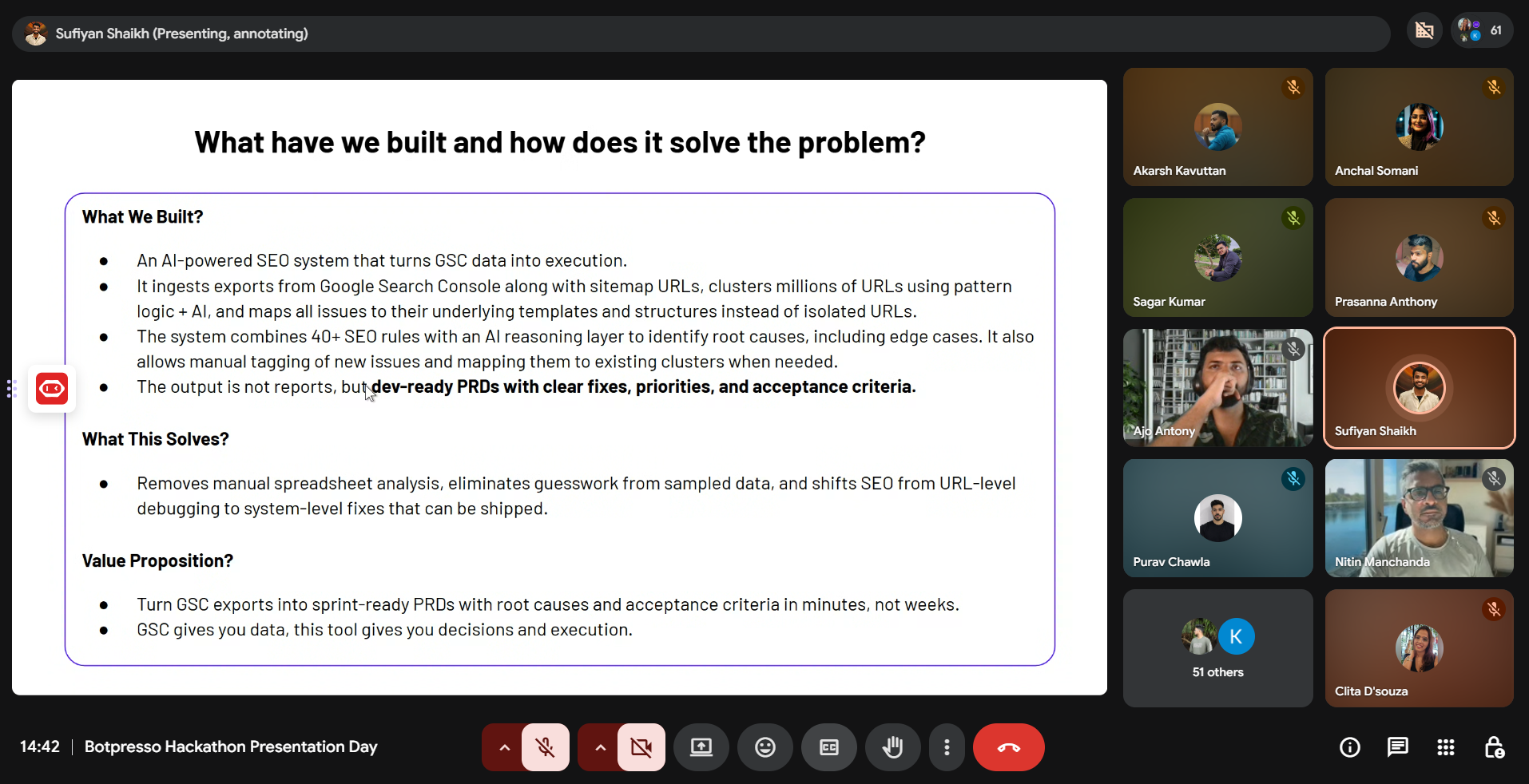
This team automated one of the agency’s most predictable weekly slogs. An n8n workflow triggers on schedule, pulls live coverage and crawl errors from the GSC API, runs them through an OpenAI layer that classifies each issue and writes specific fix recommendations, and lands the result in a colour-coded Google Sheet ready to action. The team’s estimate was a 70-80% reduction in audit time. For Faisal, a junior analyst on the team, the takeaway was simpler. “It was great. As a junior SEO analyst, I learned a lot.”
And the winners are…
After live demos on April 27, judged 50% by the jury and 50% by the audience, on usefulness, working demo, output quality, and presentation, the votes were in:
🥉 3rd Place goes to Sitemap Radar
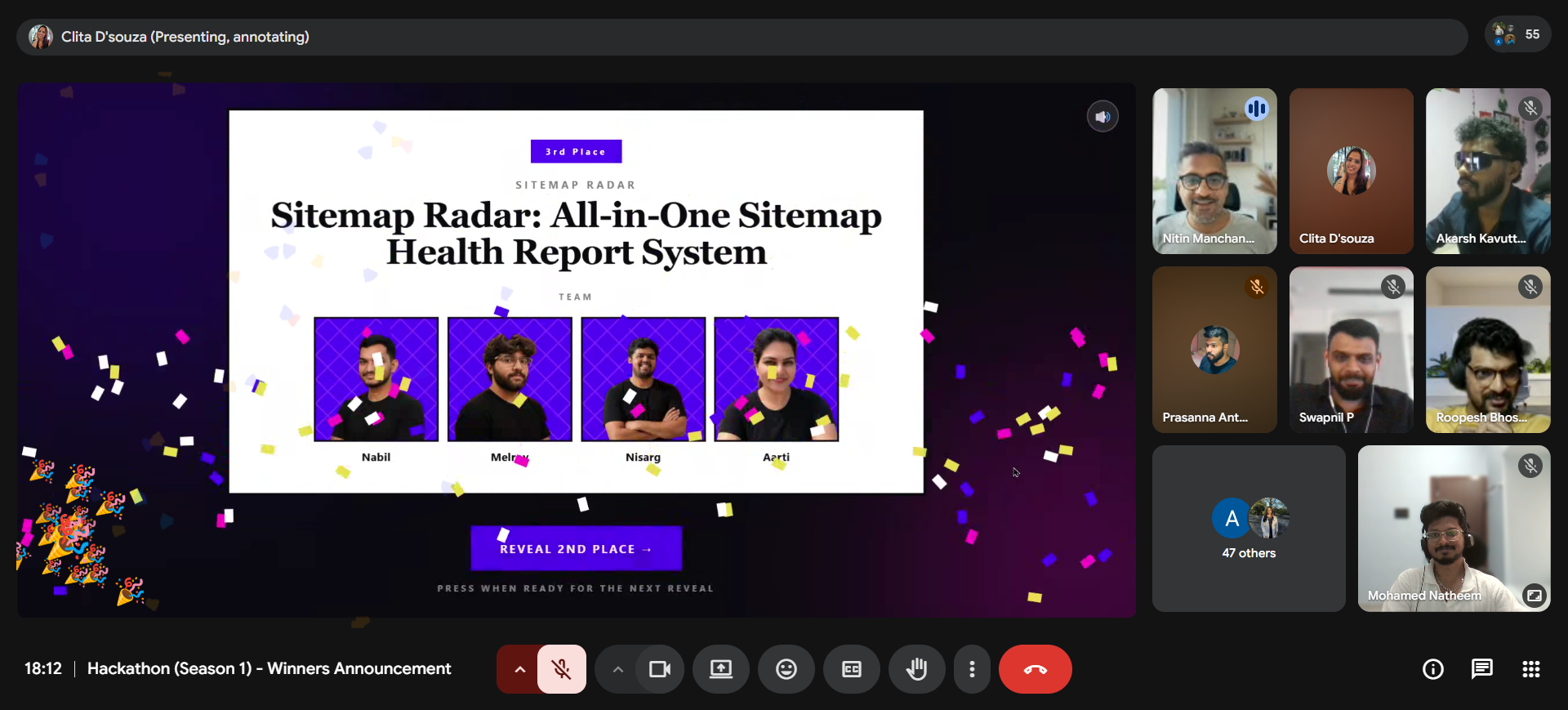
A polished, immediately-deployable tool that solves a daily pain point for every technical SEO at the company. Pure, focused execution.
🥈 2nd Place goes to The Traffic Times
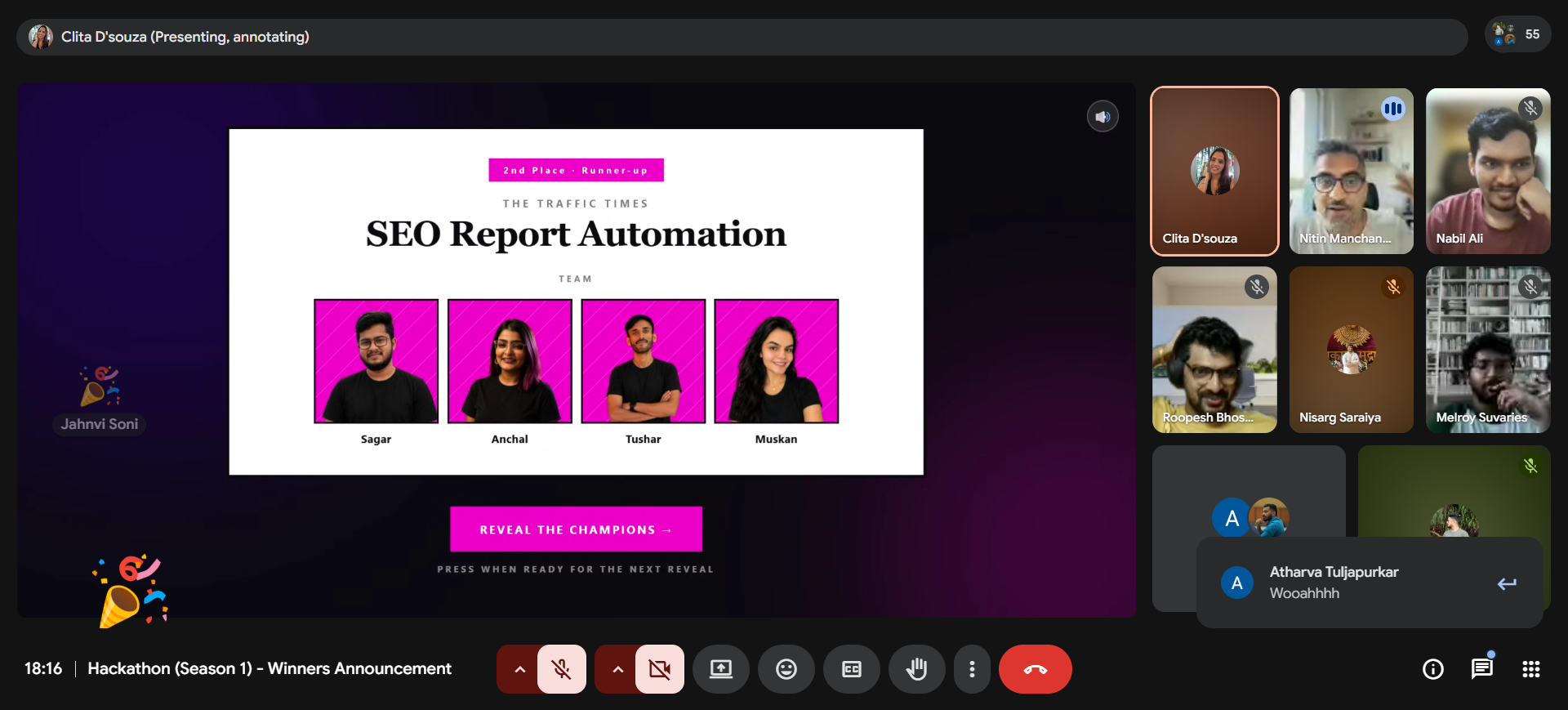
The “obvious idea everyone had thought of, but nobody had built.” Big productivity win, clean implementation, and an immediate plug-in to client workflows.
🥇 1st Place goes to SEO Files
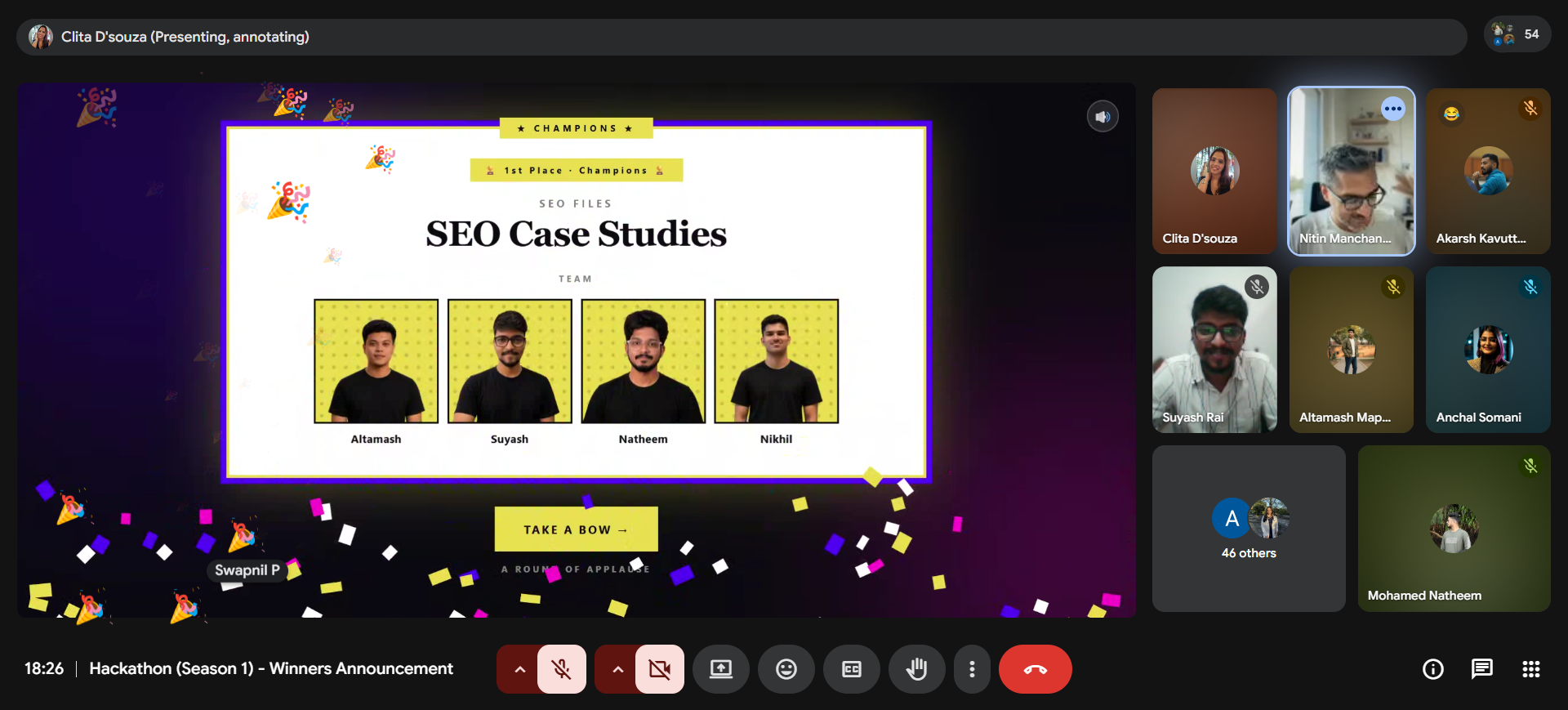
The most ambitious build of the hackathon, a full-stack community platform with auth, moderation, rich-text editing, and an AI assistant grounded in the platform’s own content. The team didn’t just solve a workflow problem; they pitched and shipped a piece of industry infrastructure in 67 hours.
What we learned
Three things became clear by demo day.
- The appetite for tool-building inside an SEO agency is enormous. When you give people permission and a deadline, the backlog of “I wish we had a tool for this” empties fast. We had more pitches than we could shortlist; we could have run two hackathons in parallel.
- Small teams of four ship faster than anyone expects. Most of these tools went from pitch slide to working prototype in 67 hours. The constraint forced clarity: pick the most painful problem, build the smallest thing that solves it, ship it. No feature creep, no perfectionism — just one weekend, one MVP.
- The best ideas weren’t the cleverest; they were the most lived-in. Every winning pitch came from someone describing their own daily friction, not a hypothetical future feature. Sitemap Radar exists because Nabil audits sitemaps. SEO Report Automation exists because Sagar writes reports. The Traffic Times won 2nd, not because the idea was novel, but because every analyst in the room was nodding by slide three.
There was also a quieter outcome — one we didn’t plan for, but that might end up being the most valuable thing the hackathon produced.
“Instead of relying on a centralised tech team for every deployment, individuals can now take ownership end-to-end, from idea to execution to live demonstration,” Mahendra says. “Over time, this strengthens the team’s ability to operate more independently, reduce bottlenecks, and deliver faster.”
In other words, the agency now has a cohort of SEOs who can ship a tool to a client by themselves. That’s the kind of capability that doesn’t show up on a scoreboard, but it shows up everywhere else.
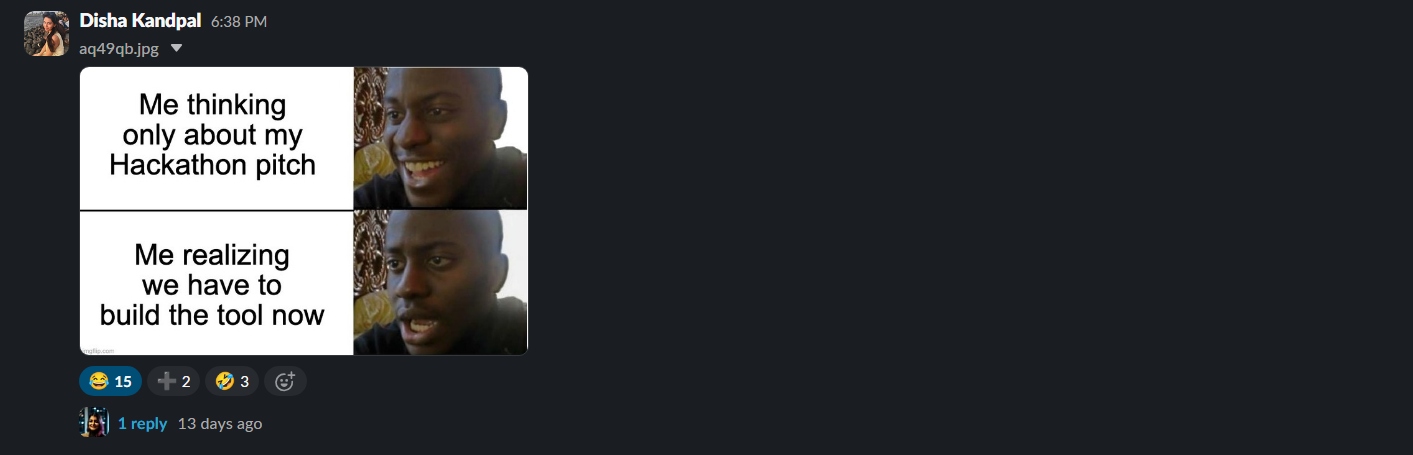
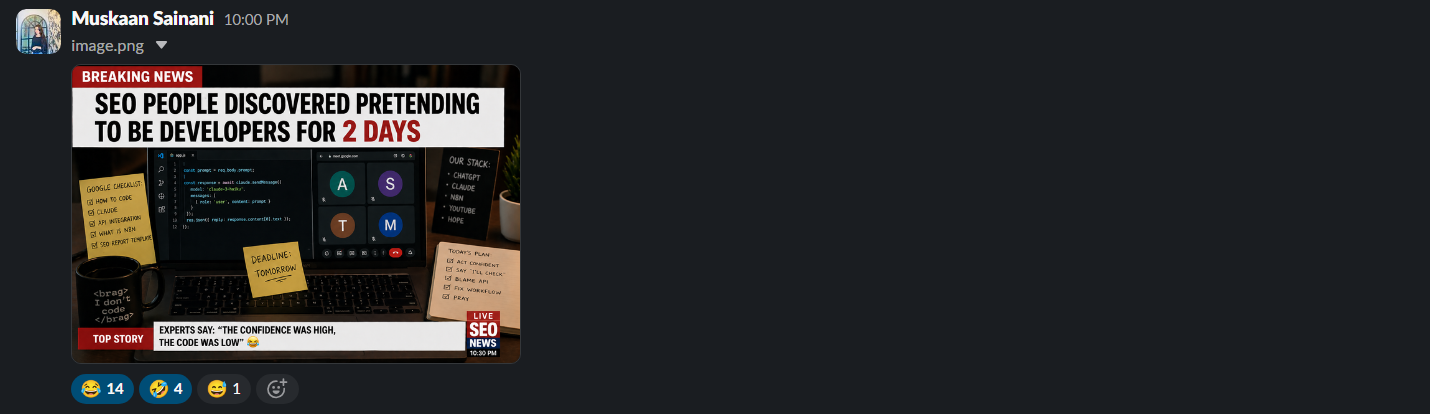
And the best part, we had fun all along – here are some BTS pics for y’all😁
Coming soon
Several of these prototypes are already moving toward production use inside Botpresso. A few might end up as standalone products you’ll see in the wild. We’ll share those stories as they ship.
In the meantime, Season 2 is already on the whiteboard. If you’d like to work alongside SEO pros who get this excited about building their own tools, our doors are open for you.