Why SEO Is Not Enough – A Benchmark Study
A Comparative Analysis of Brand Authority, Citation Depth, and Generative Search Presence
Focus: D2C Beauty & Skincare Niche | Study Date: April 2026 | Brands: Mamaearth · Purplle · Dot & Key · Plum Goodness · Tira Beauty
1. The Argument
There is a widespread assumption in digital marketing that ranking well on Google will get your brand into AI-generated answers. This study, using Semrush data from five competing Indian D2C beauty brands, demonstrates that this assumption may not completely be true and the below data makes it impossible to ignore.
Purplle has 108,700 organic keywords. Mamaearth has 71,200. Purplle has 30,000 indexed pages. Mamaearth has 2,732. Purplle has more backlinks, more content, more organic keywords — and yet its AI visibility score is 52, versus Mamaearth’s 77. Purplle is winning SEO by almost every conventional metric, and losing AI visibility by a wide margin.
Tira Beauty has 15,418 pages. Its AI visibility is 58. Plum Goodness has 986 pages. Its AI visibility is 72. More pages is not a signal AI systems respect. Recommendation trust is.
The core thesis
SEO gets you indexed. Content gets you discovered. Brand + PR + Product gets you recommended. These are three different outcomes, and only one of them determines AI visibility. That is the gap.
2. The Data at a Glance — Mamaearth as the Benchmark
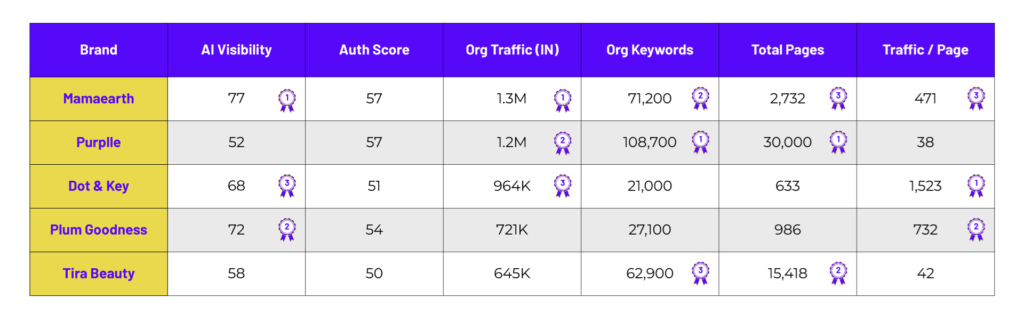
All comparisons in this study use Mamaearth as the benchmark, as it holds the highest AI visibility score (77) among the five brands analysed.
What we observed
Mamaearth is not the biggest in terms of content or keyword footprint:
- #2 in keywords (71K vs Purplle’s 108K)
- #3 in total pages (2.7K vs 30K for Purplle)
Yet it leads in:
- AI Visibility (#1)
- Organic Traffic (#1, but only marginally ahead)
Meanwhile, Purplle dominates in scale (pages + keywords) but has weak AI visibility (52). Tira Beauty on the other hand has massive page volume but very low efficiency + low AI visibility. And Dot & Key wins on traffic per page, but still ranks only #3 in AI visibility.
Our hypothesis:
- AI visibility correlates more with “content quality density” than total content footprint.
- AI visibility is strongly influenced by how clearly a brand is understood as an “entity” rather than just a website.
- AI favors intent consolidation, while SEO historically rewarded intent fragmentation.
What AI systems reward is not how much content exists, but how clearly and reliably that content represents expertise.
3. Branded Traffic as a Signal of Brand Strength
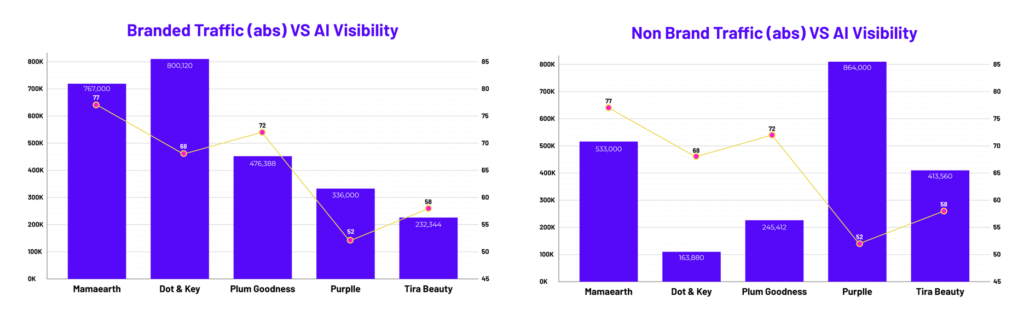
One of the clearest patterns in this dataset is that strong AI visibility tends to correlate with strong branded traffic demand, not just overall organic traffic.
What the graph actually shows
This distinction becomes important when comparing AI visibility outcomes. Brands with stronger branded demand tend to appear more consistently recognised across AI systems because branded searches are often downstream effects of broader brand awareness – including social conversations, creator mentions, reviews, editorial coverage, and repeat consumer engagement. What we observed:
- Branded traffic correlates with AI visibility
Stronger branded demand generally aligns with higher AI visibility. But then there’s an important wrinkle where Dot & Key has the highest branded traffic but does NOT lead AI visibility. Plum has lower branded traffic but higher AI visibility than Dot & Key. Which means Branded demand is necessary, but not sufficient.
- Brand demand creates eligibility, not dominance
Branded traffic is a signal of consumer recall + engagement. However, It doesn’t guarantee how that brand is represented. Branded demand increases the probability of being included in AI outputs, but editorial authority determines ranking within those outputs.
When millions of people search for a brand by name, it signals real-world trust and recall. AI models absorb this indirectly through patterns in mentions, reviews, social discussions, and editorial coverage, reflecting the broader footprint of the brand across the internet.
AI systems like ChatGPT or Claude do not directly use search volume as a ranking factor. Instead, branded demand acts as a proxy for real-world presence and correlates with the kinds of references and authority signals these systems are trained on.
4. More Pages ≠ More AI Authority
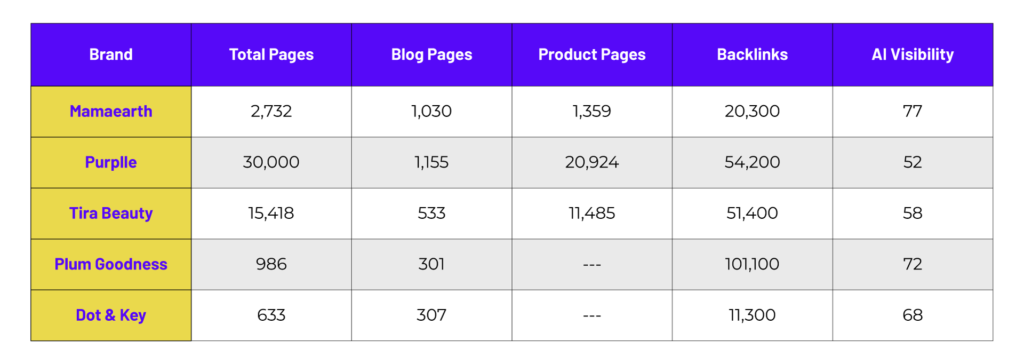
The clearest structural proof of the SEO-vs-AI gap in this dataset is the relationship between page count and AI visibility. If SEO scale drove AI recommendations, Purplle and Tira would be leading. They are not.
What we observed
- Backlinks don’t translate linearly into AI visibility. Link authority alone is not a reliable proxy for AI authority. The likely reasons are, backlinks measure popularity of pages and AI visibility depends on credibility of information sources.
- Editorial depth is the real differentiator. When it comes to blogs, AI visibility is driven by whether your content behaves like a “source” rather than a “supporting page.” This becomes evident when comparing Mamaearth and Purplle. While Mamaearth has 1,030 blog pages and Purplle has 1,155, the higher count does not translate into greater AI visibility.
AI systems prioritise credibility and citation-worthiness over scale. Product-heavy architectures dilute expertise signals, while editorial depth strengthens them. AI authority is not built through volume, but through content that can be trusted, cited, and learned from.
If you have found the case study useful so far, I have created a similar case study on AI visibility for the BFSI industry.
5. What Actually Builds AI Visibility: The Three-Layer Model
The data points to a consistent pattern across all five brands. AI visibility is not determined by any single metric. It is the product of three distinct layers operating in concert, each owned by different teams within the organisation.
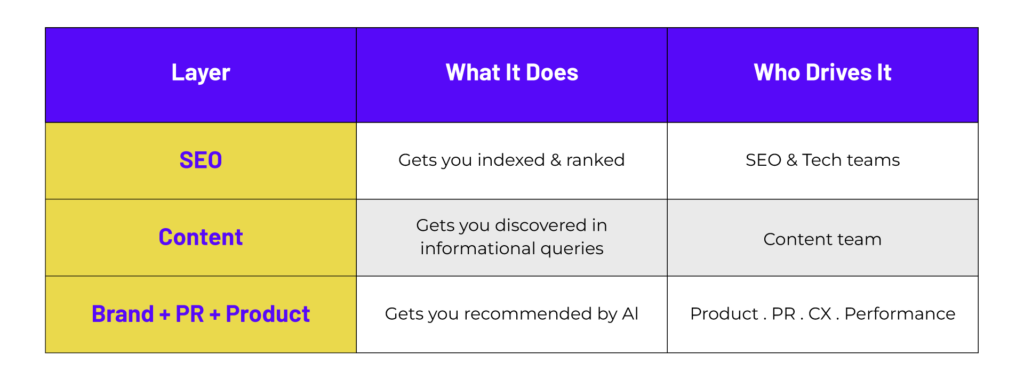
Layer 1: SEO: Gets You Indexed
SEO is the foundation. Without it, no organic discoverability. Mamaearth scores 57 on domain authority, holds 71,200 organic keywords, and has a technically clean site. But Purplle also scores 57 on authority and holds 108,700 keywords. Both have strong SEO foundations, yet one is recommended by AI and the other is not. SEO alone does not predict AI visibility.
Layer 2: Content: Gets You Discovered
Content gets a brand into informational search results. Blog depth matters more than blog volume. Mamaearth’s blog pages average significantly higher traffic per page than Purplle’s, suggesting genuine topical authority rather than keyword stuffing. Plum’s 301 blog pages achieving 12.1% of total traffic is the highest efficiency ratio in the group, a result of focused, expert-led content that earns both links and citations.
Layer 3: Brand + PR + Product: Gets You Recommended
This is the layer SEO cannot buy. It is built by:
- Product teams that create quality products generating authentic reviews on Nykaa, Amazon, and Google
- PR teams that earn high-authority editorial coverage.
- Customer experience teams that drive satisfaction, reducing negative sentiment that AI models are trained to avoid recommending
- Performance marketing teams that build brand awareness at scale, increasing branded search volume and the density of brand mentions across the web
Mamaearth’s 767,000 branded visits, 20,300 backlinks, and 8,500 AI mentions are not the output of a single team. They reflect a coordinated effort across product, content, PR, and marketing that has built strong, consistent brand association. They are the cumulative result of every function in the company doing its job well enough that the internet, collectively, has formed a strong, positive, repeated association with the brand. That is what AI models learn from.
6. Individual Brand Profiles vs. Mamaearth
6.1 Mamaearth — AI Visibility: 77
The benchmark
Mamaearth is the only brand in this set that has all three layers working at scale simultaneously — SEO authority, deep content, and absolute branded demand.
What Mamaearth does that others do not: It distributes traffic across all content types — Homepage (30%), Blog (18%), Category (27%), Product (25%). No single page type dominates. For an AI model, this means Mamaearth appears in a wide variety of query contexts: brand searches, ingredient questions, product category comparisons, and specific product needs.
Its 8,500 AI mentions across ChatGPT (2,400), AI Overviews (1,800), AI Mode (1,200) and Gemini (3,100) confirm consistent cross-platform presence. No competitor has this breadth of AI platform coverage simultaneously.
6.2 Plum Goodness — AI Visibility: 72
The most efficient AI performer in the set. With 3.5x fewer pages than Mamaearth and 44% less organic traffic, Plum achieves 72 AI visibility. The driver is not scale — it is quality signal density. Its 101,100 backlinks, the highest in the set, reflect strong editorial coverage and third-party citations, which align more closely with signals AI systems rely on than generic link volume.
Plum also demonstrates the correct reading of branded traffic. Its 66% branded share looks strong, but the absolute figure of 476,388 branded visits is 290,000 less than Mamaearth. The gap to close is not percentage, but absolute brand demand. If Plum can grow total traffic while maintaining its content quality and backlink velocity, it is structurally positioned to challenge Mamaearth on AI visibility.
6.3 Dot & Key — AI Visibility: 68
The loyalty paradox. Dot & Key has built extraordinary brand loyalty — 800,120 absolute branded visits, the only brand to exceed Mamaearth in this metric. Consumers who know Dot & Key go directly to it. But its 163,880 non-branded visits mean the brand has almost no footprint in discovery contexts. An AI model answering category queries has limited non-branded evidence to surface Dot & Key.
The implication for Dot & Key is strategic: it does not need to fix brand strength, it needs to build category authority. Deeper content around its hero ingredient categories (Vitamin C, SPF, Ceramides, Retinol), through expert guides, dermatologist endorsements, comparison content — would create the non-branded discovery surface that AI systems need to cite the brand in open-ended recommendation queries.
6.4 Tira Beauty — AI Visibility: 58
The retailer ceiling. Tira’s AI visibility challenge is not solvable by more pages or more SEO. It is structural: AI models recommend brands, not platforms. Tira’s path to higher AI visibility runs through editorial authority, including original beauty guides, trend reports, expert advice, and a distinct editorial voice that makes Tira itself the recommendation, not just the destination for brands that are already recommended.
Its 9,100 AI mentions (the highest in this set) but only 58 AI visibility is the most instructive data point. Mentions without authority or context do not translate into recommendations. Tira is mentioned frequently, likely in product listing contexts, but not recommended authoritatively.
6.5 Purplle — AI Visibility: 52 (the instructive failure)
The cautionary case. Purplle is the brand that proves the thesis most forcefully. It has more organic keywords than anyone else (108,700) with a comparable authority score (57) and more backlinks than Mamaearth (54,200 vs 20,300). And yet it scores 52 on AI visibility, 25 points behind behind Mamaearth.
The reason becomes clear in the branded traffic data: Purplle generates only 336,000 absolute branded visits — less than half of Mamaearth’s 767,000. Despite identical organic traffic volumes (~1.2-1.3M), Purplle’s brand has not converted its SEO scale into brand conviction. Consumers find Purplle for product searches but are not choosing it as their go-to brand. AI models mirror this reality: they will surface Purplle pages for specific product queries, but they will recommend Mamaearth when asked who to trust.
7. A Framework for AI Visibility
SEO → gets you indexed | Content → gets you discovered | Brand + PR + Product → gets you recommended
These are not sequential steps. They are parallel investments. Brands that run all three simultaneously, as Mamaearth does, accumulate AI visibility. Brands that over-index on one layer while neglecting the others, like Purplle on SEO or Dot & Key on brand, achieve partial visibility at best.
The practical diagnostic: If your branded absolute traffic is growing year-on-year, if your content is earning third-party citations, and if your product reviews are consistently positive, your AI visibility will follow. If any of these three is absent, no amount of SEO investment will close the gap.
9. Conclusion
AI visibility is a brand outcome, not an SEO outcome.
Purplle proves you can win SEO and still lose AI visibility. With 108,700 organic keywords, 30,000 pages, and domain authority equal to Mamaearth — it scores 25 points lower on AI visibility. The gap is not technical. It is a brand gap: insufficient absolute branded demand, insufficient content depth, and an SEO strategy that has prioritised keyword breadth over recommendation trust.
Mamaearth proves that AI visibility is achieved only when SEO is supported by brand strength, content depth, and trust signals. Its 767,000 absolute branded visits, 471 traffic-per-page ratio, 8,500 AI mentions, and distributed content architecture are not the result of any single team’s work. They are the output of an organisation where product, content, PR, performance marketing, and customer experience all contribute to a brand the internet has learned to trust and recommend.
The question to ask your team
Stop asking ‘how do we rank for more keywords?’ Start asking: ‘are we building enough absolute brand demand? Is our content deep enough to be cited? Is our PR generating enough independent validation? Are our products generating enough positive sentiment?’ The answers to those questions are your AI visibility score.
Data: Semrush | All figures approximate
About the Author
Akarsh Kavuttan is an SEO and AI Search professional from India, currently serving as Director of SEO & GEO at Botpresso, where he leads the SEO and AI search research functions.
Akarsh began his SEO journey in July 2018 at a small agency, working closely with a team of two to three people. Over eight years of industry experience, he has worked across BFSI, education, travel and tourism, SaaS, e-commerce, and enterprise, partnering with brands including Thomas Cook India, ICICI Prudential Life Insurance, Orchids International School, John Jacobs, Cleartrip, and Murf AI.
His work has received recognition at the European Search Awards in May 2025, the Economic Times Brand Equity Awards in November 2023, and the DMA Asia Sparkies in November 2022.
In the evolving field of AEO and GEO, Akarsh focuses on hands-on experimentation, tool development, and practical approaches to improving brand visibility across AI-powered search experiences.
An active contributor to the SEO industry, Akarsh regularly shares insights, experiments, and learnings through LinkedIn posts and blog articles, with a focus on advancing industry knowledge through practical research and continuous learning. He was also featured in India’s Rising Search Stars Behind Digital Brands.