It’s Monday. Organic clicks for a key section of my client’s website have dropped, and the client wants to know why. I open Search Console and confirm the decline. Then comes the hard part: which URLs dropped from the Google index, when, and what changed? A lot of questions, no quick answers.
The team starts digging through, but the answer arrives days later. We were in that position on paper, and chose a different route on an enterprise Magento website migration. Here is what happened when more than 77K URLs were redirected overnight.
During a Magento migration for an enterprise e-commerce client, the client’s dev team bulk-redirected a legacy catalogviewid URL template covering more than 77,000 URLs. We saw the index-status change per URL the same day, with dates attached in our fully automated IndexVigil tool.
Before we launched the tool, we learned about these changes weeks later from a traffic chart, then spent days analysing the root cause. At Botpresso, we understand how crucial it is to monitor and report critical issues on time. We hence developed an SEO sustainability framework package. This framework includes the IndexVigi tool, which supports daily index status tracking, automated email alert systems, and key URL-level details (something that Search Console does not provide), allowing us to report issues on time with zero manual effort.
This post covers the traffic drop incident, what the data looked like, and what it means for monitoring URL indexation on large sites during migrations.
The setup: a legacy URL pattern redirection
The Magento site served a legacy /catalogviewid/ format alongside its search-engine-friendly (SEF) URLs. Those legacy URLs were indexed and earning clicks.
Before any change was made in the pre-migration phase, we loaded the full list of website pages into IndexVigil, our internal index-monitoring tool, for daily index-status tracking as part of the migration monitoring.
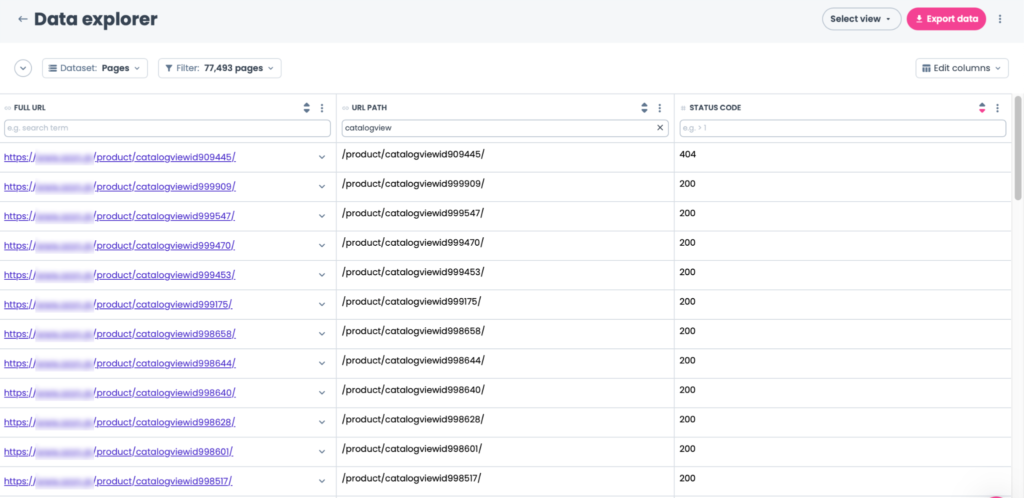
The Magento site served a legacy /catalogviewid/ format alongside its search-engine-friendly (SEF) URLs. Those legacy URLs were indexed and earning clicks.
Before any change was made in the pre-migration phase, we loaded the full list of website pages into IndexVigil, our internal index-monitoring tool, for daily index-status tracking as part of the migration monitoring.
The traffic footprint of the affected pattern:
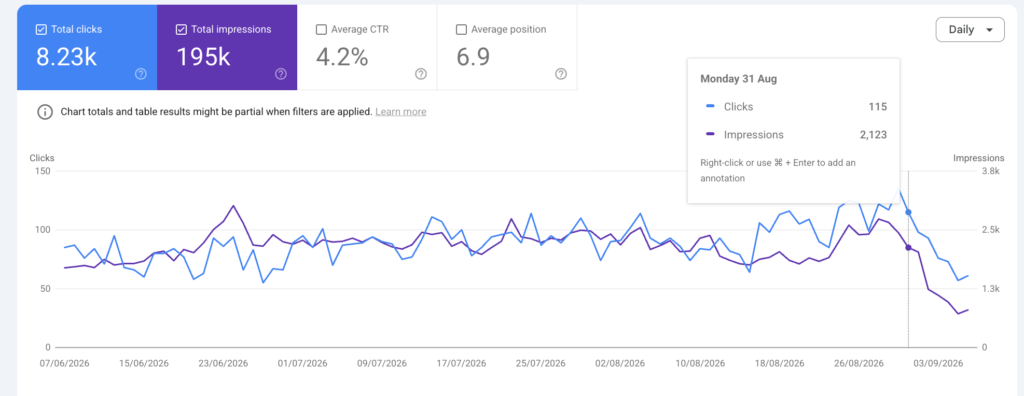
This was not a marginal set of URLs. Search Console, filtered to pages containing catalogviewid, showed this for the last 3 months:
| TOTAL CLICKS 8.23K | IMPRESSIONS 196K | AVERAGE CTR 4.2% | AVG POSITION 6.9 | PAGE QUANTUM 77493 |
What happened, step by step
- Legacy URLs identified. Thousands of /catalogviewid/ were indexed and driving clicks next to the SEF URLs.
- URLs added to monitoring in the pre-launch phase. The full list went into IndexVigil for daily index-status tracking before any change was made.
- Dev team bulk-redirects the template.
- The status change is recorded. Within the daily crawl cycle, tracked URLs are flipped from Indexed to Page with a redirect, per URL, dated, with a last crawl timestamp.
- Cause and effect go to the client. The Search Console decline lined up with the recorded status change on the same URL set. No reconstruction was needed.
What the IndexVigil daily record looked like
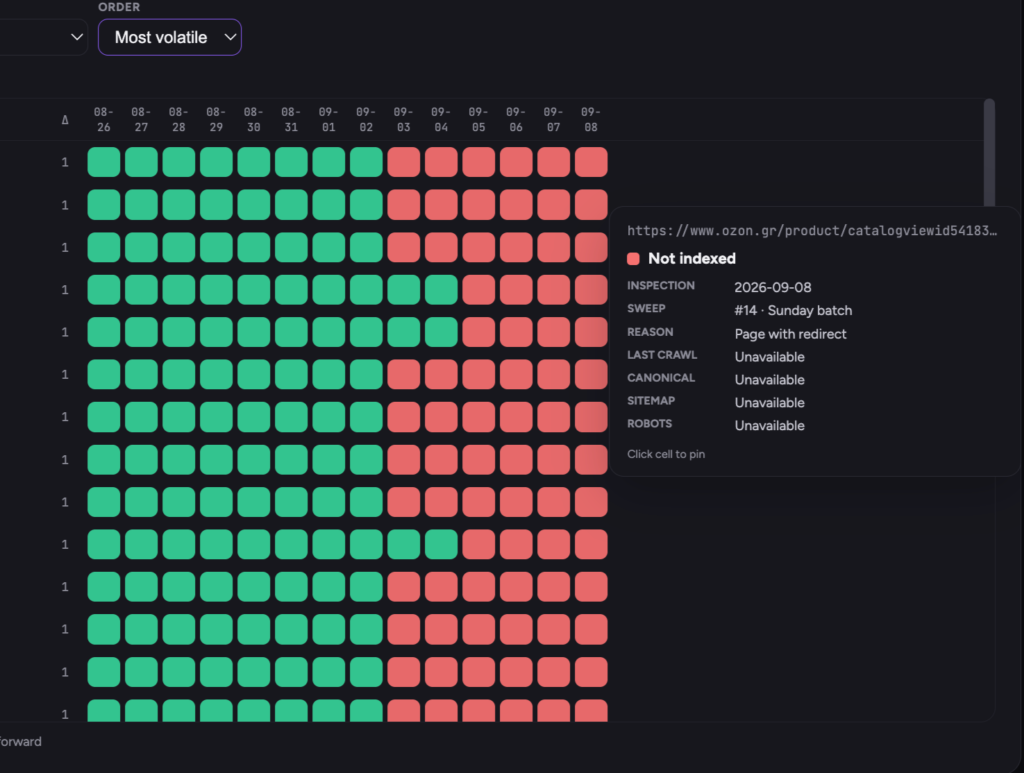
IndexVigil renders one cell per URL per day. These URLs showed a continuous run of green cells, which shows that the page is indexed in Google. From 3rd September, we see a clean break to red, which stands for Not indexed cells, with the reason recorded as Page with redirect. The break is visible at the URL level and the pattern level at the same time.
That combination is what makes the record usable as evidence in a client conversation: the specific URLs, the specific date, and the specific reason, all in one view, rather than inferred backwards from a traffic chart.
Why Search Console alone was not enough
| CAPABILITY | SEARCH CONSOLE | INDEXVIGIL |
|---|---|---|
| Section lost traffic | Yes | Yes |
| Which URLs left the index | No | Yes |
| Exact date per URL | No | Yes |
| Reason per URL | Sampled | Yes |
| Last crawl per URL | One at a time | Yes |
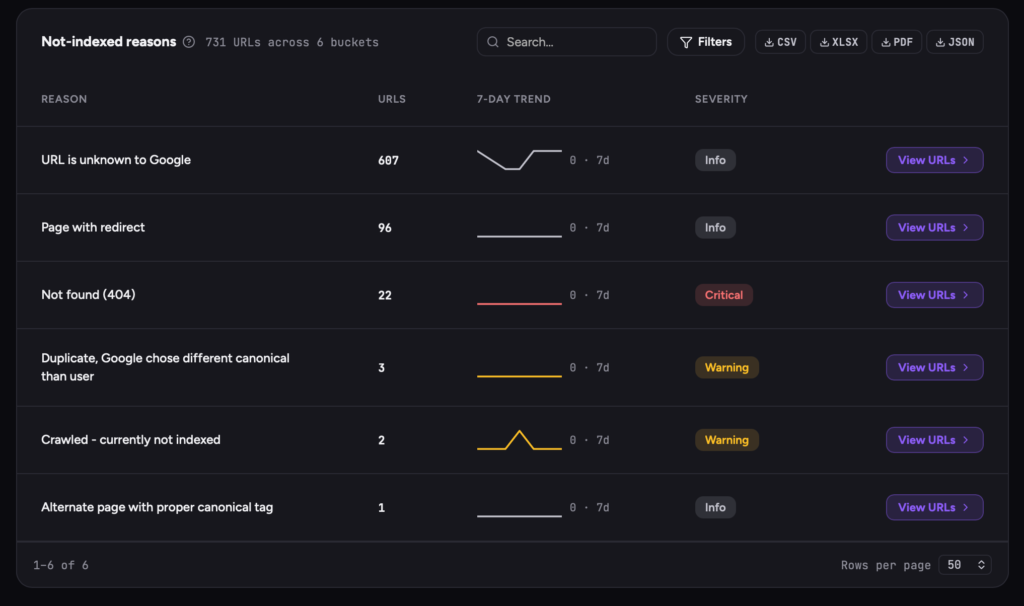
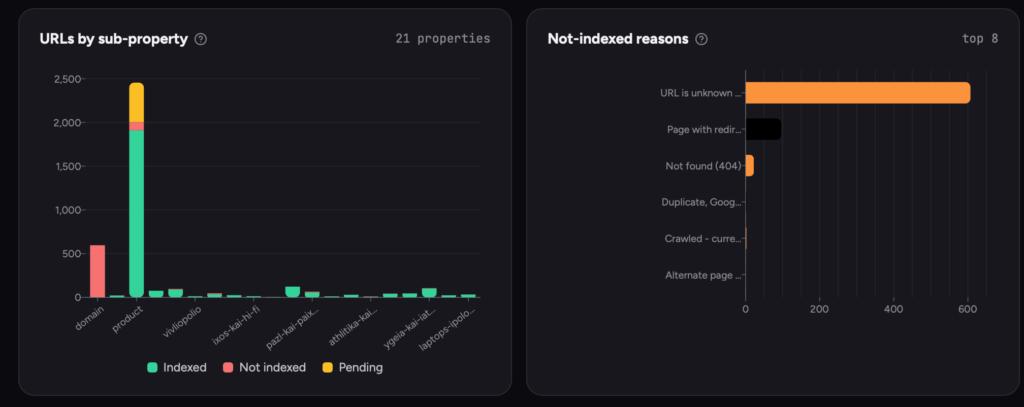
Search Console is a fire report. It tells us the damage after the fact: clicks down, impressions down, a section underperforming. A smoke alarm works differently. It goes off while the problem is still small. In our case, our IndexVigil tool runs as the smoke alarm. The gap is index-level detail at URL scale, and that gap is what our daily tracking layer fills.
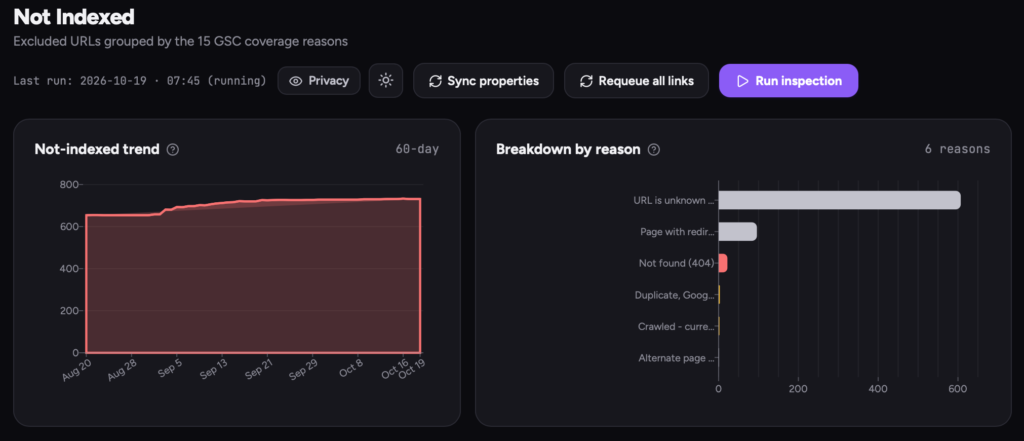
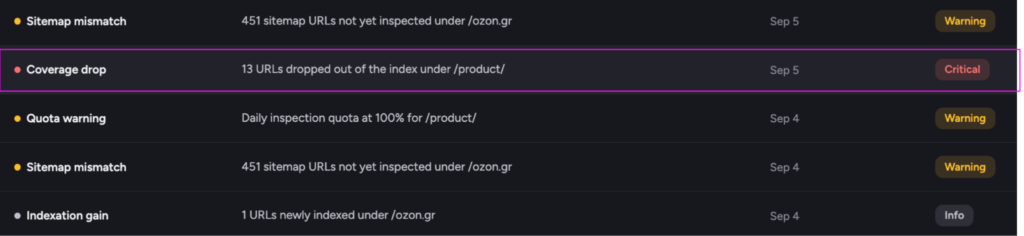
Though the Search Console confirmed that the section lost traffic, it could not tell us which URLs left the index, on which date, or why. For a 77,493-URL pattern, those are the questions the client asks first.
Key takeaways
- Bulk changes ship without notice. Tracking our most important URLs must be in our pre-migration checklist. As enterprise migrations involve bulk deployments, tracing a traffic drop back to its root cause is hard. A defined important URL list under daily tracking can flag any change within one crawl cycle, rather than waiting for Search Console data. Page-level index status monitoring is not optional on large sites. Someone will change something, and we want to know the same day with minimal manual effort. This is where we needed to build a fully automated IndexVigil tool.
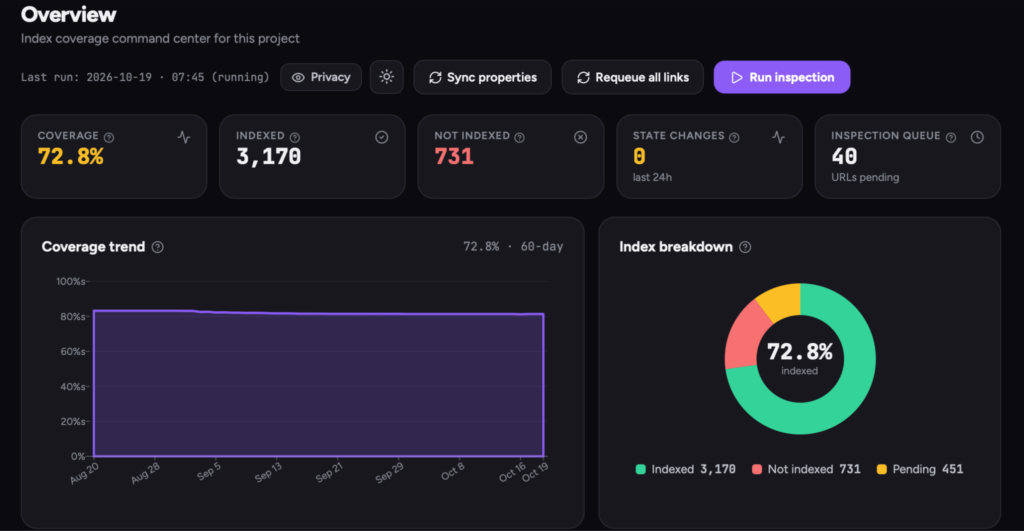
- For our client website, IndexVigil provided us with the URL-level index data, helping us to identify the root cause. Search Console confirmed the decline, but the IndexVigil tool’s daily record showed which URLs moved from Indexed to Page with a redirect, and on which date. That saved hours of manual investigation.