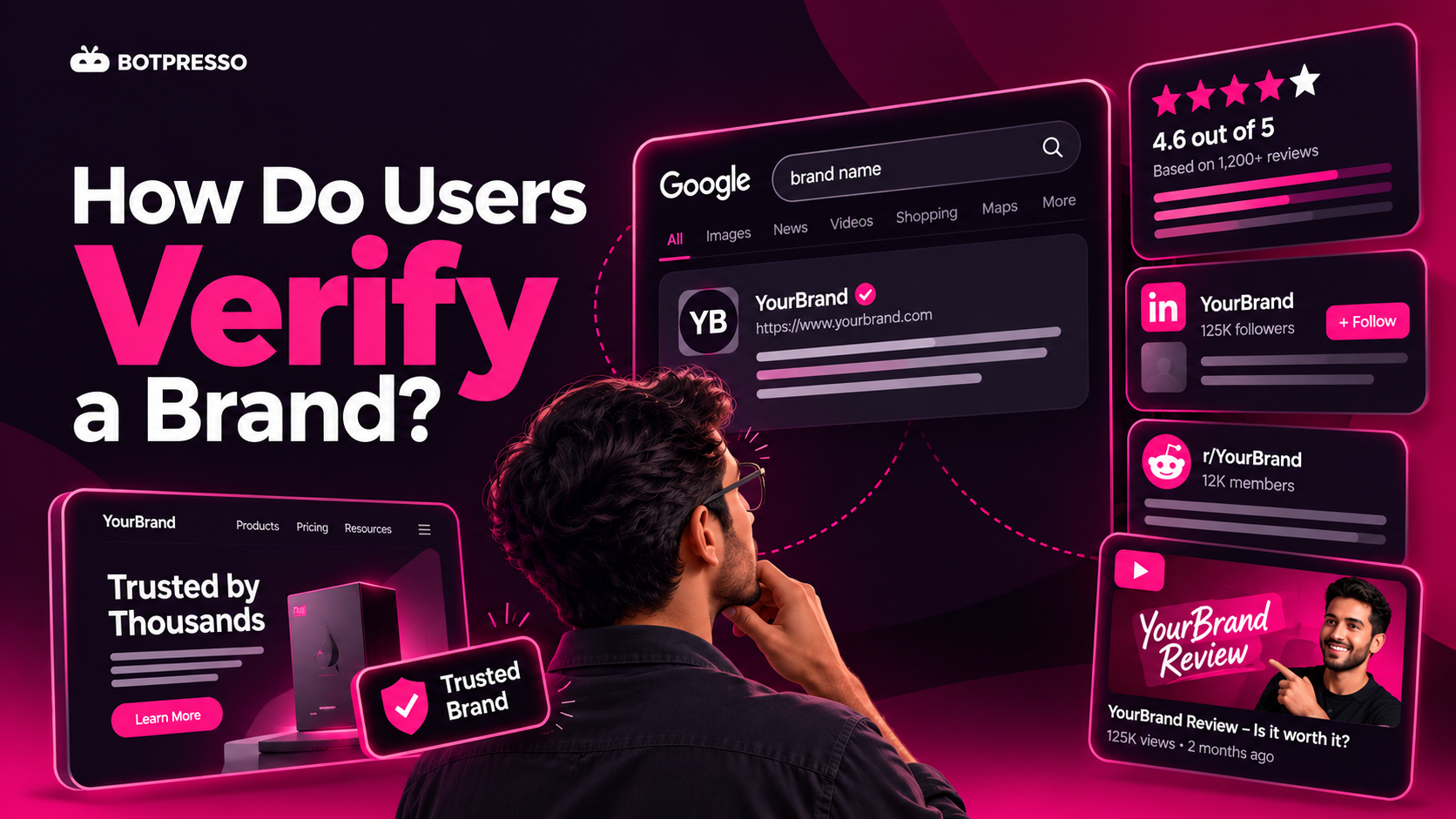
People search for brand trust in different ways. Some check whether an unfamiliar business is legitimate, while others compare verified reviews on third-party platforms. Google Search Console can reveal these patterns across SaaS, travel, and e-commerce.
TL;DR
- Google Search Console (GSC) queries reveal five recurring brand-validation patterns: legitimacy and authenticity checks, third-party reviews, customer complaints, community discussions, and industry-specific product evaluation.
- Users searching for unfamiliar brands may ask whether a business is genuine, safe, or legitimate.
- SaaS users may mention platforms like G2 and Capterra for reviews. Travel and e-commerce users may look for ratings, complaints, and feedback on product quality or purchase experiences.
- Reddit and other forums provide another route to independent feedback.
- Use regex filters in GSC to find these queries and guide your content strategy. The regexes below are starting points, not exhaustive classifiers. Their results should be validated against actual queries and customised for each industry.
Why I Went Down the GSC Rabbit Hole
After watching Malte Landwehr speak about “What Makes ChatGPT Recommend My Brand?” and highlight the importance of having a review page on your own website for AI visibility, I went down the Google Search Console (GSC) rabbit hole. I wanted to understand a simple question: How do people verify a brand before trusting it?
I analysed search queries across SaaS, travel, and e-commerce. I looked for patterns in how users check authenticity, read customer feedback, and verify purchases.
Finding the Query Patterns
I started with seeding a few known keywords into GSC, such as “reviews”, “feedbacks”, and “complaints” to identify searches releated to brand trust and customer experience.
From there, I followed a 2 step process:
Step 1: Identify relevant pages
I reviewd the queries and swicthed o the Pages ab to identify the most relevant URLs appearing r those searches. This helped me find ages already attracting visiblity for review and feedback related queries.
Step 2: Expand the query set
I selected a relevant URL, removed the original query filter, and applied a page-level URLfilter instead. I then analysed all the queries associated with the page to discover additional variations and patterns in how users searches for brand reviews, authenticity, nd customer feedback.
I repeted this process aross websites in travel, SaaS and ecommerce to identofy reurring and industry specific differences.
Five Patterns in Brand Verification Searches
1. Legitimacy and Authenticity
Some brands are small or unfamiliar. Users may want to check that the business is genuine before they engage with it. Searches may include “Is [brand] legit?”, “Is [brand name] a genuine brand?” or “Is [brand name] real or fake?”
These queries state the need for reassurance about the brands legitimacy and trustworthiness.
2. Third-Party Reviews and Ratings
Users often seek external feedback rather than relying only on a brand’s website. For a SaaS platform, examples include “[brand name] reviews on G2” and “What do Capterra reviewers say about [brand name] ?”
The presence of review platforms in these queries suggest that users want external validation and not just brand published testimonials.
3. Customer Complaints and Negative Experiences
Users also investigate potential problems before making a decision. Some users search for “[brand name] complaints” or “[brand name] reviews and complaints”. They want to know about risks, drawbacks, and past customer experiences.
These queries an reveal concerns that a brand’s marketing pages may not address.
4. Community-Led Validation
Users may turn to Reddit, Quora, and other discussion platforms to find independent opinions. Examples include “[brand name] reviews on Reddit” and “Is [brand name] worth buying? Reddit”
All these forum platformsprovide additonal places users can seek opinions beyond offical brand messaging.
5. Industry-Specific Evaluation
The underlying intent may be similar, but the questions vary by industry. SaaS users may search for software review platforms, travel users for booking experiences and traveller feedback, and e-commerce users for product quality, delivery, returns, and purchase confidence.
Regex Filters for GSC
The following regexes can help uncover these patterns. Assuming you guys are familiar with the process, hence skipping the steps.
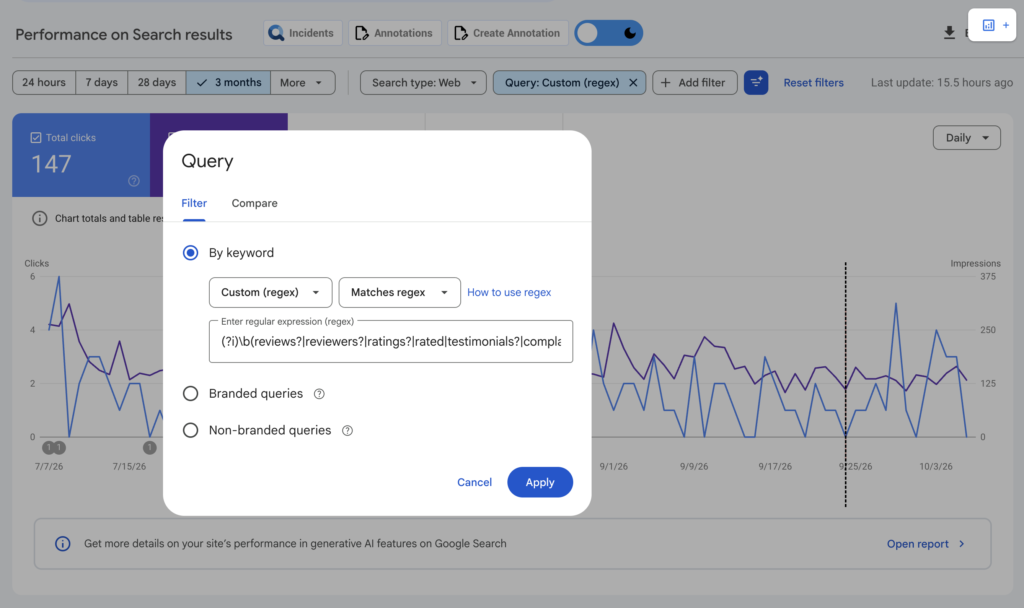
1. Generic Brand Trust and Review Queries
(?i)\b(reviews?|reviewers?|ratings?|rated|testimonials?|complaints?|feedback|pros and cons)\b|\b(legit|legitimate|genuine|fake|scams?|trustworthy|authentic|authenticity|safe|honest|verified|unbiased)\b|\b(g2|capterra|trustpilot|trustradius|gartner|software ?advice|softwarereviews|getapp|peerspot|sourceforge|product ?hunt|alternativeto|clutch|goodfirms|spiceworks|sitejabber|reviews\.io|bbb|better business bureau|yelp|tripadvisor|trip advisor|glassdoor|ambitionbox|mouthshut|justdial|consumer reports|scamadviser|hacker news|stack overflow|reddit|quora)\b|worth (it|buying)|good brand|real or fake|what (do|does) .* say about2. E-commerce
(?i)b(reviews?|ratings?|complaints?|feedback|quality|genuine|legit|fake|scams?|trustworthy|safe|returns?|delivery|refunds?|reddit|amazon|flipkart|walmart|trustpilot|mouthshut|consumer reports)b|worth (it|buying)|good brand|real or fake3. Travel
(?i)b(reviews?|ratings?|complaints?|feedback|traveller reviews|hotel reviews|booking experience|reliable|legit|safe|scams?|reddit|tripadvisor|booking.com|trustpilot)b|worth (it|booking)|real or fake4. SaaS
(?i)b(reviews?|ratings?|complaints?|feedback|testimonials?|pros and cons|verified|unbiased|reliable|reddit|quora|g2|capterra|trustradius|gartner peer insights|software advice|getapp|peerspot|sourceforge|product hunt|alternativeto|spiceworks|softwarereviews)b|worth (it|buying)How to Apply These Insights to Your GSC Data
- Validate the matches: Platfrom names can create alse positives. For example, “clutch” may refer to a vehicle component or a bag rather than the review platform.
- Customise by industry: Include the review platforms and terminology relevant to your business.
- Interpret the data accurately: GSC shows queries that gave your site impressions, but it has reporting limitations. It does not represent every search sers. make.
These filters reveal queries that generated impressions for your website, subject to GSC’s reporting limitations. They do not represent the entire market’s search demand.
About the Author
Akarsh Kavuttan is an SEO and AI Search professional from India, currently serving as Director of SEO & GEO at Botpresso, where he leads the SEO and AI search research functions.
Akarsh began his SEO journey in July 2018 at a small agency, working closely with a team of two to three people. With over eight years of experience, he has worked across BFSI, education, travel, SaaS, e-commerce, and enterprise. His clients include Thomas Cook India, ICICI Prudential Life Insurance, Orchids International School, John Jacobs, Cleartrip, and Murf AI.
His work has received recognition at the European Search Awards in May 2025, the Economic Times Brand Equity Awards in November 2023, and the DMA Asia Sparkies in November 2022.
Akarsh works in Answer Engine Optimisation (AEO) and Generative Engine Optimisation (GEO). He focuses on hands-on experimentation, tool development, and practical ways to improve brand visibility in AI-powered search.
He is an active contributor to the SEO industry. He regularly shares insights, experiments, and learnings through LinkedIn posts and blog articles. He was also featured in India’s Rising Search Stars Behind Digital Brands.