Botpresso is an AI-native SEO and GEO agency founded by Nitin Manchanda, who previously led SEO for trivago and Omio. What sets us apart is less the list of services and more how we run them: we fix what prevents search engines and AI tools from reading your site first, we build systems rather than one-off pages, and we decide what to work on based on its business value.
Every agency says it is data-driven, technical, and focused on results, and plenty of good agencies do some of the things we describe below. So instead of asking you to take our word for it, this page pairs each difference with three things: what we claim, how we do it, and a client result you can check, with its time period and source.
Key takeaways
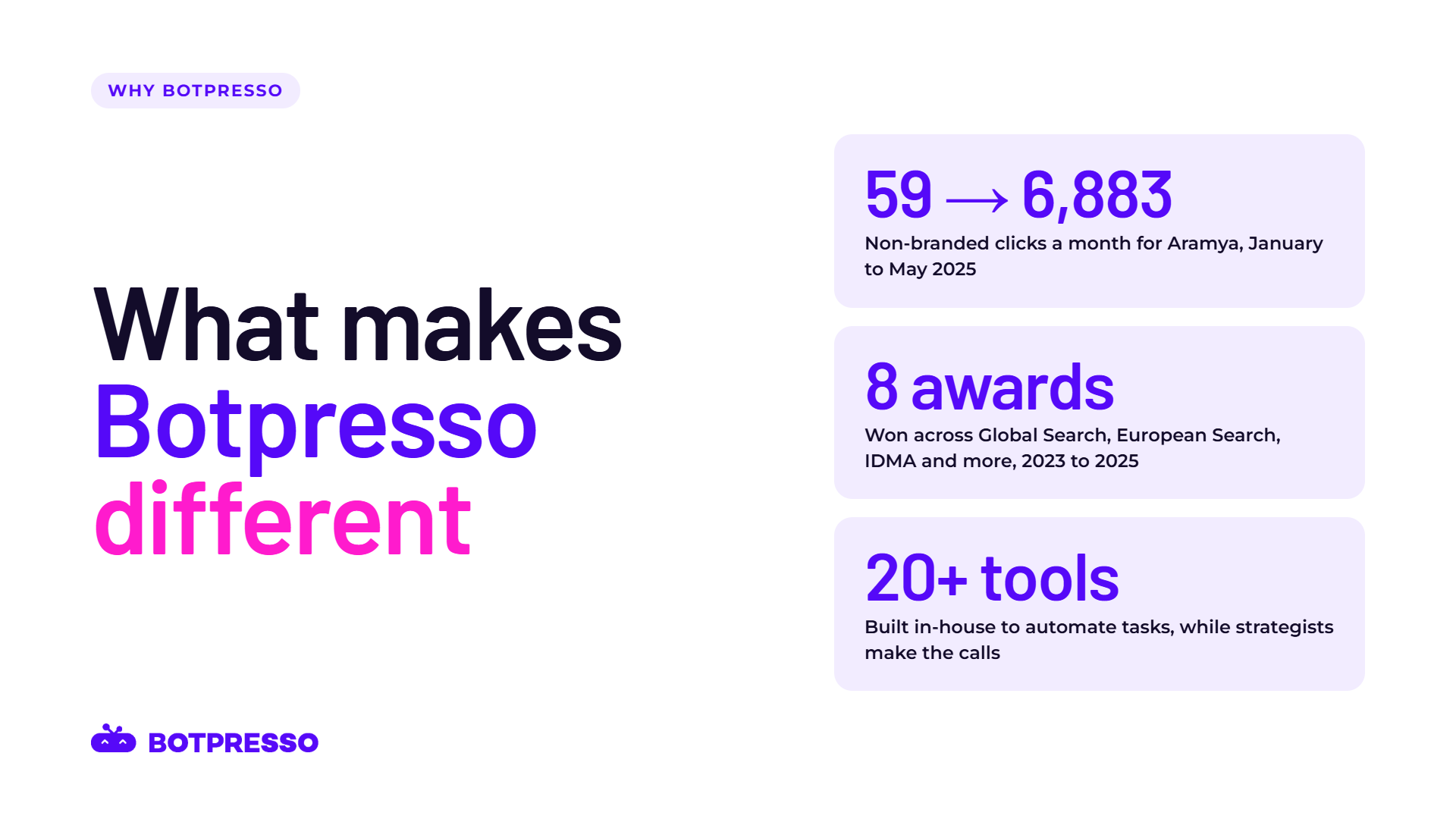
- Foundation first. We fix crawling, indexing and rendering before producing content. Aramya’s store was rendered almost entirely in the browser, so Google could barely read it. Fixing that first took non-branded clicks from 59 to 6,883 a month between January and May 2025, and won a Global Search Award.
- Systems, not single pages. For Headout, we built an internal-linking algorithm that ranks pages by search volume, keyword difficulty, offer count and revenue. The campaign was a Global Search Awards 2023 finalist.
- Business value decides priority. We score work with ICE and RICE frameworks and report on revenue and leads, not just rankings.
- Sometimes less content wins. We cut or consolidate pages when they compete with each other or miss search intent.
- AI-native means automated tasks, not automated judgment. We run an internal workspace of more than 20 tools and publish several of our Python scripts so anyone can check them. Strategists make the decisions.
- SEO and GEO run as one program. Visibility in ChatGPT, Gemini and Google’s AI answers depends on the same foundations plus third-party presence, which we plan together.
- No commitments we can’t keep. Before you sign, we tell you whether you have a growth story or a fixing story, and we won’t promise results to win the deal. Murf AI’s first content experiments with us didn’t work, and the case study says so.
- A team that asks, checks and learns. We ask questions before recommending, base advice on your data, give strategists room to try new ideas without micromanagement, and share what we learn through internal SEO Bytes sessions.
1. We fix what stops search engines and AI from reading your site, before anything else
What we claim: if Google or an AI crawler cannot properly read a page, nothing written on it matters. So every engagement starts with how your site is crawled, rendered and indexed.
How we do it: we check whether important pages are reachable within a few clicks, whether content depends on JavaScript that crawlers struggle with, whether thousands of low-value URLs are crowding out the pages that earn money (index bloat), and whether your server or CDN rules quietly block the crawlers that feed AI tools. We would rather spend the first weeks of a project fixing this than publish content into a site that cannot be read.
The proof:
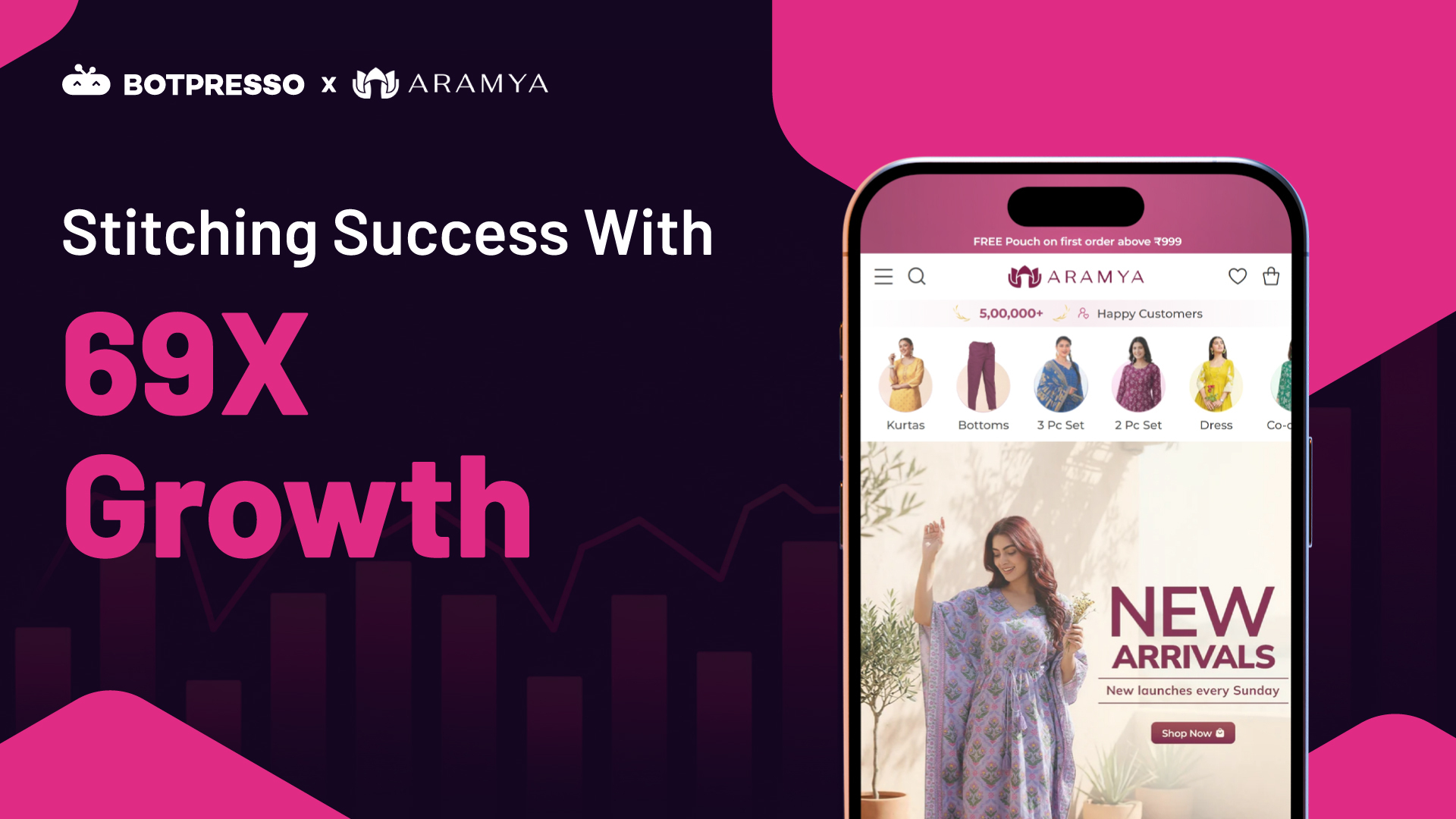
- Aramya, Indian ethnic-wear ecommerce. The store ran a React frontend on a Shopify backend, rendered entirely in the browser. Important SEO elements appeared only after JavaScript ran, so most of the catalogue was invisible to Google. There was no developer capacity for a full migration to server-side rendering, so we worked with the client’s one developer to server-render only the critical SEO elements. URLs crawled rose 3,000%. Between January and May 2025, non-branded organic clicks grew from 59 to 6,883 a month and organic revenue by 58%. The campaign won at the Global Search Awards 🏆.
- The Rug Decor, home decor ecommerce. Thin collection pages were causing index bloat and blocking key product pages from being indexed, and every new collection made it worse. We ran a technical audit, pruned unnecessary pages, fixed broken pages and links, and reworked navigation. Between January and October 2023, SEO-driven revenue grew 2,416%, and organic sessions grew 432%. The campaign won Gold 🥇at the 2023 DMAasia ECHO Awards and Best ROI at the IDMA Awards 2024.
- Headout, travel experiences. The audit found keyword cannibalisation, wasted crawl budget and hreflang errors across regional pages. Fixing these came before any growth work.
What this means for you: expect the first findings to be about your site’s foundations, not new blog posts. If an agency starts with a content calendar before checking indexing, ask why.
💡Learn how to evaluate & choose your next SEO agency?
2. We build systems, not one page at a time
What we claim: on large sites, the gains come from fixing patterns across thousands of pages, not from polishing pages one by one.
How we do it: two examples of what that looks like.
- Internal linking by algorithm: Instead of adding links by hand, we score pages and let the score decide where links go. For Headout, the score combined search volume, keyword difficulty, offer count and revenue, and we studied how search engine bots were crawling the site before changing anything. The result was more internal links pointing at the page cluster that mattered most.
- Programmatic SEO: When a business has many pages of the same type (destinations, product alternatives, locations), we build them from structured data and templates. For Murf AI, we built an “alternatives” section targeting comparison searches such as “ElevenLabs alternative”, and launched more than 15 pages for markets including Russia, Brazil and Turkey.
Programmatic pages only work if each page offers something distinct. A template filled with near-identical text is exactly what Google’s spam policies call scaled content abuse, and we won’t build it.
The proof:
- Headout: Between January 2022 and April 2023, organic revenue grew 1,081.24%, and organic sessions grew 406.2%. The campaign was a finalist in the Travel SEO category at the Global Search Awards 2023.
- Murf AI: We have created data-driven programmatic SEO pages targeting “alternatives” BoFu keywords at scale. This helped the brand generate significant visibility without extensive manual effort.
What this means for you: if your goal is to scale incrementally, ask the agency how they would plan that out and understand whether that aligns with your business goals and Google’s guidelines.
3. We decide what to do next by using the RICE framework
What we claim: an audit with two hundred findings and no order of work does not help a team with limited developer time. We bring the few things that matter this quarter, what each is worth, and who needs to do what.
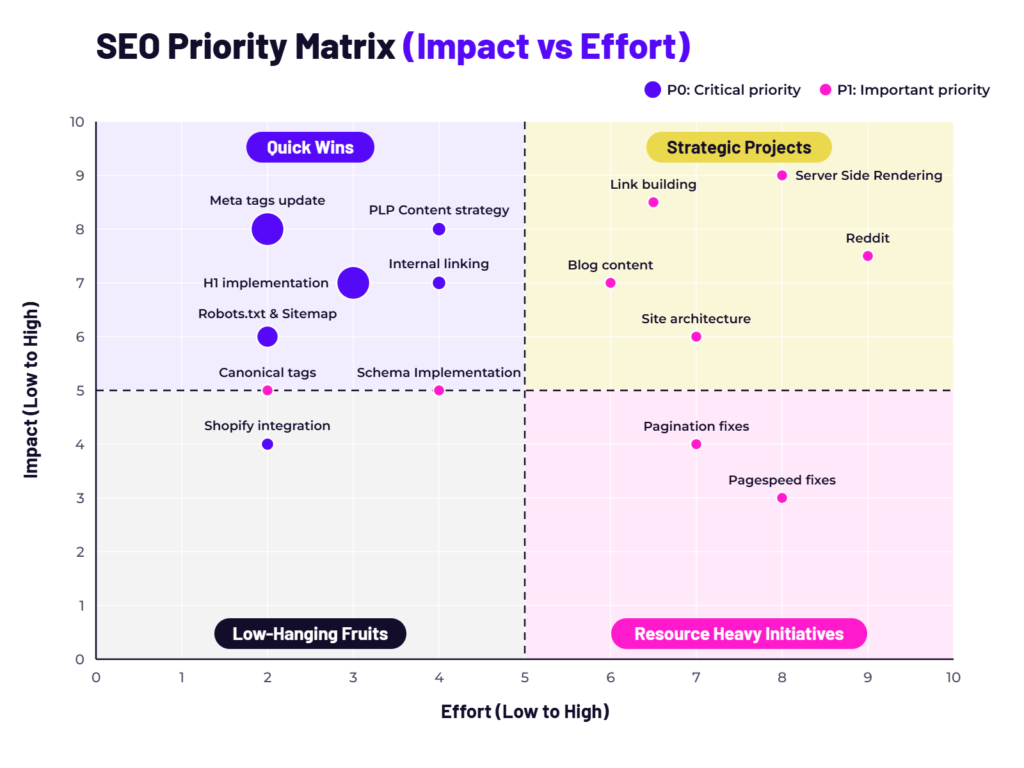
How we do it: every proposed task is scored before it is scheduled, using ICE (impact, confidence, ease) or RICE (reach, impact, confidence, effort). The scores are shared with you, so you can see why one fix comes before another and push back if your priorities differ. We report on the numbers your leadership asks about: revenue, leads, sign-ups and non-branded traffic, with rankings as a supporting signal.
The proof:
- The Rug Decor had a small team and a tight budget. We used the ICE method to decide what to do first and made growth in new users the main target. Alongside the SEO work, conversion changes lifted purchase-stage conversion by 7%. The campaign won Best ROI at the 🏆 IDMA Awards 2024.
- Aramya had one developer for SEO and a limited budget, so every task went through a RICE matrix: if it didn’t move the goal per rupee spent, it didn’t ship. That is why the first fix was a partial server-side rendering workaround rather than a full rebuild. The campaign returned 1,108% on investment over five months. (See the image above)
Client testimonial: “We especially appreciate their data-driven approach: diving deep into the ‘why’ before implementing the ‘how.'” Megha Kumari, Growth Marketing, Cult.fit.
What this means for you: ask any agency to show how it ranked its last client’s backlog, and which metric it reported to that client’s leadership.
4. Sometimes the answer is less content, not more
What we claim: many agencies are paid by output, so the default recommendation is more articles. Often the faster win is removing, merging or trimming pages that compete with each other or don’t match what searchers want.
How we do it: we look for pages targeting the same search (cannibalisation), pages with thin or outdated content, and category pages carrying text that pushes products below the fold. Then we decide case by case to merge, redirect, trim, rewrite or remove from Google’s index.
💡Related Read: Botpresso Website Content Audit Guide
The proof:
- We’ve cut down category page content by ~50%, on purpose for one of our ecommerce clients and saw 72.48% uplift in organic clicks.
- The Rug Decor. Page pruning reduced index bloat so new collection pages could get indexed.
What this means for you: an agency focusing solely on measuring output by volume of content or other deliverable without any actual business impact is a red flag.
5. “AI-native” means we automate tasks, not judgment
What we claim: every agency now has access to the same AI models. The difference is what you feed them and who checks the output. We automate repetitive analysis and keep decisions with experienced strategists.
How we do it:
- What machines do: crawling and log analysis, keyword clustering, monitoring for ranking and technical changes, first-pass content and competitor analysis, all using Python scripts and AI workflows.
- What people do: strategising, prioritising, reviews before going live, making informed decisions based on the data, and talking to your team.
We build and share that knowledge
Most agencies describe their automation. We publish ours. These are free scripts our team wrote and uses on client work, each with a walkthrough you can run yourself:
- Find internal links missing from rendered HTML. Compares the links in a page’s raw HTML with the links that appear after JavaScript runs. This is the same class of problem we fixed for Aramya, where internal links only existed after rendering.
- Content similarity check with cosine similarity. Scores how alike two pages are, to find near-duplicates and cannibalization before deciding what to merge or trim.
- GSC API winners and losers. Pulls Google Search Console data through the API to show which pages and queries gained or lost clicks between two periods.
- Detect a website’s publishing velocity. Estimates how often a site publishes new content, useful for benchmarking competitors.
- Hreflang XML sitemap generator. Builds hreflang sitemaps for sites with multiple language or regional versions, the kind of fix we made for Headout’s regional pages.
- Automate Shopify blog publishing. Publishes approved blog content to Shopify in bulk, so a reviewed batch of articles goes live without manual copy-pasting.
Our internal SEO toolkit
Behind client work sits an internal workspace of more than 20 tools and a shared script library that every team member can contribute to. A few examples by job:
| Job | Tools we built |
|---|---|
| Keyword research | Keyword clustering, keyword intelligence, keyword translation across languages. |
| Rankings and forecasting | Rank tracker, SERP checks by exact location and device, traffic forecasting. |
| Content | Content brief agent, meta title and description generator for bulk files. |
| Crawling and indexing | Server log analyser, index monitoring for pages dropping out of Google, a robots.txt conflict checker. |
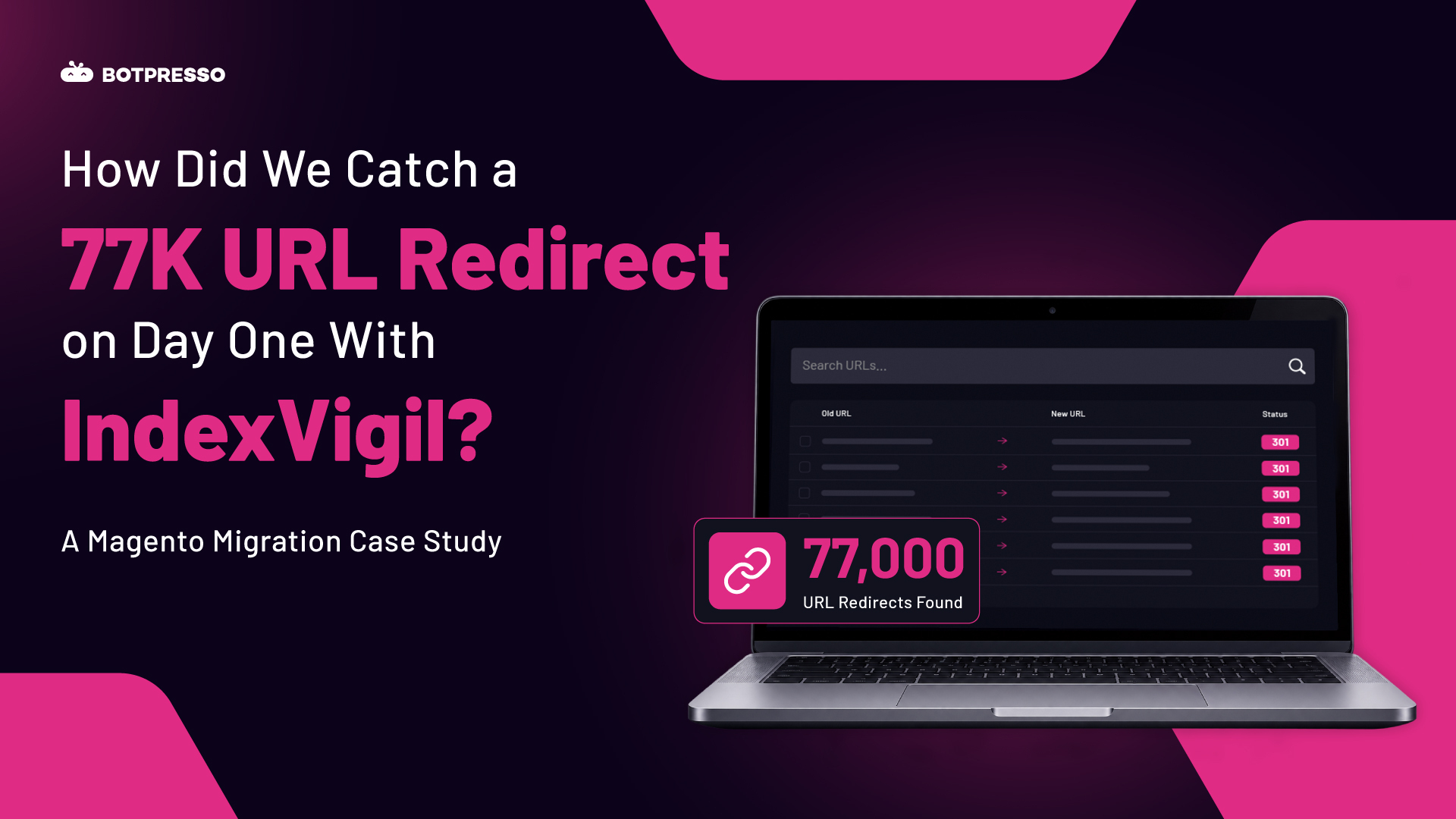
| Migrations | Redirect mapper that matches old and new URLs by title similarity. |
| Reporting | SearchBrew, a Google Sheets add-on that pulls Search Console and GA4 data, including query-to-revenue views. |
| GEO and reputation | RedditVigil for brand mentions and sentiment on Reddit. |
The tools save hours on each task, but they don’t make decisions. A strategist still reads the output, checks it against the business goal, and decides what ships.
The proof:
- Aramya. To map collection pages to real search demand on a limited budget, we built an AI-assisted content pipeline with a human validator at the end to check quality before anything was published. Unique search queries the site appeared for rose 120% between January and May 2025.
- Our founder has written and spoken about automation in SEO for years: a talk at BrightonSEO on using data to scale SEO (Swydo write-up), an interview on what works in SEO automation, and a contribution to Majestic’s SEO in 2024 on using AI.
- Before Botpresso, he built an SEO regression suite that compared SEO properties after every code deployment to catch problems before they reached search engines.
- Here’s one more piece of proof where our engineers discuss how they built an AI agent for GSC analysis.
What this means for you: when an agency says it is AI-powered, ask which tasks are automated, which are not, and who reviews the output.
6. SEO and GEO run as one program
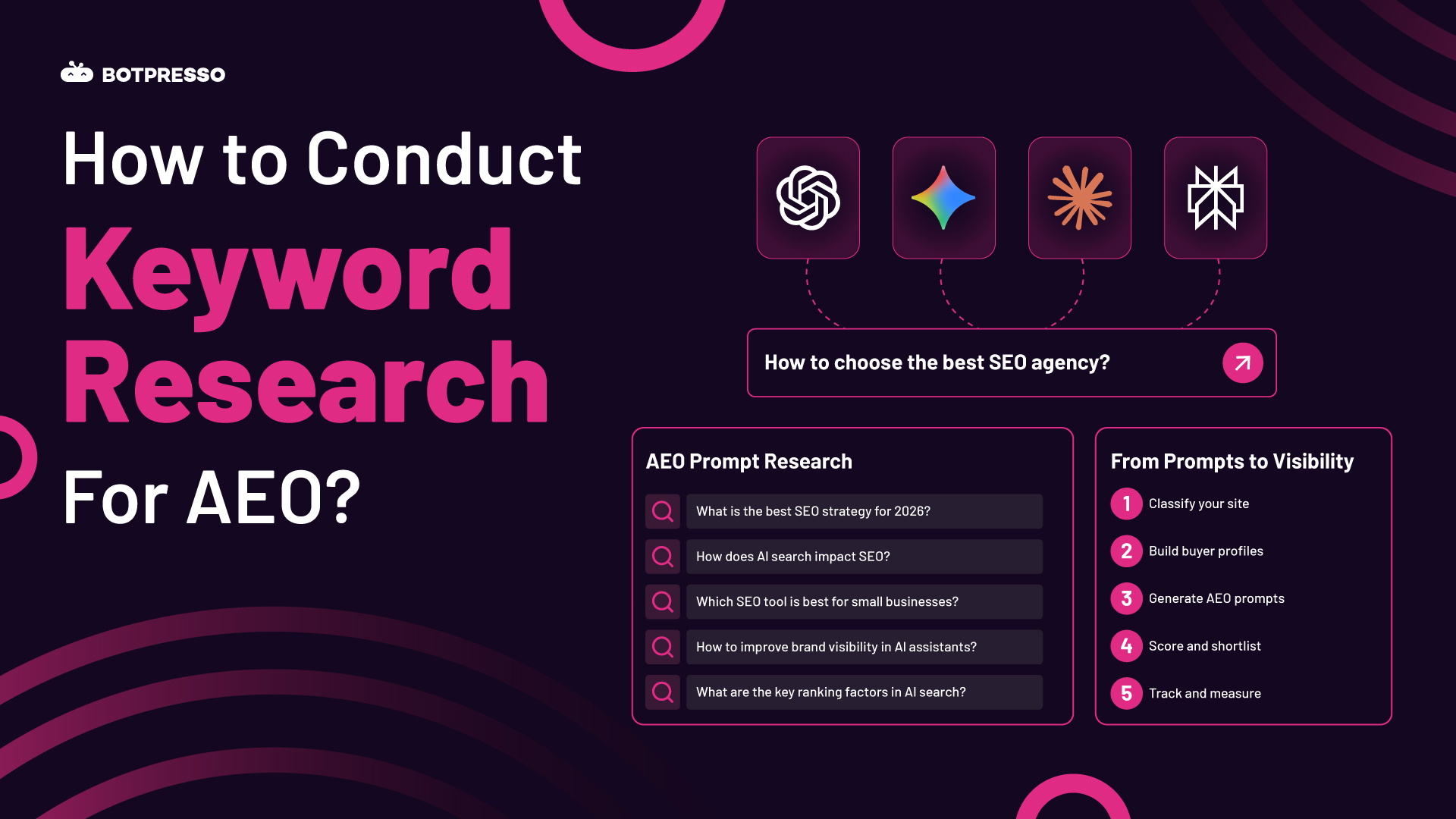
What we claim: your buyers now research on ChatGPT, Gemini, Google’s AI answers, Reddit, and YouTube as well as in Google search. Ranking well on Google does not guarantee you’ll be mentioned in AI answers, so we plan both together rather than selling GEO (Generative Engine Optimisation) as a separate add-on.
How we do it: our GEO work has four parts.
- Accessibility: making sure AI crawlers can reach and read your site, including crawler rules, server-side rendering, structured data and clean HTML.
- Discovery: finding the third-party pages AI tools cite for your category (reviews, comparisons, roundups) where competitors appear and you don’t, and getting you onto them.
- Content engineering: structuring pages so each section answers one question on its own, and covering the follow-up questions AI tools search for behind each main query.
- Sentiment: tracking what Reddit, review sites and YouTube say about you, because AI tools weigh what others say about a brand more than what it says about itself.
The proof (We test what works and what’s not):
- Why winning SEO doesn’t guarantee AI visibility
- Our study on ChatGPT referral traffic
- Does /llms.txt actually work?
- And we preach what we do as well.
What this means for you: ask any agency offering GEO how they test, measure, and optimise your website. Since GEO is a new avenue, testing before claiming something works is very crucial.
7. We tell you whether you have a growth story or a fixing story, before you sign
What we claim: organic growth compounds, which also means it takes longer than most quarterly reviews would like. We’d rather lose a deal than promise a timeline your team then has to defend at month four.
How we do it: before a contract, we tell you which situation you’re in. A growth story means the foundations are sound and the job is to expand reach. A fixing story means something is broken (indexing, a migration, a traffic drop) and the first months go into repair. Each has a different timeline, and we state ours in writing.
“We are also open about what doesn’t work for your business.”
The proof: Murf AI, an AI voice platform, was a fixing story. From June 2024, its rankings swung sharply on competitive text-to-speech searches, and by September 2024, non-branded clicks and new users had hit a low. The site was already technically healthy, so there was nothing obvious to fix.
- What didn’t work: our first changes to the Home and Text to Speech pages, including keyword changes, new content and a full restructure, did not move results.
- What did: a content-decay analysis and blog refresh, improvements to on-page widgets after competitor analysis, programmatic alternatives pages, and more than 15 international pages.
- Results: 101 more high-intent keywords in Google’s top 3 compared with August 2024, and 136 more compared with September 2024. The campaign won Most Innovative Campaign (SEO) at the 🏆 European Search Awards 2025.
“Their proactive team constantly brings fresh ideas and feels like an extension of our in-house team.” Soumyadip Banerjee, Lead, SEO and CRO, Murf AI.
What this means for you: ask any agency for a campaign where its first idea failed, and what it did next. This will help you understand the transparency and the critical-thinking mentality.
The proof, in one place
Everything on this page can be checked against a third party: the awards bodies that judged our entries, the events where we spoke, and the clients who agreed to be named.
Awards won
| Year | Award | Category | Client and case study |
|---|---|---|---|
| 2025 | Global Search Awards | Best Use of Search, Retail/Ecommerce: Small | Aramya |
| 2025 | European Search Awards | Most Innovative Campaign (SEO) | Murf AI |
| 2025 | IDMA Awards | Best SEO Campaign (Gold) | Zwende |
| 2025 | BW Marketing Merit Awards | Best SEO Campaign | Zwende |
| 2024 | IDMA Awards | Best ROI | The Rug Decor |
| 2023 | DMAasia ECHO Awards | Retail and E-tail (Gold) | The Rug Decor |
| 2023 | Brand Equity Awards | Search Marketing / Paid Search | EduBridge |
| 2023 | Sparkies Awards | Best AI-Enhanced Customer Experience | Flaberry |
Shortlisted
- Global Search Awards: Headout, Travel (2023); Botpresso, Best Global Small SEO Agency (2024); The Rug Decor, Zwende and Quizizz (2024).
- European Search Awards: Zwende, Airbyte and The Rug Decor, plus a second Murf AI entry (2025); The Rug Decor, Zwende, EduBridge and Quizizz (2024).
- US Search Awards 2025: Airbyte (Best Use of Search, B2B SEO) and Murf AI (Most Innovative Campaign).
Talks, interviews and expert contributions
- Data-Driven Approach to Scale SEO at BrightonSEO
- International Search Summit
- Majestic, SEO in 2024: embracing AI in SEO
- SEO is AEO podcast with Jason Barnard: enterprise SEO
- SEO by Marta: what works in SEO automation
- Columnist profile on YourStory; author on Semrush’s blog
What clients say
“If there’s one SEO agency to trust, it’s Botpresso. I was skeptical about SEO agencies, but they completely changed my perception.” Innu Nevatia, Co-founder, Zwende
“The Botpresso team’s years of SEO experience in successfully handling e.com brands have been critical in helping us break through the ceiling.” Parag Jain, Co-founder and Chief Growth Officer, Headout
“Their technical expertise, content optimisation, and data-driven insights boosted our organic traffic.” Tanmay Sarkar, Digital Marketing Manager, Airbyte
Independent reviews are on our Clutch profile.
The team behind the work
The seven differences above come from how our team is run. If you’re hiring an agency, the culture inside it decides how your account is handled on an ordinary Tuesday, not just in the pitch.
We ask questions before we answer. The first couple of weeks with a client are mostly questions: about buyers, margins, release process, what your leadership is measured on. A recommendation built on a wrong assumption costs you a quarter.
We look at the data before forming an opinion. Every recommendation starts with evidence from your Search Console, analytics, server logs or crawl data, and we show you that evidence alongside the advice. If the data doesn’t support an idea, we drop it, including our own.
We don’t overpromise to close a deal. If we can’t commit to a result or a timeline, we say so before you sign, even when it costs us the deal. You won’t hear a guarantee from us that we can’t back.
We treat mistakes as something to learn from, openly. Not every idea works. Our first changes for Murf AI didn’t. What matters is spotting it quickly, saying so, and changing course. Our case studies include what failed, not just what worked.
Our people have room to be creative, without micromanagement. Strategists own their accounts and are trusted to try new approaches. That freedom is where tools like our internal-linking algorithm and the scripts came from. Team members built them while solving client problems, and they’re now shared across the team.
Learning/unlearning is part of the job. We run regular internal knowledge-sharing sessions called SEO Bytes, where team members teach each other what they’ve learned from recent client work and tests. We conduct independent experiments to validate what actually works in SEO & GEO, rather than blindly accepting industry assumptions.
Questions to ask any SEO agency, and our answers
These are the questions we would ask if we were hiring an agency. Use them with anyone on your shortlist, including us.
- Can you show a case study in my industry, with traffic and revenue or lead results?
- What would you do that another competent agency wouldn’t?
- How do you measure impact, and what will I have after 90 days?
- Can I see a sample audit and speak to a client?
- Do you guarantee results?
When Botpresso isn’t the right fit
We’d rather say this now than three months into a contract. We are probably not the right agency if:
- You need results within a single quarter. Organic growth compounds over months and years. If the budget depends on a short-term traffic spike, paid search is a better fit.
- You’re comparing agencies on price per article or per link. We price on the outcome and the team it takes, not on unit output.
- Nobody on your side can ship changes. Most of our early impact needs developer or CMS time. Without it, recommendations stay on paper.
- You want a long list of findings rather than a short list of priorities that would drive results.
- You’re looking for link schemes or mass-produced AI content. We don’t do either.
FAQs
Who founded Botpresso?
Nitin Manchanda, a software engineer turned SEO. He previously led SEO at trivago and Omio and has worked with Flipkart. He speaks regularly at industry events, including BrightonSEO and the International Search Summit.
Which industries does Botpresso work in?
Mainly travel, ecommerce and marketplaces, SaaS, edtech, health and wellness, and financial services. Clients include Headout, Murf AI, Airbyte, Zwende, Cult.fit, Cleartrip and Foodpanda.
What is the difference between SEO and GEO?
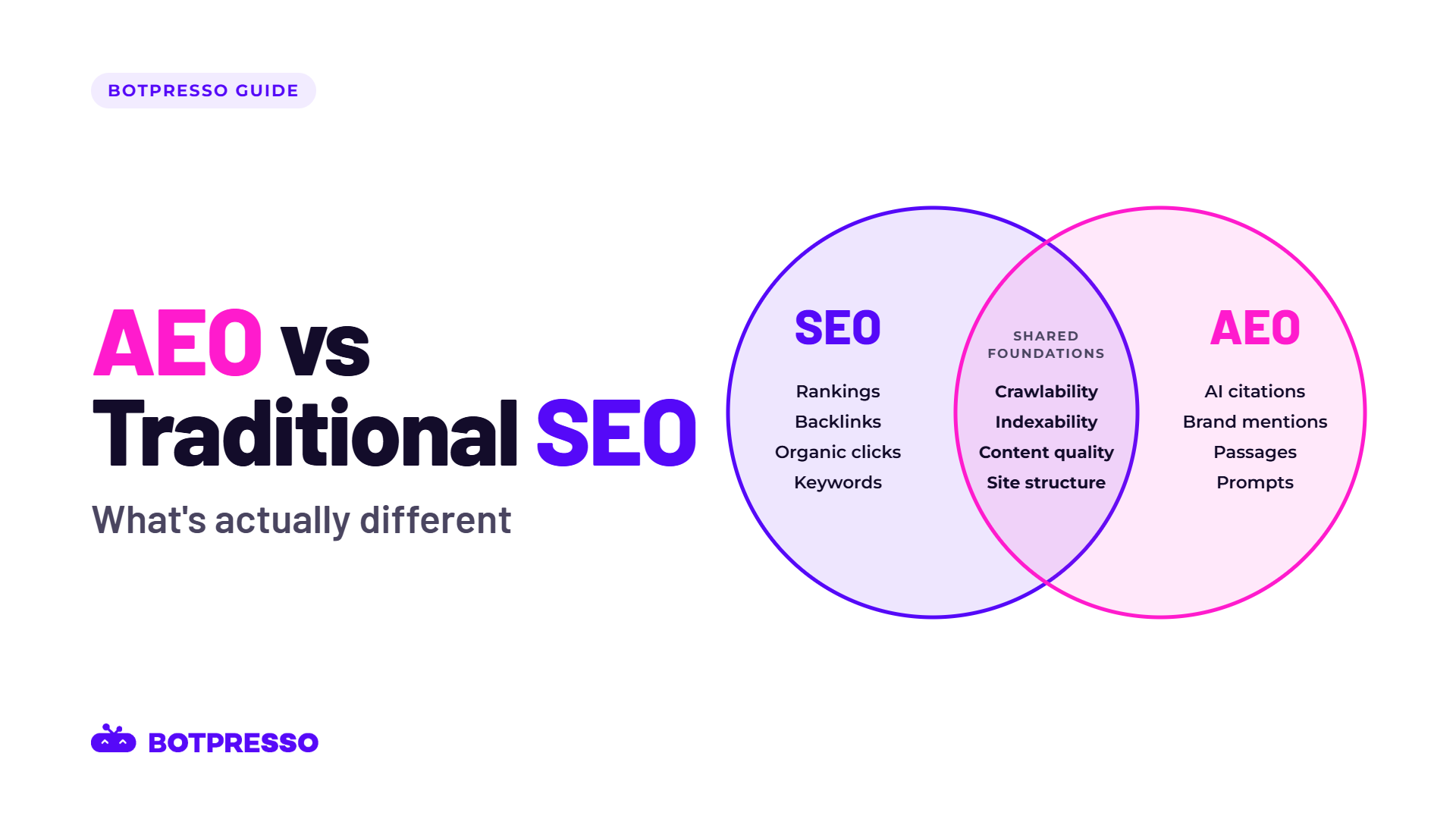
SEO aims to make your pages rank in search results. GEO aims to get your brand mentioned and cited in AI answers from tools like ChatGPT, Gemini and Google’s AI Overviews. GEO depends on the same foundations as SEO, plus your presence on third-party sites, reviews and communities that AI tools rely on.
Does Botpresso guarantee results?
No. We don’t guarantee rankings or AI mentions, because no agency controls them. We commit to a written plan, agreed business metrics, transparent reporting and honest timelines.
How much does working with Botpresso cost?
It depends on the scope of the project, complexity, and the team required.
How do I start with Botpresso?
Book a strategy call. We’ll ask about your goals and current situation and tell you honestly whether we think we can help.