AEO keywords are not keywords in the SEO sense. They are prompts, full questions and requests that people type into ChatGPT, Gemini, Perplexity, Claude and Google AI Mode. No AI platform publishes how often a prompt is asked, so there is no search volume to sort by. Keyword research for AEO therefore means generating a set of prompts, tracking them on a fixed schedule, and recording whether your brand is mentioned or cited in the answers.
In this guide, I keep the term “AEO keywords” because that is how most teams search for the topic. Each time it appears below, read it as “prompts”. The same applies to informational and AEO keywords: an informational AEO keyword is an informational prompt such as “how does X work”, and it is tracked in the same set as commercial prompts such as “best X for Y”.
The sections below cover what AEO keyword research is, how it differs from SEO, a framework for building and tracking a prompt set, and what the keyword research tools for AEO in LLMs can and cannot give you.
Key takeaways
- AEO keywords are prompts, not keywords. No AI platform publishes prompt volume, so you generate a prompt set and track it.
- We follow a five step framework where we classify the site, build the buyer profile, generate prompts across six intent buckets, score and shortlist the ones we feel meets the requirements, then track in Peec AI.
- No keyword research tool exists for AEO in LLMs. Bing’s grounding queries and lead-reported prompts are the closest real data.
- Build the prompt set from the buyer, product and market, and read results as a trend.
What is keyword research in AEO?
Keyword research in AEO is the process of building a fixed set of prompts and tracking them, to find where AI systems look for authoritative sources to cite and where your organization can provide the definitive answer. It is prompt generation plus prompt tracking. It is not keyword discovery.
Traditional keyword research focuses on search volume and ranking difficulty. A tool shows how often a phrase is searched each month and how hard it is to rank for. Neither number exists in AI search. No AI platform shares how often a prompt is asked, and there is no stable first place in an AI answer, so a prompt set measures coverage and says nothing about demand. If tools do share, it’s worth asking them
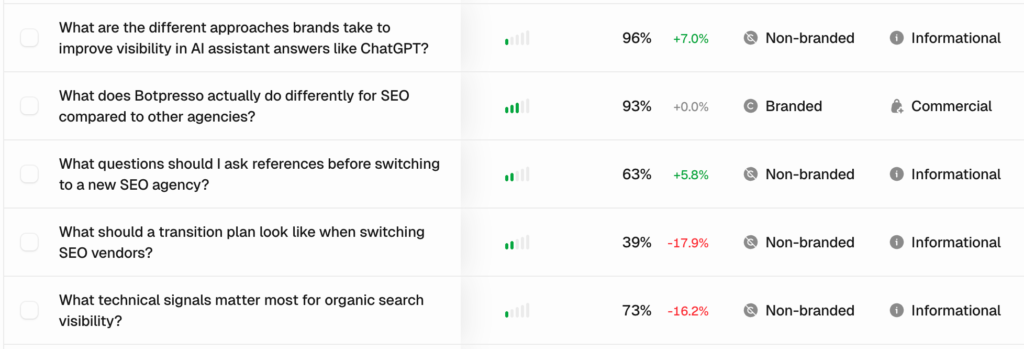
The above is an example from one of the tools, here it indicates the kwywrod “What does Botpresso actually do differently for SEO compared to other agencies?” has higher search trends as compared to “What technical signals matter most for organic search visibility?”, I doubt that.
For that reason, AEO has no keyword research in the SEO sense. It does not even have prompt research, where you hunt for the prompts with the largest volume. The work has two parts:
- Generate prompts. Write the questions your buyers ask AI assistants, mapped to your products, buyer personas and stage of the buying journey.
- Track them. Run the same prompts on a schedule across AI platforms and record whether your brand is mentioned, whether your pages are cited, how the AI describes you and which competitors it names instead.
This changes the goal the team works toward. In SEO, the goal is to rank, so the team asks “what keywords should we rank for?” In AEO and GEO, the goal is to get recommended.
Hence, the team now asks, “what prompts should we track to check if we are being recommended?” An informational prompt such as “how do I choose a text to speech tool” chases a citation, where your page is used as a source. A commercial prompt such as “which text to speech tool should I buy” chases a mention, where you are named as a recommendation.
One important thing to note is that answers change between runs. In SparkToro research, the same list of brands came back in fewer than 1% of runs, so results are read as a trend across many runs and not as a single answer. This is rather interesting, we will also be addressing this in our article below.
How is keyword research for AEO different from SEO?
SEO keyword research rests on quantitative data: monthly search volume, keyword difficulty, cost per click and SERP competition. Success means ranking a page and earning clicks. AEO research is mostly qualitative. It looks at relevance, audience intent and the problems a brand can solve, and success means being selected, synthesized and cited in the answer.
The input changes too. People type long, conversational, multi-sentence prompts, so AEO keywords are full questions and not short phrases. LLMs do not match exact keywords. They interpret semantic meaning, entity relationships and topical authority, so a page built around one exact-match keyword can stay invisible if it lacks depth and structure.
AEO Keyword Research Framework followed at Botpresso
Below is the AEO and GEO prompt generation framework that I, Akarsh Kavuttan, built. It generates prompts instead of looking them up. After researching the topic, I organized the process into five steps: classify the site, build the buyer profile, generate prompts across six intent buckets, score and shortlist, then upload to Peec AI and track. Prompts come from the buyer, the product and the market, and every step ends in a list that can be tracked.
Step 1: Classify the site
The site type decides whether personas are needed.
- Type A (persona-driven): a focused product and a defined audience, such as SaaS, SMBs and niche businesses. Prompts are an outcome of persona x bucket x product.
- Type B (category-driven): a broad audience where one persona is not meaningful, such as e-commerce and travel. Skip personas. Prompts are an outcome of bucket x product or category.
Step 2: Build the buyer profile and confirm core offerings
For Type A, consolidate persona data from the client, website and product pages, customer reviews, FAQs, support conversations, CRM data and sales team feedback. Capture role, industry, company size, primary problem, buying triggers, objections, decision criteria and alternatives considered. Not every field is required.
For both types, confirm the list of core offerings, products or categories to target. For Type B this list replaces the persona entirely. Get written client approval on the profile or the list before any prompt is generated.
Step 3: Generate prompts across six intent buckets
Ground the prompts in how real buyers in that market talk about the product: on-platform reviews, localized search behavior and local forums, with Reddit as a secondary cross-check only. Then generate 8 to 15 prompts per bucket for each product at first pass. Informational and AEO keywords sit mostly in the first two buckets.
| Bucket | Buyer state | Example prompt |
| Problem-Aware | Knows the pain, not the solution category | “How can I add professional voiceovers to my videos without recording my own voice?” |
| Exploration / Research | Comparing solution categories | “What are the best text to speech tools for video voiceovers in 2026?” |
| Comparison | Two or more named options | “[Brand A] vs [Brand B]: which text to speech tool suits marketing teams?” |
| Alternative | Looking to switch or replace | “What are good alternatives to [Brand B] for realistic text to speech voiceovers?” |
| Use-Case Driven | Specific scenario or job to be done | “How can a YouTuber generate natural sounding voiceovers for long-form videos quickly?” |
| Brand | Knows the brand, validating | “Is [Brand A] text to speech reliable for marketing campaigns? What do reviews say?” |
The Brand bucket exists so the engagement can measure how AI assistants describe the client when it is named directly. Sentiment and review signals surface here.
Each bucket is a buyer state, so the six buckets also serve as the buyer expertise and funnel lens. Results are tracked per bucket, so a gap points to the stage that needs work.
Step 4: Score and shortlist
Score each prompt from 1 to 5 on four criteria, then average them:
- Buyer relevance
- Commercial intent
- Brand relevance
- Competitive exposure
Shortlist the top 50 prompts.
Step 5: Upload to Peec AI and track
Send the top 50 prompts to the client for final written approval. Once approved, upload the final set to Peec AI and confirm that tracking is live for the full set. Please note, the number 50 here is just for starters, once you get hold of the approach feel free to expand that exponentially.
What are some popular keyword research tools for AEO in LLMs?
There is no keyword research tool for AEO in LLMs. Keyword research tools work because Google’s Keyword Planner gives them search data to build on. No AI search platform publishes how often a prompt is asked, so no tool has prompt data to build prompts or keywords from. The tools that suggest prompts generate them from their own context using a seed topic, a database or a model. Those prompts are synthetic. They show what could be asked and not what people ask.
This is why the framework above builds the prompt set from the buyer profile, the core offerings and the six intent buckets, and not from a tool.
However the closest option for now is Bing Webmaster Tools
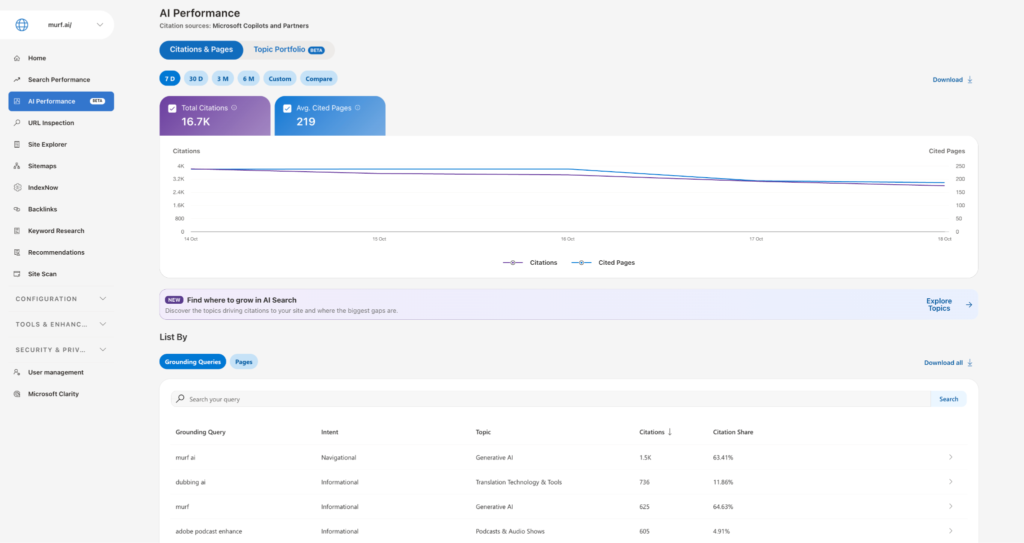
Bing does not provide prompts either, but it provides first-party data that no third-party tool has. In February 2026, Bing released an AI Performance report inside Bing Webmaster Tools, as a public preview. It is free for verified site owners and covers citations in Microsoft Copilot, AI summaries in Bing and select partner integrations.
The report includes grounding queries. Bing describes them as the key phrases the AI used when retrieving content that was cited in its answer. In practice, they are the fan-out searches the AI ran behind the answer, reported by the platform itself.
However, there are limitations here too. Grounding queries are not what people type into Bing or Copilot, so read them as topics and not as literal prompts. The report also lists a subset of them only when your site is used as a source, and only for Microsoft’s AI experiences.
I use grounding queries as a check on the prompt set. If a topic shows up in the grounding queries and none of the tracked prompts covers it, that topic is a gap to write a prompt for.
Build the prompt set yourself
Build the prompt set yourself, using the steps above, and treat the tools as inputs:
- Classify the site and build the buyer profile: Decide whether the site is persona-driven or category-driven, then get written client approval on the buyer profile or the core offerings list.
- Generate the core set: Start from the approved buyer profile and offerings list, and write 8 to 15 prompts per intent bucket for each product.
- Check the set against grounding queries: Compare the topics in Bing’s grounding queries with your buckets, and write a prompt for any topic that no prompt covers.
- Score and shortlist: Score each prompt from 1 to 5 on buyer relevance, commercial intent, brand relevance and competitive exposure, average the scores, and shortlist the top 50.
- Get approval and start tracking: Send the top 50 to the client for final written approval, load the approved set into a visibility tool such as Peec AI, and read the results as a trend.
Gather real prompts from your own leads
A lot of pros out there have also proposed a way to gather real user prompts at scale, for free, from the people who convert. I’ve seen Peec doing this, and recently Ethan Smith, founder of Graphite, also shared a LinkedIn post on it.
The method is self-reported attribution. Instead of asking only “How did you hear about us?”, Graphite built a conversion funnel that asks three questions:
The method is self-reported attribution. Instead of asking only “How did you hear about us?”, Graphite built a conversion funnel that asks three questions:
- How did you hear about us? (channel)
- What LLM did you use? (product)
- What prompt did you enter? (prompt)
This shows whether a user came in through AI, which LLM they used and the prompt they entered. Graphite reports these results:
- 30% of inbound leads come from AI. The split was 52% from ChatGPT and 40% from Claude.
- ChatGPT sends 10x the referral traffic that Claude does, yet the share of leads self-reporting Claude is almost as high as ChatGPT. This suggests last-touch attribution under-reports conversions via Claude.
- AI leads tend to be less qualified than leads from channels such as referrals.
- Only 21% of leads that self-report AI appear as AI referral traffic. The rest appear as search (49%) and direct (30%).
AEO keywords are prompts, and no platform publishes data on them. The prompt set comes from the framework, and Bing’s grounding queries are the closest first-party check on it.
About the Author
Akarsh Kavuttan is a global SEO & AI search professional from India, currently serving as Director of SEO & GEO at Botpresso, where he leads the SEO and AI search research functions.
Akarsh began his SEO journey in July 2018 at a small agency, working closely with a team of two to three people. With over eight years of experience, he has worked across BFSI, education, travel, SaaS, e-commerce, and enterprise. His clients include Thomas Cook India, ICICI Prudential Life Insurance, Orchids International School, John Jacobs, Cleartrip, and Murf AI.
His work has received recognition at the European Search Awards in May 2025, the Economic Times Brand Equity Awards in November 2023, and the DMA Asia Sparkies in November 2022.
In the evolving field of AEO and GEO, Akarsh focuses on hands-on experimentation, tool development, and practical approaches to improving brand visibility across AI-powered search experiences.
He is an active contributor to the SEO industry and regularly shares insights, experiments, and learnings through LinkedIn posts and blog articles. He was also featured in India’s Rising Search Stars Behind Digital Brands.