Choosing an SEO agency isn’t about comparing promises, fees, or polished dashboards. It’s about one thing: which operating model can actually deliver measurable business value?
Before you switch agencies or decide to bring SEO in-house, you need to understand what’s really holding your SEO back.
This guide explains how to diagnose the root problem, audit your current SEO partner using a 12–24 month performance baseline, and compare agency, in-house, and hybrid models based on their true total cost of ownership
Most importantly, you’ll leave knowing how to build a leadership case for change that goes beyond opinions and sales pitches and is backed by evidence that can withstand scrutiny.
Key takeaways
- Diagnose whether the issue lies in strategy, execution, or implementation capacity before blaming the agency.
- Separate branded from non-branded traffic, as reported organic growth may come entirely from branded demand that the agency did not create.
- Evaluate SEO using total cost of ownership rather than retainer size, considering that an in-house SEO specialist costs $65K to $100K annually, plus 40% to 55% in overhead and tools.
- Set realistic expectations for SEO timelines, as 58% of respondents in an Ahrefs poll said SEO takes three to six months to show results.
Start by Diagnosing the Real Problem, Not the Agency
The issue is rarely whether your agency is “good.” The issue is whether your SEO operating model is producing measurable business value. Before you evaluate a replacement, separate three distinct problems:
- a strategy problem (the agency is solving the wrong problems)
- an execution problem (the strategy is right, but delivery is weak)
- an implementation-capacity problem (recommendations are sound but internal teams cannot ship them).
An agency is never a hands-off vendor. Someone internal must own priorities, unblock engineering, and ensure recommendations reach production.
Three problems look like agency failure but are not
- SEO’s time lag: In an Ahrefs poll, 58% of respondents said SEO takes three to six months to show results. Search engines need to discover, crawl, index and evaluate pages before changes can affect search results. Google’s SEO Starter Guide also notes that some changes take effect within hours, while others may take several months. The timeline also depends on the website’s authority, the changes made and search competition.
An agency inheriting a weak SEO foundation may need time to build momentum, but progress should still be measurable. Track technical fixes, indexation and non-brand impressions in the first 90 days to distinguish normal delays from execution problems with the agency. Lag is expected in outcomes, never in inputs. - Algorithm-update volatility: Google’s March 2026 core update rolled out shortly after a spam update, and the two coincided with substantial ranking changes. SE Ranking found that 79.5% of URLs in the top three search results changed positions during the March updates, compared with 66.8% after the December 2025 core update. Because search updates can affect rankings independently of an agency’s work, investigate when the decline began, which pages and queries were affected, and whether competitors experienced similar changes before attributing the loss to agency performance.
- Internal implementation bottlenecks: Implementation bottlenecks are the most common reason ecommerce SEO projects miss their goals. Development backlogs, limited engineering capacity and delays can prevent recommendations from being put into practice. If your engineering team deprioritises SEO tickets, even a sound agency strategy may struggle to deliver results. Track recommendation-to-implementation rates and time to implementation before judging outcomes.
How to Audit Your Current SEO Partner Before You Decide
Establish a clean 12–24 month baseline
1. Collect data from five sources: Use Google Search Console for search performance, GA4 for organic sessions and conversions, your CRM for qualified leads and revenue, your SEO platform for historical rankings, and CMS records for published, updated or removed pages.
2. Compare equivalent periods: Review clicks, impressions, CTR and average position year over year. Segment Search Console data by query, page, country and device.
3. Find what drove the change: Check whether traffic grew because of non-branded discovery, increased branded searches or seasonal demand. Look for pages and queries gaining or losing clicks, then check whether organic sessions and business outcomes followed the same trend.
4. Compare results with the agency’s activity log: Identify which completed changes align with improvements or declines. Clicks and impressions trends are more useful than average position alone when assessing overall progress.
Separate branded from non-branded before judging anything
An agency may report strong organic growth even when most of the increase comes from people already searching for your brand. That does not necessarily mean its SEO work is bringing in new audiences.
Compare branded and non-branded queries in Google Search Console over the same period. Define branded queries to include your company name, product brands and common misspellings. Search Console’s branded-query filter can help where available, but it is not a complete or definitive way to separate the two groups. Review individual queries as well.
If branded searches account for most of the growth, investigate whether PR, paid campaigns, offline marketing or seasonal demand contributed. If non-branded clicks have increased, identify the queries and landing pages driving that growth. Then check whether those visitors are converting into relevant leads or customers. This gives a clearer view of whether the agency is expanding search discovery or reporting growth in existing brand demand.
Build the activity-to-outcome map
Ask the agency to connect the work it completed to measurable results. For content, that means looking beyond the number of articles published to see whether they attracted relevant search traffic and contributed to business outcomes.
For example:
12 articles published > 5 gained meaningful non-branded clicks > 2 generated conversions > ₹X in attributable pipeline.
These figures are illustrative. The actual numbers will depend on your site and tracking setup.
The point is to establish what happened at each stage. Did the articles attract the right audience? Did visitors convert? Can those conversions be linked to qualified leads or pipeline? Attribution may not be exact, but the agency should explain its method and the evidence behind its claims.
If the agency cannot connect completed work to measurable outcomes, that is a finding in itself. It may indicate weak tracking, poor reporting or work that has not delivered demonstrable value. Ask the agency to identify the gap and explain how it plans to address it.
Audit the technical foundation
Technical SEO issues can prevent search engines from finding, crawling, indexing or correctly understanding important pages. Review the latest crawl report and Google Search Console data, then compare the findings with the agency’s audit and completed fixes.
Don’t judge the agency by the number of issues it reports. Check whether it prioritised problems by impact, and verified that critical fixes were implemented. Repeatedly flagging the same unresolved issues is a reason to question its execution and follow-through.
Check for:
- Crawling and indexability: Incorrect robots.txt rules, missing or outdated XML sitemaps, unwanted noindex directives and important pages missing from Google’s index.
- URL and page issues: Incorrect canonicals, broken redirects, 4xx and 5xx errors, duplicate or thin pages, and orphan pages that lack internal links.
- Site structure and rendering: Weak internal linking, problems with pagination or faceted navigation, and important content that fails to render correctly on mobile or when JavaScript is used.
- Performance and search signals: Core Web Vitals issues, invalid structured data and incorrect hreflang implementation on multilingual or regional sites.
- Historical changes: Site migrations, URL changes and major template updates that may have affected organic performance.
Audit content on a 30–50 page sample
Review 30–50 pages chosen across key content types, including blog posts, service pages and category pages. The aim is to find out whether the agency has built a useful content library or simply increased publishing volume. Also check whether the agency has published large volumes of similar content with little added value. Google’s scaled content abuse policy targets content produced primarily to manipulate rankings rather than help users, regardless of how it was created.
For each page, assess:
- Quality: Does it match search intent, offer original insights, demonstrate first-hand expertise and provide accurate information?
- SEO performance: Does it attract impressions and meaningful clicks? Does it compete with other pages on your site for the same queries?
- Business value: Is it internally linked, commercially relevant and contributing to conversions or qualified leads?
- Purpose: Does the page serve a distinct user need, or is it thin, repetitive or unnecessary?
Ask: If we stopped paying the agency tomorrow, which of this content would we still want?
Audit backlinks by how they were acquired
Ask the agency for a sample of the links it has built or earned, along with how each was acquired. The number of referring domains alone tells you little about link quality or risk. A smaller set of relevant, editorially earned links may be more valuable than hundreds of unrelated placements.
Pay particular attention to links that exist mainly to pass ranking signals rather than help users discover relevant content. Compare the agency’s methods with Google’s link spam policies.
Classify the links into three groups:
- Healthy: Genuine editorial mentions, links earned through real relationships, and relevant industry resources.
- Questionable: Low-quality directories, guest-post networks, unrelated websites, repetitive anchor text and placements that appear to be paid for.
- High-risk: Link schemes, artificial sitewide links and spam tactics intended to manipulate search rankings.
Apply the disclosure test: Would you be comfortable if this link-building work were made public?
If the answer is no, ask the agency to explain the tactic, its purpose and any potential risk to your site.
Reporting red flags
Ask the agency to explain any gaps and provide the underlying data. A good report should show what changed, what may have caused it, what remains uncertain and what the agency plans to do next. If it cannot distinguish evidence from assumptions, you have limited info to judge its performance.
Watch for:
- Rankings without business outcomes: Reports focus on keyword positions but omit organic traffic, conversions, qualified leads or revenue.
- Growth without context: Percentage increases appear without absolute numbers, branded and non-branded performance are mixed together, or comparison periods are chosen to make results look better.
- Inconsistent measurement: The agency changes its tracked keywords between reports, quietly drops poorly performing terms or pages, or takes credit for growth in branded searches without examining what drove it.
- Unsupported claims: Correlation is presented as proof that the agency’s work caused a result, while technical changes go undocumented and their impact is not investigated.
- No clear next steps: Reports describe past performance but offer no explanation for declines, lessons from failed initiatives or priorities for the next period.
Conduct the asset ownership audit before you give notice
Flag any asset still registered to the agency, inaccessible to your team or missing from your records. Before giving notice, check that your business owns or has administrative control over the following assets:
- Google Search Console: Property ownership and administrator access.
- Google Analytics 4 (GA4): Account access and historical data.
- Google Business Profile: Primary ownership and administrator access.
- CMS: Administrator access and control over website content.
- Domain and DNS: Access to the domain registrar and DNS settings.
- Google Tag Manager: Account ownership and container access.
- SEO tools: Account credentials, subscriptions and project data.
- Content: Published articles, drafts, briefs and other content created for your business.
- Image assets: Original files and relevant usage rights.
- Digital PR accounts: Outreach platforms, campaign records and publisher contacts.
- Vendor relationships: Contracts, contact details and relevant account information.
- Documentation: Technical audits, strategy documents, implementation records and change logs.
- Crawl data: Historical crawl exports and technical issue reports.
- Keyword research: Keyword lists, mapping documents and research files.
- Historical reports: Previous performance reports, dashboards and supporting data.
Put five questions to your agency in writing
- Which work in the last 12 months produced the most measurable business value?
- Which recommendations are still unimplemented, who is responsible for implementing them, when were they approved, and what impact do you expect from each one?
- Can you confirm our ownership and access to every SEO-related asset, account, deliverable and historical dataset?
- Have any links been acquired that could violate Google’s spam policies?
- If another team took over tomorrow, what should they fix first?
Agency, In-House, or Hybrid: Which Model Actually Fits You?
There is no universally correct model. The right choice depends on the importance of organic search, site complexity, internal SEO leadership, and your workload.
Ten-dimensional comparison
The table below compares agency, in-house, and hybrid models across ten dimensions that determine fit, control, and long-term cost.
| Dimension | Agency | In-House | Hybrid |
|---|---|---|---|
| People and structure | Multi-specialist team | Single generalist or small team | Internal lead + external specialists |
| Expertise breadth | High (technical, content, PR) | Limited by headcount | High |
| Business knowledge | Low to Medium | High | Medium to High |
| Speed to start | Fast (2–4 weeks) | Slow (3–6 months recruiting) | Moderate |
| Scalability | High (surge capacity) | Low | High |
| Day-to-day control | Low | High | High |
| Cost structure | Variable (retainer) | Fixed (salary + overhead) | Mixed |
| Knowledge retention | Low | High | High |
| Cross-functional integration | Low | High | High |
| Tool-stack ownership | Agency-held | Company-owned | Company-owned |
Total cost of ownership
In-house TCO
In-house TCO = salaries + benefits and overhead + recruitment + tools + management time + training
The real cost goes beyond salaries. You also need to account for benefits, recruitment, SEO tools, training, management time, overheads, and hiring specialists when needed. An in-house SEO specialist typically costs $65K–$100K annually, with another 40–55% added for overheads and tools. A lean two-person SEO team can therefore cost around $35,500–$36,500 per month, even before adding writers.
Agency TCO
Agency TCO=retainer + internal implementation costs + coordination costs + vendor-management time
With an agency, the main cost is the monthly retainer, plus some internal time for coordination and vendor management. You get access to multiple specialists without hiring each role separately. Agency costs can range from $5K to $250K, depending on the business size, scope, and goals.
What the market does
A 2025 Conductor report found that 49% of organisations use a hybrid model, 41% are predominantly in-house, and only 10% are fully outsourced. Large organisations rarely choose exclusively between in-house and agency. They use both.
The one-person trap
One generalist cannot cover technical SEO, content strategy, analytics, digital PR, and execution. A functioning internal team typically requires a product-adjacent SEO lead, a content strategist, and an analytics owner, plus external support for technical depth and digital PR.
In-house vs. SEO Agency Decision Table
| Factor | Choose Agency | Choose In-House |
|---|---|---|
| Organic search importance | SEO matters but isn’t a core internal capability. | SEO is a core growth channel requiring daily ownership. |
| Site complexity | Your site needs specialist support. | Your site requires continuous technical SEO oversight. |
| Workload | Workload varies by project or campaign. | Workload is consistently high. |
| Internal SEO leadership | You lack an experienced SEO lead. | You have an experienced SEO lead and team. |
| Engineering dependency | SEO requires limited developer involvement. | SEO requires frequent engineering changes. |
| Markets and brands | You manage a few markets or brands. | You need dedicated SEO teams across multiple markets. |
| Budget (illustrative) | Under $10K/month | $30K+/month |
| Seasonality | SEO demand peaks during specific seasons or campaigns. | SEO requires consistent, year-round ownership. |
How Do We Build the Case to Leadership for Replacing Our SEO Agency?
Replacing an agency is a resource-allocation decision, not a verdict on whether the agency is “good.” The case has to show what was invested, what was expected, what was actually returned, and what the next phase requires.
Open with resource allocation
Use this structure: “We are investing $X per month. Expected return was Y. Actual return is Z. I am requesting to evaluate whether this partner is the right fit for the next phase.” Avoid “I don’t think the agency is very good”; it frames the discussion as preference, not performance.
Five evidence buckets
Together, these buckets show whether the agency is producing value, executing well, and fitting the next phase:
| Bucket | What to Examine | What It Tells You |
|---|---|---|
| Business outcomes | Revenue, pipeline, conversions, qualified leads | Is SEO contributing to business growth? |
| SEO outcomes | Non-brand traffic, visibility, landing-page performance, indexation | Is search performance improving? |
| Execution | Recommendations, implementation rates, publishing output, completed fixes | Does the agency deliver what it promises? |
| Strategic fit | Commercial alignment, adaptability, market coverage, specialist depth | Does the agency fit your future needs? |
| Economics | Total cost, ROI, payback period, opportunity cost | Is the investment worth it? |
Twelve-month scorecard
Compare investment against impact across all four dimensions; a gap in any one of them is the finding.
| Dimension | What to Measure | What a Gap May Reveal |
|---|---|---|
| Investment | Agency fees, internal hours, and content production costs | Costs may be higher than expected or require more internal support than planned. |
| Business impact | Organic pipeline, conversions, qualified leads, and revenue | SEO activity may not be translating into measurable business value. |
| Search performance | Non-brand clicks and impressions, strategic visibility, converting landing pages, indexed pages, and technical issues | The agency may be attracting the wrong traffic or failing to address barriers to organic growth. |
| Execution | Recommendations delivered vs. implemented, content planned vs. published, and technical fixes proposed vs. completed | Delays, incomplete work, or internal bottlenecks may be limiting results. |
Separate performance from SEO’s time lag
Time lag is real, but it does not excuse everything. Assess whether problems were identified promptly, recommendations were implementable, priorities reflected impact, declines were investigated, opportunities matched commercial intent, post-launch impact was measured, and the strategy adapted to changes in search. If most answers are yes, the lag is doing its work. If they are no, the issue is execution, not patience.
Present three options
- Option A: Retain with defined changes. Named owners, deliverables, implementation commitments, reporting standards, and 90-day success criteria.
- Option B: Review three to five agencies against one standardised brief.
- Option C: Build a hybrid or in-house model.
Address transition risk
Attach a transition plan covering account ownership, data access, documentation, redirects, active projects, reporting continuity, knowledge transfer, and baseline monitoring. This answers the “switching will hurt traffic” objection before it is raised.
How to Evaluate and Shortlist a New Agency
Build a weighted scorecard
Score every agency on the same dimensions and weight them by what your situation actually demands. A technical, migration-heavy site should weight technical depth higher; a content-led B2B site should weight content and measurement higher. The weights matter more than the raw scores, because they force the conversation onto what you are buying.
| Dimension | What to Assess | Suggested Weight |
|---|---|---|
| Relevant SEO experience | Comparable site type, market, and business model | 20% |
| Delivery-team seniority | Who actually does the work, not who pitched | 15% |
| Technical depth | Crawl, indexation, JavaScript, migrations, Core Web Vitals | 15% |
| Measurement | Non-brand segmentation, activity-to-outcome mapping, revenue attribution | 15% |
| Implementation support | How they unblock engineering and content production | 10% |
| Communication | Cadence, escalation path, single point of contact | 10% |
| Emerging areas | AEO and AI-powered search capability, tested rather than merely claimed | 15% |
Use one brief
Give every agency the same goals, data, constraints, budget, and expected outcomes. Identical inputs are what make proposals comparable. Include your 12–24 month baseline, access to Search Console and analytics, commercial priorities, and the specific outcomes leadership expects. Then hold every agency to the same response format and the same deadline.
Ask the right questions
Test their diagnosis, first-90-day priorities, delivery team, and measurement approach. Then ask directly how they are adapting SEO strategy to AI-powered search and what role AEO plays in their method. Strong agencies have a tested point of view. Weak ones describe the category back to you.
- Diagnosis: What do you think our actual problem is, based on the data we shared?
- First 90 days: What would you prioritise, in what order, and why?
- Delivery team: Who does the work day-to-day, and how senior are they?
- Implementation: How do you get recommendations shipped when engineering is the bottleneck?
- Measurement: How will you separate branded from non-brand performance and map activity to pipeline?
- AEO and AI search: What have you tested, what did the data show, and what changed as a result?
Read proposals critically
Prefer a hypothesis-led proposal that explains the problem, the evidence, the priorities, ownership, and how success will be measured. Avoid proposals that only list deliverables like a content calendar, a link target, or a reporting cadence without connecting them to an outcome. The strongest proposals are willing to say what they would not do, and why.
How Disruptive Is It to Switch SEO Agencies Mid-Year?
Switching SEO agencies mid-year is manageable. Expect disruption concentrated in rankings, traffic, reporting, and institutional knowledge.
| Area | Risk |
|---|---|
| Rankings | Low to medium: Rankings may fluctuate due to unrelated search changes or unnecessary changes made during the handover. |
| Organic traffic | Medium: Existing momentum may weaken if important work is paused, content production stalls, or critical issues go unresolved. |
| Reporting | Low to medium: Reporting may become inconsistent if the incoming agency uses different tools, tracking methods, or baselines before aligning them with historical data. |
| Content production | Medium: Publishing may slow down if briefs, editorial calendars, approvals, or work in progress are not transferred properly. |
| Technical SEO | Medium to high: Conflicting or poorly coordinated changes to redirects, canonicals, indexing rules, or site templates can affect search performance. |
| Backlinks | Low to medium: Link-related risks may arise if existing outreach relationships are lost or important redirects are missed during a site change. |
| Institutional knowledge | Medium to high: Important context can be lost if the outgoing agency does not document past decisions, ongoing tests, technical dependencies, and the reasons behind previous changes. |
The main risk
The incoming agency changes things before understanding them. For the first month, understand the existing strategy and establish a baseline. Do not make large-scale changes simply because you would have built it differently. Undoing a rushed change costs more than waiting four weeks.
Do not stack changes
Do not combine the switch with a redesign, CMS or domain migration, URL restructuring, content pruning, or navigation overhaul. Google’s site move documentation is explicit: change only one thing at a time. Stacking changes makes cause and effect impossible to attribute.
Choose the timing carefully
Switch outside peak season, especially when organic search is revenue-critical or highly seasonal. Google advises timing moves to coincide with lower traffic. Fewer users are affected by temporary volatility, and Googlebot has more capacity to recrawl and reindex..
The SEO Vendor Transition Plan
T-4 weeks: build the transition document
Capture 12–24 months of performance data, rankings, backlinks, technical issues, content, roadmaps, and experiments. The why matters more than the what. Request a decision log with four columns: change, reasoning, expected impact, observed impact. Missing observed impacts become open questions for the first 30 days.
Transfer ownership and access
Transfer Search Console, GA4, Tag Manager, CMS, Git, DNS/CDN, SEO tools, content systems, and dashboards. Watch for second-order dependencies like dashboards built on agency licences, API connections under agency accounts, scheduled exports that silently stop. Revoke the outgoing agency’s admin rights only after the overlap ends, and keep an internal employee in administrator control throughout.
Complete the SEO asset handover
Inventory four categories explicitly: technical (audits, redirect maps, canonical rules), content (briefs, calendars, cannibalisation records), off-page (backlink history, outreach lists, disavow files), and strategy (keyword maps, live tests, next steps).
Require an independent assessment
Ask the incoming agency what it would keep, stop, change, and investigate. An agency that changes everything has not understood the site; one that changes nothing brings no expertise. Require inherited facts, assumptions, and new recommendations to be separated so the first roadmap is auditable.
Run a 1–2 week overlap
Route knowledge transfer through the company, not between agencies, so the incoming team inherits your framing rather than the outgoing team’s. Record every session and store it internally.
Freeze risky changes and set a cutover date
Freeze URLs, redirects, canonicals, robots.txt, sitemaps, indexation, templates, internal links, and structured data. The freeze exists for attribution. If something breaks, you need to know which team changed what, and when.
The first 30/60/90 days
| Window | Focus | Exit Criteria |
|---|---|---|
| Days 1–30 | Validate data, tracking, risks, and inherited work | Baseline confirmed; open questions logged |
| Days 31–60 | Prioritise fixes and create a roadmap | Roadmap approved with owners and sequencing |
| Days 61–90 | Execute, measure, and reforecast | First performance read against baseline |
Set success metrics before work starts
Define traffic, conversion, revenue, visibility, indexation, backlink, content, and technical metrics up front, with a baseline value and a target for each. Segment non-brand from branded from day one, or the incoming agency will inherit credit for demand it did not create. Annotate the vendor-change date in analytics so every future report is read against the transition rather than an unmarked timeline.
Build a transition timeline
The first table doubles as a downloadable RACI with one owner and one deliverable per step, from T-4 weeks to Day 90. Publish it where both agencies and internal stakeholders can see it, and treat slippage on any row as a risk to escalate rather than a detail to absorb.
How to Evaluate an Agency’s AI Search and AEO/GEO Capability
Not every agency claiming AEO expertise has a clear methodology behind it. When evaluating an agency, look beyond promises of “AI visibility” and ask:
1. How they generate prompts: A credible GEO partner should be able to explain where its prompt set comes from. Look for real user queries, Search Console data, sales conversations, or synthetic expansion based on the target personas and how it keeps that set current as models change. Ask how many prompts they track, whether they segment by intent or funnel stage, and how they avoid prompts that no buyer would ever type.
2. How they track visibility: Look for a defined measurement method. Which AI surfaces they monitor, how often, and whether they track brand mentions, citations, or both. Observe how they handle the fact that answers vary by user, location, and session. An agency that reports a single “AI visibility score” without explaining the methodology is telling you the score is the product, not the insight.
3. How their findings become content decisions: The output of prompt and citation analysis should be specific: which pages earn citations, which formats get quoted, which topics need coverage, and which existing pages need restructuring. If the recommendation is always “publish more,” the agency is not doing AEO; it is doing volume.
4. How they measure change over time: AI answers are volatile, so visibility must be tracked over time, not just at a point in time. Ask how often they re-run the prompt set, whether they attribute shifts to model updates, algorithm changes, or their own content edits, and how they separate real gains from noise.
For example, at Botpresso we tested whether AI systems accessed llms.txt, a file intended to help them understand website content. Despite publishing the file and adding it to the site’s link headers, server logs recorded no requests to it. This proves that as an agency, we shouldn’t just accept whatever the industry says and believes is true. We need to test it ourselves to ensure we deliver only what works to the client without wasting time and resources.
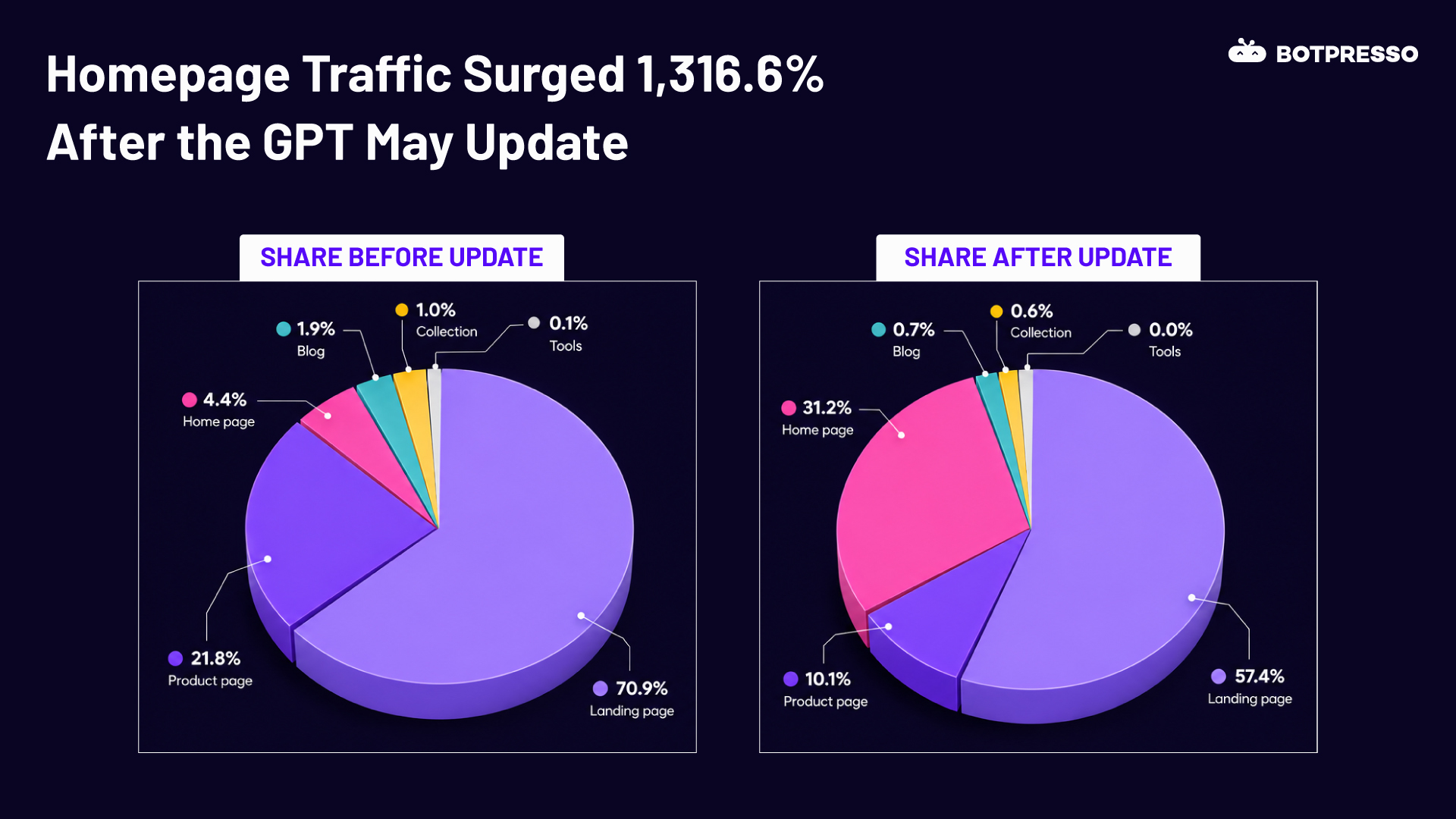
We also do regular studies to see how AI platforms work and evolve. Recently, we analysed ChatGPT referral traffic across 52 websites, comparing six-week periods before and after ChatGPT’s May link update to see how the platform evolved in this update.
When assessing an agency, ask for examples of how it has investigated such changes and what it did differently as a result. The aim is to understand what the data shows before deciding what to change.
The Decision Framework to Retain/Replace Your SEO Agency
| Question | Yes | No |
|---|---|---|
| Is organic demand growing? | Retain | Investigate |
| Is valuable non-brand traffic growing? | Retain | Renegotiate |
| Is SEO producing business results? | Retain | Replace |
| Is the technical foundation healthy? | Retain | Renegotiate |
| Is the content portfolio valuable? | Retain | Renegotiate |
| Has the agency introduced risk? | Replace | Retain |
FAQs
Will changing SEO agencies hurt my rankings?
Not necessarily. Risk increases when the incoming agency makes major changes before understanding the site, or when the switch overlaps with a migration, redesign, or seasonal peak.
How long before a new SEO agency shows results?
Most sites see measurable results within 3–6 months, with meaningful revenue impact at 6–12 months. Year two delivers the largest compounding gains.
Is an agency cheaper than hiring in-house?
Not automatically. Compare agency fees plus internal coordination and implementation costs with salaries, benefits, tools, management, training, recruitment, and specialist cover.
Can one in-house SEO hire replace an agency?
No. A single generalist cannot cover technical SEO, content strategy, analytics, digital PR, and execution at scale. A functioning internal team requires multiple roles.
What if my current agency will not hand over access?
Ensure your contract specifies asset ownership and access provisions. An internal employee must retain administrator control of Search Console, GA4, CMS, and DNS before serving notice.
How many agencies should I shortlist?
Three to five, evaluated against one standardised brief with identical goals, data, and constraints.
Should I tell my current agency I am evaluating alternatives?
Yes, after completing the asset ownership audit and securing access. Transparency reduces transition friction.
How much should we budget for SEO?
Budget according to the required workload, competition, site complexity, markets, and implementation capacity; not a universal percentage of revenue or a fixed number of links.
What are the clearest signs that an SEO agency is underperforming?
Rankings-only reporting, no non-brand segmentation, percentage growth without absolutes, inability to map activity to outcomes, and no forward plan.
Which KPIs should a new agency improve in its first 90 days?
Non-brand clicks, indexed page count, technical issue resolution rate, recommendation-to-implementation rate, and baseline measurement accuracy.
What contract terms should we check before signing?
Exit notice period (30–60 days), asset ownership clauses, deliverable breakdown, performance benchmarks, and data access provisions.
When should we renegotiate instead of replacing an agency?
When the strategy is sound but execution or reporting needs tightening, and the agency demonstrates willingness to adapt with defined 90-day success criteria.
About the Author
Akarsh Kavuttan is an SEO and AI Search professional from India, currently serving as Director of SEO & GEO at Botpresso, where he leads the SEO and AI search research functions.
Akarsh began his SEO journey in July 2018 at a small agency, working closely with a team of two to three people. With over eight years of experience, he has worked across BFSI, education, travel, SaaS, e-commerce, and enterprise. His clients include Thomas Cook India, ICICI Prudential Life Insurance, Orchids International School, John Jacobs, Cleartrip, and Murf AI.
His work has received recognition at the European Search Awards in May 2025, the Economic Times Brand Equity Awards in November 2023, and the DMA Asia Sparkies in November 2022.
Akarsh works in Answer Engine Optimisation (AEO) and Generative Engine Optimisation (GEO). He focuses on hands-on experimentation, tool development, and practical ways to improve brand visibility in AI-powered search.
He is an active contributor to the SEO industry. He regularly shares insights, experiments, and learnings through LinkedIn posts and blog articles. He was also featured in India’s Rising Search Stars Behind Digital Brands.