You rank well on Google. Your website has the content people are looking for. So why are AI tools like ChatGPT and Perplexity recommending your competitors instead?
Getting mentioned in AI answers takes more than strong search rankings. ChatGPT may shortlist brands before retrieving a single page, while Perplexity draws on web sources to build its answers.
Your presence across the web helps your brand get considered, while relevant, accessible content gives AI platforms a reason to cite it. Understanding this process is the first step towards improving your visibility.
Key takeaways
- Google rankings alone do not guarantee visibility on ChatGPT or Perplexity. Your brand must also be recognised in its category and supported by relevant sources.
- Build credible mentions through industry coverage, comparison articles, reviews and relevant online platforms.
- Make your website accessible to AI crawlers, keep brand information consistent and publish clear, original content that AI can retrieve and cite.
- Track brand mentions, citations, competitor visibility and AI referral traffic to measure progress.
- Test a consistent set of prompts, address visibility gaps and review results regularly.
How Do ChatGPT and Perplexity Decide Which Brands to Mention?
AI answers draw on what a model learned during training and what it retrieves from the web when answering a question. For a brand to appear in an answer, it first needs to be considered relevant to the user’s question. The AI then finds information about it and decides whether that information supports including the brand in its response.
Training Memory vs Live Retrieval
AI platforms can answer in two ways: by drawing on what they learned during training, or by pulling in fresh information from the web. Retrieval-augmented generation (RAG) combines the two, pairing a language model with external information fetched at the moment a question is asked.
Clear, well-organised content (headings, lists, direct answers) makes it easier for systems that fetch information live to pull out and use. But getting into a model’s training data is a slower process, built by publishing consistently on a topic until you’re seen as a trusted source and referenced by relevant external sources.
Not every prompt triggers a web search. ChatGPT may answer a question such as “How do I build a content plan?” using its existing knowledge. Perplexity’s standard search experience typically retrieves web sources to help construct its answer. The behaviour can vary depending on the platform and how the question is asked
Stage 1. Getting on the Shortlist
ChatGPT can introduce brand names into its search queries even when users haven’t mentioned them. A significant number of conversations contained unprompted brand names in the first search query.
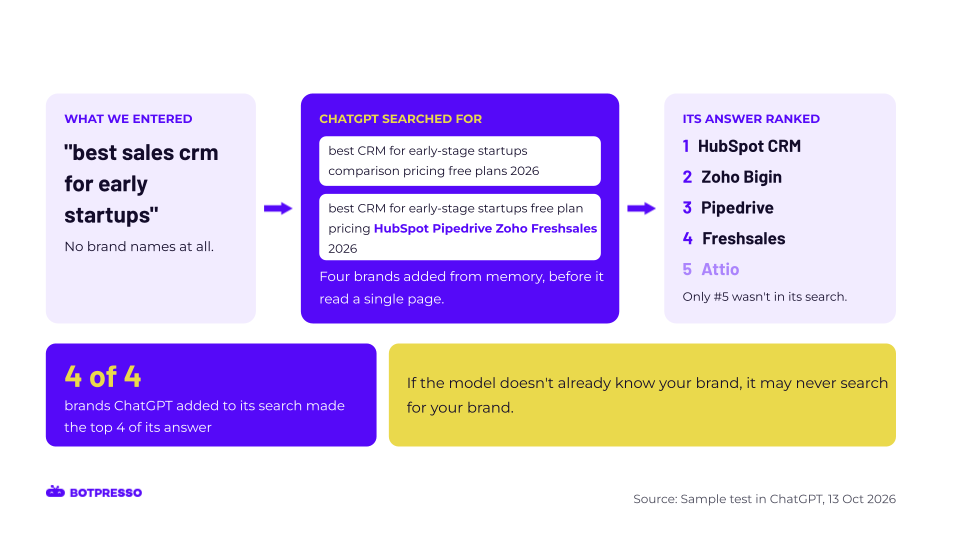
A brand’s reputation can influence whether it enters the shortlist.
Stage 2. Getting Retrieved
AI systems can only retrieve pages they can access. Important pages should be indexable, crawlable, and accessible to the relevant AI crawlers. Check your robots.txt rules to ensure they don’t block the crawlers you want to allow. Also, keep essential information in the page’s initial HTML rather than relying entirely on JavaScript to display it.
Some AI crawlers may struggle to render JavaScript, which can leave key content inaccessible. Test your pages regularly to identify access issues. These steps make your content easier to retrieve, but they don’t guarantee that an AI platform will select it for an answer.
Stage 3. Getting Cited
Being retrieved does not guarantee that a page will be cited.
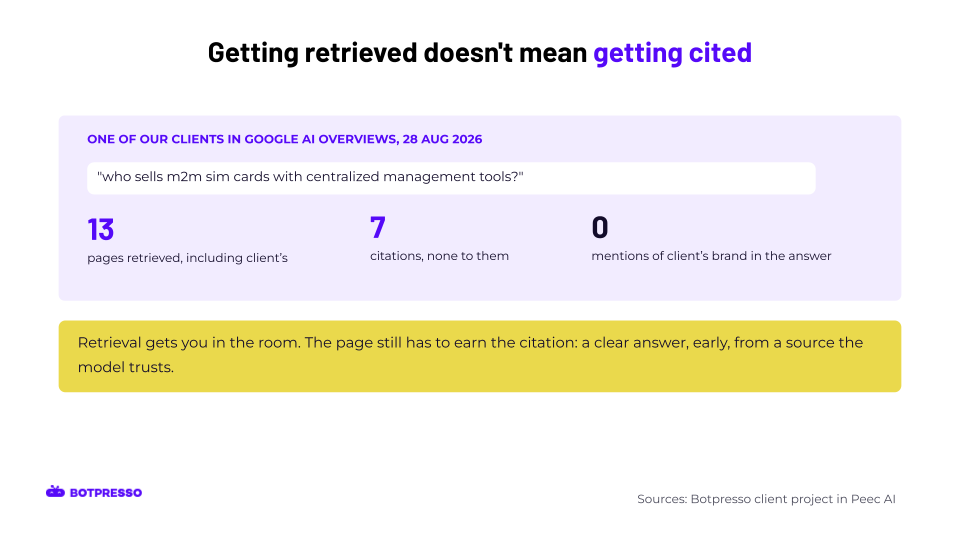
AI systems must find the page relevant to the question and useful enough to support the answer. Research involving 252,000 trials across six language models found that topical relevance and a source’s position in the retrieved results had the strongest effects on which source was cited first. Explicit pricing and recent timestamps also helped.
For GEO, the pages need to answer the specific question with concrete information. Include relevant specifications, current prices where applicable, and evidence to support factual claims. Keep information consistent and update outdated details.
How ChatGPT and Perplexity Differ
A brand can appear in ChatGPT’s answer but remain absent from Perplexity’s response to the same question. The reverse is also possible. Here are some of the reasons why:
1. Perplexity offers more citation opportunities
In one comparison, Perplexity averaged 21.87 citations per question, compared with 7.92 for ChatGPT. A separate comparison found a similar gap, with Perplexity averaging 16.35 citations per prompt against ChatGPT’s 6.88.
For brands, this means there may be more opportunities to earn a citation in a Perplexity answer. However, appearing in the citations does not necessarily mean the brand will feature in the recommendation itself.
2. Retrieval posture
Perplexity behaves like a research layer: it rewards pages that are useful, current, and extractable as one node in a broad multi-source answer. ChatGPT rewards pages that can function as a strong “evidence container”—a compact, authoritative page that supports multiple claims in the final synthesis.
3. Both platforms draw from different sets of websites
Based on 1500 chats from one of our clients’ datasets on Peec AI: ChatGPT leans heavily on bank and institutional sources: npci.org.in, axis.bank.in and hdfc.bank.in lead its retrievals, and corporate and institutional domains make up 79% of the total. Perplexity casts a wider net, pulling from editorial and reference sites like NerdWallet, CNBC, Bankrate and Experian alongside bank sites, with editorial and reference sources reaching 29% of retrievals compared to ChatGPT’s 9%.
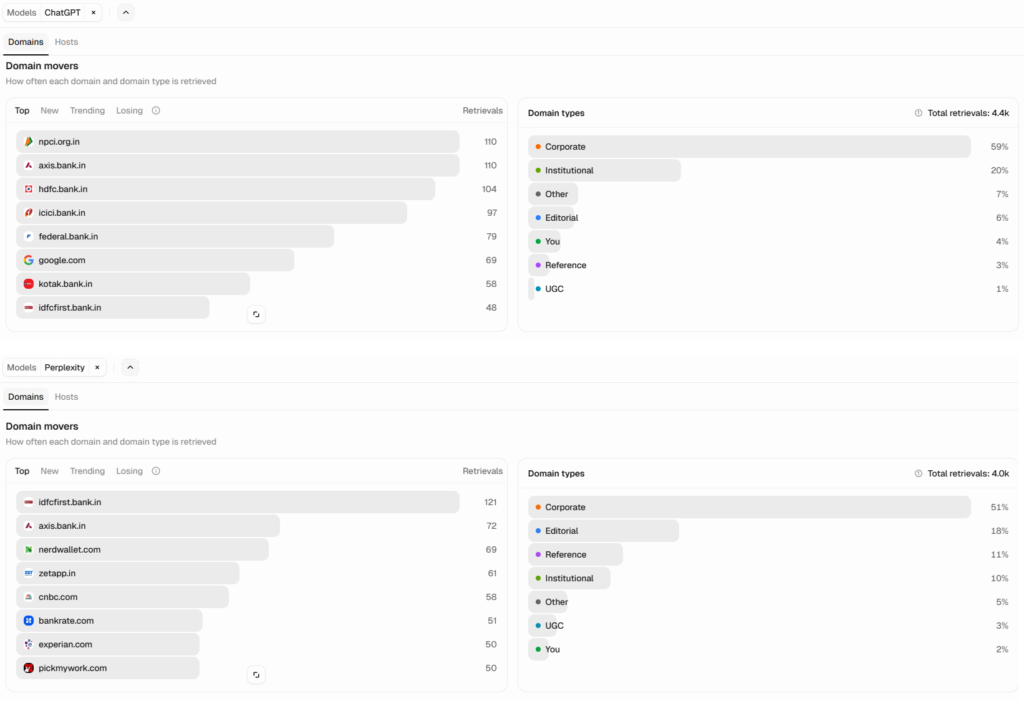
Source: Botpresso’s client project on Peec AI
4. What earns visibility also differs
For Perplexity, a page can win by covering a specific subquestion well and being easy to extract from; clear sections, definitions, data, comparisons, and procedures. For ChatGPT, semantic fit, credibility, and evidence density matter more: the strongest pages are easy to retrieve, well-structured, aligned with the query, and rich in reusable evidence both within the website and also external sources.
Why Do Competitors Get Mentioned by ChatGPT or Perplexity But You Don’t?
Reason 1: AI Already Knows Them as Part of the Category
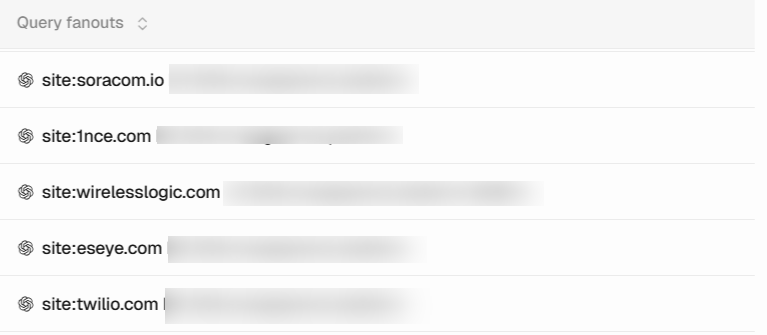
AI platforms may favour brands they already associate with a product category. As we have seen earlier, when ChatGPT generates a search query, it can include brand names the user never mentioned. If your competitors appear in those queries but your brand does not, the gap may be because of brand recognition and authority, rather than a technical SEO issue.
Example of query fanouts generated by ChatGPT with brand names specified for one of our clients at Botpresso:
Reason 2. They Have More Independent Mentions
AI platforms like ChatGPT and Perplexity can encounter competitor brands across multiple sources beyond their own websites. These mentions help establish how a brand is discussed within its category.
Focus on building a credible presence across relevant platforms.
- G2 and Capterra for software reviews.
- Trustpilot for customer feedback.
- Reddit for community discussions.
- YouTube for product reviews and demonstrations.
- LinkedIn for industry conversations.
- Industry publications for expert coverage and independent mentions.
Reason 3. They Appear in Comparison Articles and Rankings
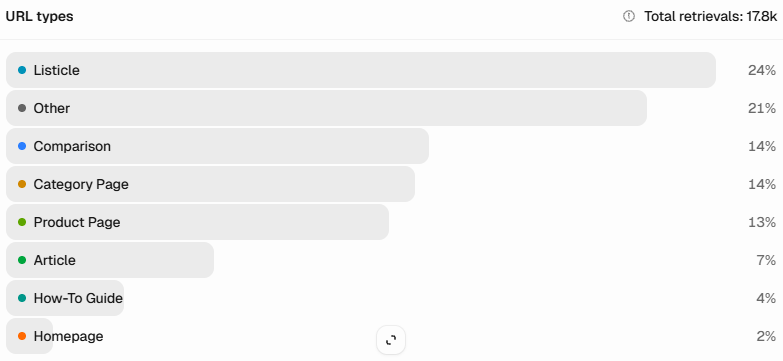
When users ask AI to compare options, platforms may retrieve buying guides, ranked lists and product comparisons. If competitors feature in these pages and your brand is absent, they have a direct advantage in that context. Identify which comparison pages appear for your target queries, then pursue inclusion where your brand genuinely fits.
Here’s an example from one of our clients’ trackers on Peec AI where you can see that “Listicle” is what’s been retrieved the most:
Reason 4. Their Brand Signals Are Clear and Consistent
ChatGPT and Perplexity need reliable information to identify a brand and understand what it offers. Keep your brand name, description and category consistent across your website, LinkedIn, Crunchbase, review platforms, business directories and press coverage. Your About page also matters because it explains what the company does, whom it serves and where it fits in the market. Conflicting descriptions or outdated details can make it harder to establish a clear picture of your brand.
Reason 5. Their Pages Are Easier to Retrieve and Cite
Competitors may appear more often because their pages match the specific queries AI generates, not just broad category keywords. Create a focused page for each search intent rather than having several pages compete for the same question. Technical accessibility matters too. In an analysis of AI crawler traffic, ChatGPT’s crawler fetched JavaScript files in 11.50% of its requests but did not execute them. Keep key facts and pricing in the initial HTML so crawlers can access the content.
What Approaches Do Brands Use to Improve Visibility on ChatGPT and Perplexity?
Improving AI visibility starts with making a website accessible to the systems that retrieve its content. The first step is to check whether technical barriers are preventing that content from being discovered.
1. Fix Eligibility and Crawler Access
Before investing in content or digital PR, check whether AI systems can access the website. Different crawlers serve different purposes, so allowing one does not automatically allow another to use your content for search or training.
Understand which crawlers need access
A useful starting point is to distinguish training crawlers from retrieval crawlers. Training crawlers collect content that may be used to develop AI models. Retrieval crawlers discover or fetch pages that can support answers to current questions. Some platforms use separate crawlers for these purposes, while others rely on existing search infrastructure.
| Bot / User Agent | Company | Type | Purpose |
|---|---|---|---|
| OAI-SearchBot | OpenAI | Search | Indexes content for ChatGPT Search. |
| ChatGPT-User | OpenAI | Agent | Fetches pages in real time when a user asks ChatGPT to read or interact with a webpage. |
| GPTBot | OpenAI | Training | Collects content that may be used to improve future OpenAI models. |
| OAI-AdsBot | OpenAI | Ads | Verifies landing pages and advertising content for OpenAI’s advertising systems. |
| PerplexityBot | Perplexity | Search | Indexes content to surface and link websites in Perplexity search results. |
| Perplexity-User | Perplexity | Agent | Fetches pages in real time when a user asks Perplexity a question that needs a webpage. |
| Googlebot | Search | Crawls and indexes webpages for Google Search and AI features. |
Check robots.text and server-level restrictions
A robots.txt file tells compliant crawlers which parts of a website they may access. However, it is not the only control that matters. A CDN’s web application firewall (WAF) or bot protection service can block a crawler even when robots.txt allows it. Review both sets of rules, and check server logs for failed requests or access errors.
Also, blocking one crawler does not necessarily block every service from that platform. For example, OpenAI separates its search crawler from its training crawler. If a brand wants its pages to appear in ChatGPT search while opting out of training use, those settings need to be considered separately.
Content Signals offer another way to express preferences about search, AI input and training through directives such as search, ai-input and ai-train. However, this is an emerging convention, not a universal control that every crawler is guaranteed to honour.
Keep important content accessible
Technical access is only part of the job. Crawlers also need to extract the information on the page. Keep essential product details, pricing and explanations in the initial HTML rather than making them available only after JavaScript runs. Use semantic HTML, including meaningful headings and properly structured content, so automated systems can interpret the page more reliably.
Treat llms.txt as optional
There was a lot of buzz around llms.txt. So, naturally we decided to put it to the test. With this test, we found that the file received zero requests from any of the crawlers, be it AI crawlers or search engines. This does not prove that no AI crawler will ever read llms.txt in the future. It proves why the file should not be treated as a proven visibility lever. Instead treat it as an inexpensive experiment you can conduct.
2. Get Into the Category Vocabulary Through Digital PR
Visibility on LLMs like ChatGPT or Perplexity depends partly on whether a brand appears in the sources that shape conversations about its category. Digital PR helps build that presence through relevant industry publications, analyst reports, partnerships and the comparison articles buyers consult. You have to earn credible coverage that establishes the brand’s relevance, not simply to accumulate mentions. Google also cautions against manipulative practices designed to influence search rankings, so coverage should reflect genuine expertise rather than manufactured endorsements.
3. Win the Comparison Space You Do Not Own
AI platforms often draw on comparison articles and product roundups when answering questions about competing options. A mention gap analysis helps identify where your brand is missing or poorly represented. The aim is to earn inclusion in third-party evaluations that AI platforms already retrieve, while giving buyers a fair basis for comparison.
Start with two lists:
- Missing: Pages that feature competitors but leave your brand out. Find a relevant reason for the publisher to consider adding it.
- Weak: Pages where your brand appears below the top three options. Share updated product information or evidence that supports a stronger position.
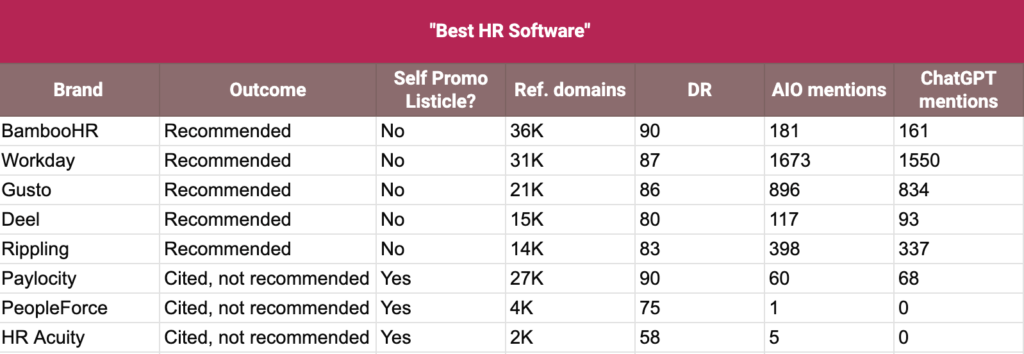
Build your own comparison page for authenticity. Publish an honest page comparing your product with key competitors. Explain meaningful differences and acknowledge where an alternative may be a better fit. Avoid self-ranked “best of” lists that declare your brand the winner without credible evidence.
Here’s a test conducted by Lily Ray that shows the negative impact of self-ranked best of lists:
4. Build Platform-Specific Presence
Different platforms surface different types of content. A strong presence on your website alone may not be enough if AI answers in your category draw on YouTube videos, Reddit discussions or other external sources. Focus on the platforms that appear for the questions your customers ask.
Build your owned presence:
- Blog or research content that demonstrates your expertise.
- YouTube videos that demonstrate products or explain how to solve a problem.
- Executive LinkedIn posts that share expertise and useful industry insights.
- Podcasts and webinars that give subject matter experts a platform to discuss relevant topics.
Strengthen your earned presence:
- Reviews that reflect genuine customer experiences.
- Press coverage that adds independent context about your brand.
- Community recommendations on relevant forums and discussions, including Reddit.
You don’t have to be everywhere. Identify the source types that appear in AI answers for your category, then build a credible presence on the platforms that matter most.
5. Strengthen Entity Clarity
AI platforms need to identify your brand correctly and understand what it offers. Clear positioning and consistent business information help establish that identity across the web. What you should do is give AI systems a consistent, unambiguous picture of your brand and its place in the category.
Create a concise positioning statement and a detailed “About” page explaining what the business does, whom it serves and how it differs from alternatives. Keep the brand name, category and description consistent across your website and external profiles.
To clarify identity, add appropriate Organisation and Person schema to your website. Where relevant, use sameAs links to established profiles on platforms such as Wikipedia, Wikidata and Crunchbase. These connections can help search engines understand which entity a page represents.
Keep product information consistent. For ecommerce brands, product pages, structured data and the Google Merchant Centre feed should describe the same product accurately. Differences in names, prices or specifications can create confusion.
6. Build Reviews and Manage Sentiment
Customer reviews influence how people perceive a brand and provide context about its products or services. Regularly monitoring review platforms helps identify gaps in coverage and outdated information that could affect how the brand is represented online. There are two things you can do.
- Create a scorecard for each relevant platform, recording whether a profile exists, its rating, review count and the date of the latest review. Compare these metrics with your top three competitors to identify where your brand needs attention.
- Then, address negative feedback professionally rather than leaving complaints unanswered. If a review contains outdated or incorrect information, respond with the facts and request a correction from the original publisher where appropriate. Avoid manufacturing positive reviews or manipulating ratings.
7. Make Content Citable
Put the main answer near the top of the page and use self-contained passages that make sense outside their original context. Support your points with first-hand experience, original data and specific examples rather than generic advice found across multiple websites.
Build pages around distinct search intents. If several pages target the same question, consolidate overlapping content where appropriate. Address related questions within existing pages instead of creating a separate page for every wording variation. Google considers mass-producing content without adding value a form of scaled content abuse.
Keep important pages current and comprehensive. Add relevant images or videos where they improve understanding, and update information when facts change. Publication and update dates can help readers assess freshness. Your main pages should answer the core question clearly and provide enough supporting detail for readers seeking deeper information.
8. Publish Original Data and Research
Original research gives your brand something that other websites can reference rather than simply repeat. Surveys, industry benchmarks, proprietary datasets and expert interviews can reveal findings that are difficult to obtain elsewhere. When supported by transparent methods, these findings can become useful evidence for journalists, industry publications and AI-generated answers.
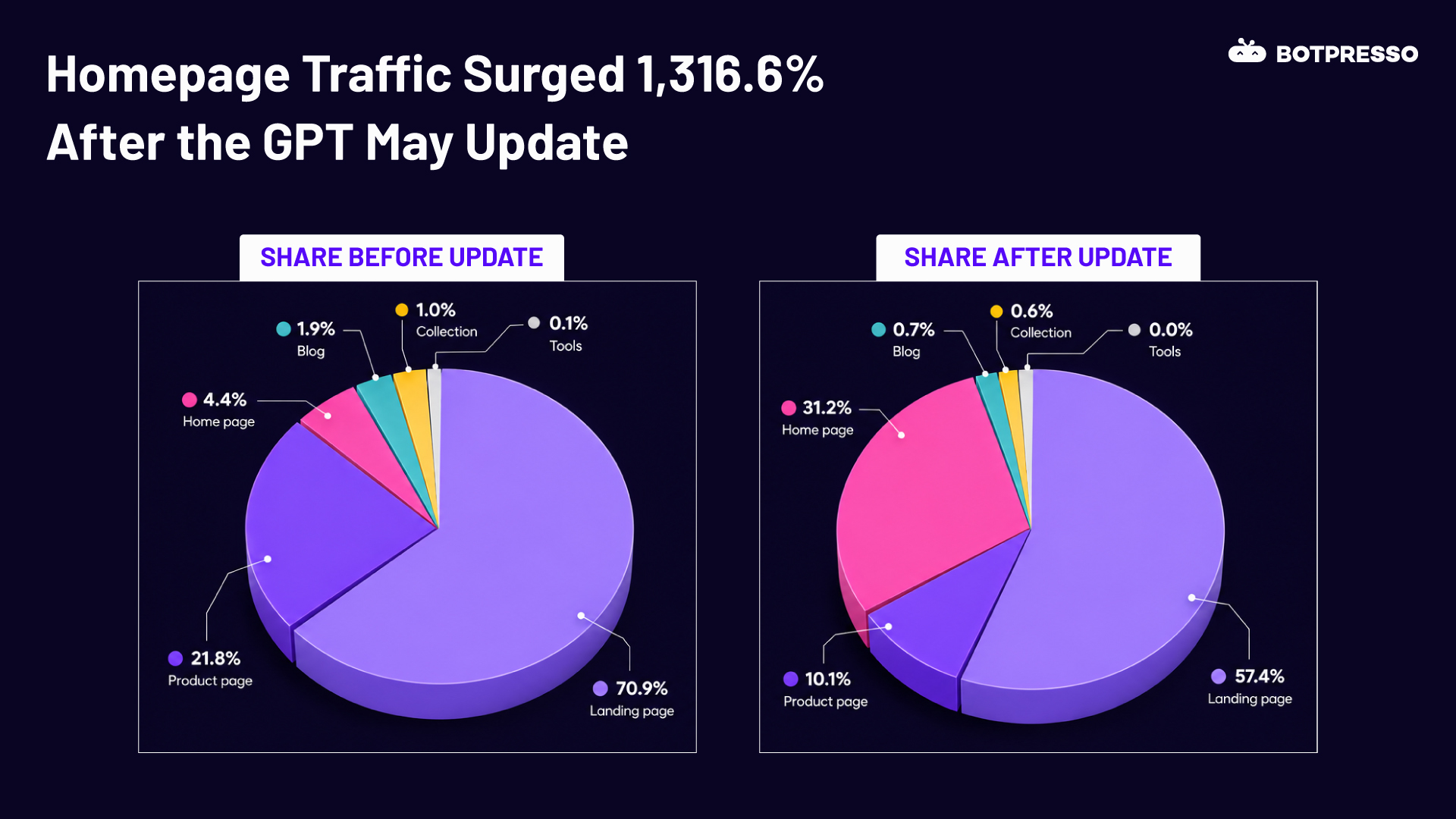
Botpresso’s analysis of ChatGPT referral traffic is one example. The study examined Google Analytics 4 data from 52 websites across B2B and B2C markets, comparing two six-week periods around the May 2026 change in ChatGPT’s use of clickable links. Referral sessions increased by 97.9% overall, while homepage traffic rose by 1,316%. Blog referrals, however, declined by 28%.
These findings reveal why overall traffic alone can hide important changes in where AI sends visitors. The study also illustrates how first-party data can challenge assumptions and give other sources specific findings to reference.
Publish the methodology alongside the results, explain the limitations and present key figures in plain text. Original research cannot guarantee AI citations, but it gives your brand a distinct contribution to the information available in its category.
How to Measure Whether You Are Actually Getting Mentioned
A consistent measurement framework helps you establish a baseline, compare competitors and identify where your brand needs to improve.
Build a 50-Prompt Set Across Six Buckets
Build your prompt set around six types of buyer questions. Use sales calls, support tickets and long-tail Google Search Console queries, especially searches containing eight or more words, to reflect the language customers actually use.
| Bucket | Example Prompts to Test |
|---|---|
| Problem-aware |
|
| Exploration |
|
| Comparison |
|
| Alternative |
|
| Use-case |
|
| Branded |
|
Expand each bucket based on your market and customer questions. Do not exclude branded prompts. They reveal how AI describes your business and whether that description matches your actual positioning.
Read the Query ChatGPT Writes for Itself
ChatGPT may expand a prompt into several search queries before generating an answer. Inspecting these queries can reveal which brands it associates with your category and what information it seeks to answer the question.
Use browser DevTools or a tool such as FanoutFox to inspect the search queries generated for your test prompts.
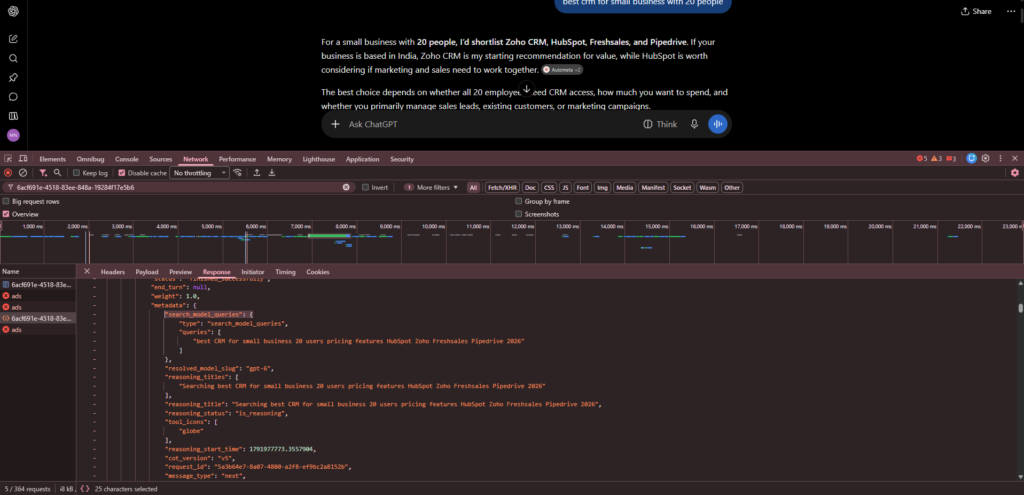
Run each prompt five times and record which brands appear in the queries and which appear in the final answers. Look for brands that recur across all five runs. These are useful indicators of your current competitive set, even if you do not consider them direct business competitors. If your brand is consistently absent, it may not yet be part of ChatGPT’s initial consideration set for that topic.
Track Mentions and Citations Separately
A brand can appear in an AI answer without its website being cited. Equally, AI may cite a brand’s page without naming the brand in its response. Tracking both reveals whether your business is being recommended or its content is being used as a source.
Score Visibility with Clear Metrics
Once you track mentions and citations, turn the results into a scorecard clients can follow. Use the same prompt set across platforms and reporting periods so changes are easier to compare.
Track the metrics that explain visibility:
- Brand mentions: counts how often AI platforms name your brand in their answers, whether or not they link to you. Track this across a consistent set of prompts so you can see how it changes over time.
- Citations: shows how often AI platforms cite your pages as a source, and which URLs they cite. A brand can be mentioned without being cited, so look at both.
- Share of voice: compares your brand’s mentions with those of the competitors you track.
- Sentiment: assesses how AI describes your brand, including whether the language is positive, neutral or negative. Review the actual responses rather than relying entirely on automated labels, which can miss context.
- AI referral traffic: measures visits to your website from AI platforms. Use Google Analytics 4 (GA4) to identify referral sessions from sources such as ChatGPT and Perplexity, then examine the landing pages and conversions associated with that traffic.
- AI crawler activity: shows which AI crawlers request your pages and how often. Review server logs for recognised crawler user agents, requested URLs, response codes and crawl frequency. This helps identify access issues, but crawler activity alone does not prove that a page was indexed, cited or used in an answer.
Google Search Console provides performance reporting for eligible generative AI features through its available search performance reports. Bing Webmaster Tools also offers AI Performance reporting, which can show how your content is cited across supported Microsoft AI experiences.
Bring the results into one scorecard, with separate views for each AI platform. Report the change from your baseline, the competitors gaining visibility, and the pages receiving AI referrals. This gives a clearer picture of what is improving and where further work is needed.
Demand Generation
Track branded search traffic and direct traffic alongside AI referral sessions to understand whether AI visibility is translating into greater brand awareness. Compare results against a baseline and account for seasonality and other marketing campaigns. Look for sustained changes rather than short-term spikes. Rising branded searches alongside increased AI brand mentions may indicate growing awareness, while referral traffic shows whether AI platforms are sending visitors to your website.
What These Approaches Do Not Guarantee
These approaches can improve your chances of being mentioned by ChatGPT and Perplexity, but they cannot guarantee visibility. A brand may have strong content, credible third-party coverage and clear positioning yet still be absent from some answers.
Each platform weighs information differently, and its retrieval systems can change over time. Results may also vary by prompt, context and when the query is run. Treat AI visibility as an ongoing optimisation effort, not a one-time fix. Measure changes consistently and adapt your approach as platforms and customer search behaviour evolve.
90-Day Action Plan
A 90-day plan gives you a structured way to identify visibility gaps, address them and measure progress.
Days 1–30: Diagnose and Fix Foundations
- Finalise the 50-prompt set and inspect the search queries ChatGPT generates for those prompts.
- Check crawler access rules, robots.txt and CDN settings.
- Correct inconsistent brand descriptions across your website and external profiles.
- Separate owned website citations from third-party citations to identify where your brand currently gains visibility.
Days 31–60: Close the Gaps
- Identify missing competitor mentions and pursue relevant third-party inclusion opportunities. Start a structured review programme.
- Consolidate pages competing for the same search intent and publish honest comparison pages.
- Address related questions within existing pages where they add value for readers.
Days 61–90: Expand Signals
- Publish original research based on first-party data or customer insights.
- Build a presence on relevant platforms through YouTube content and creator collaborations.
- Re-run the prompt set, compare results with your baseline and schedule a quarterly review to track changes.
FAQs
1. Does ranking on Google guarantee AI visibility?
No. Ranking well on Google can help your content get discovered, but it does not guarantee that ChatGPT or Perplexity will mention your brand. AI platforms use different retrieval methods and may draw on sources beyond traditional search results.
2. Do backlinks influence AI mentions?
Backlinks can help search engines discover pages and assess their authority. However, backlinks alone do not guarantee AI mentions or citations. Relevant coverage, useful content and clear brand information also contribute to your online presence.
3. Do I need an llms.txt file or schema to appear in AI answers?
Neither is a guaranteed requirement. The impact of llms.txt on AI visibility remains unproven. Structured data, such as Organisation schema, can help clarify your brand’s identity, but it does not guarantee citations. Prioritise accessible pages and accurate information first.
4. Do ChatGPT and Perplexity use the same sources?
No. Both can retrieve web content, but their source selection and citation behaviour differ. A website cited by Perplexity may not appear in a ChatGPT answer to the same question. Track each platform separately.
5. How long does it take for AI assistants to recognise a brand?
There is no fixed timeline. Results depend on factors such as how established your brand is, how accessible its content is and how often relevant sources mention it. Track a consistent set of prompts over time rather than expecting immediate changes.
6. Can small brands compete with larger brands in AI search?
Yes. Smaller brands can improve their chances by focusing on specific customer needs, publishing credible specialist content and building a presence in relevant industry sources. Competing on a well-defined niche may be more practical than targeting broad category queries immediately.
7. How can brands correct how AI describes them?
Start by checking your website’s About page, product descriptions and external profiles for outdated or inconsistent information. Update the original sources where possible, strengthen relevant structured data and monitor AI responses for changes. Corrections may take time to appear, and no single update guarantees an immediate change.
About the Author
Akarsh Kavuttan is an SEO and AI Search professional from India, currently serving as Director of SEO & GEO at Botpresso, where he leads the SEO and AI search research functions.
Akarsh began his SEO journey in July 2018 at a small agency, working closely with a team of two to three people. With over eight years of experience, he has worked across BFSI, education, travel, SaaS, e-commerce, and enterprise. His clients include Thomas Cook India, ICICI Prudential Life Insurance, Orchids International School, John Jacobs, Cleartrip, and Murf AI.
His work has received recognition at the European Search Awards in May 2025, the Economic Times Brand Equity Awards in November 2023, and the DMA Asia Sparkies in November 2022.
Akarsh works in Answer Engine Optimisation (AEO) and Generative Engine Optimisation (GEO). He focuses on hands-on experimentation, tool development, and practical ways to improve brand visibility in AI-powered search.
He is an active contributor to the SEO industry. He regularly shares insights, experiments, and learnings through LinkedIn posts and blog articles. He was also featured in India’s Rising Search Stars Behind Digital Brands.