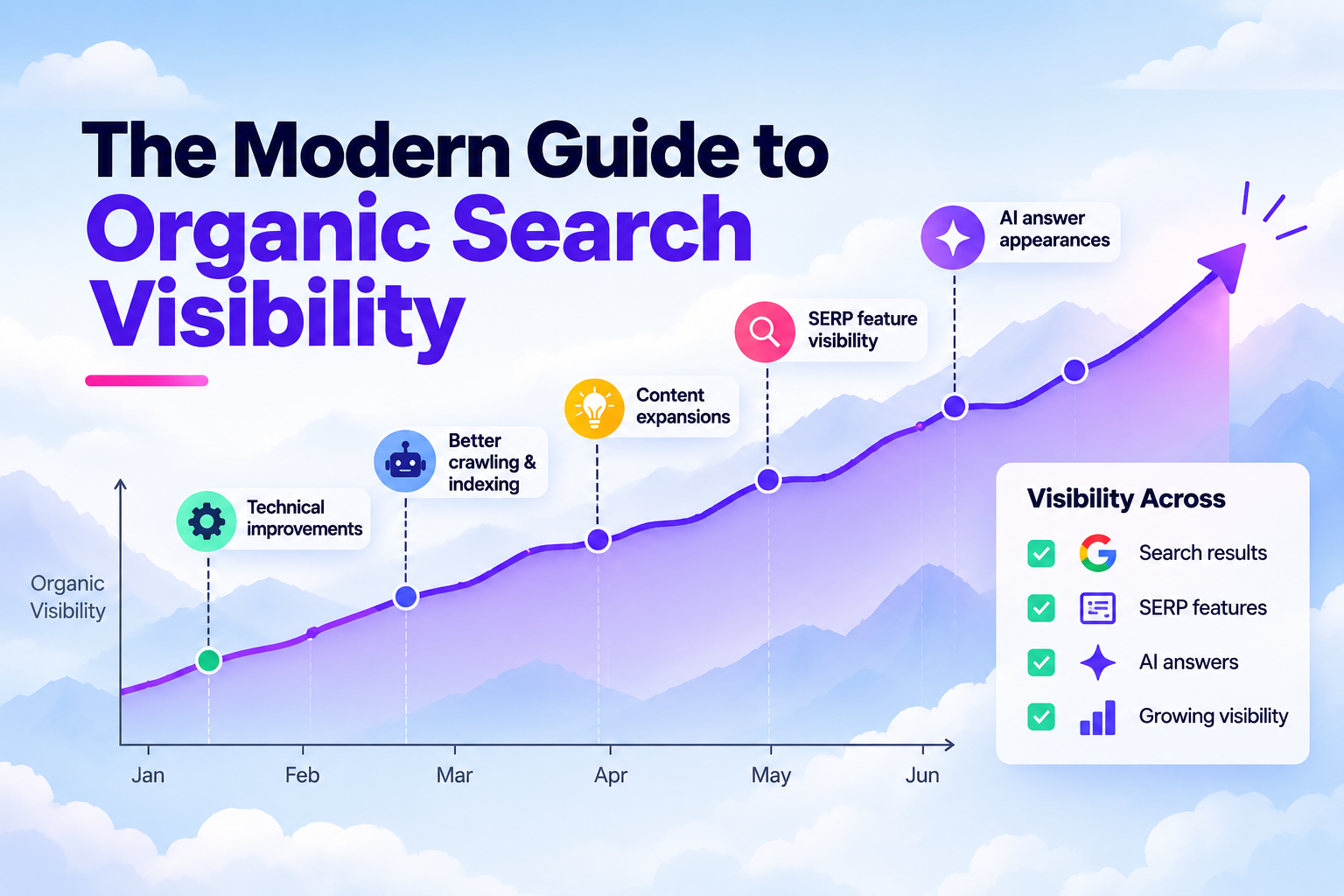
Organic search visibility has changed fundamentally. Rankings alone no longer fully explain organic traffic, while AI Overviews and other SERP features increasingly mediate how users interact with search results. Answer engines such as ChatGPT, Perplexity, Gemini and Google’s AI Mode now also retrieve, summarise and cite web pages, which adds a second layer of visibility on top of search rankings. This guide covers defining modern visibility, evaluating strategy readiness, diagnosing indexing and rank failures, scaling into new categories, executing seasonal campaigns, and measuring multi-layered organic performance across both search results and AI answers.
Key takeaways
- Organic search visibility measures how broadly a site appears across relevant search queries and SERP features.
- An effective SEO strategy depends on search demand, competitor visibility, information advantage, viable economics, realistic timelines, and reliable measurement.
- Technical foundations such as site architecture, crawlability, indexation, internal linking, and structured data support search visibility. Server-side rendering and AI crawler access decide whether answer engines can read your pages at all.
- SEO is the base layer for AEO (Answer Engine Optimisation) and GEO (Generative Engine Optimisation). Pages that search engines and AI crawlers can access, understand and trust are the ones AI answers draw from.
- SEO performance can be measured across traditional search metrics, AI and SERP visibility, and downstream business outcomes.
What “Organic Search Visibility” Actually Means Now
Search is no longer one place. People look for answers on Google, in AI Overviews and AI Mode, and in assistants like ChatGPT, Claude, and Gemini. Organic visibility is the breadth of relevant queries your brand shows up for across all of these surfaces, not your rank for a single head term on a single platform.
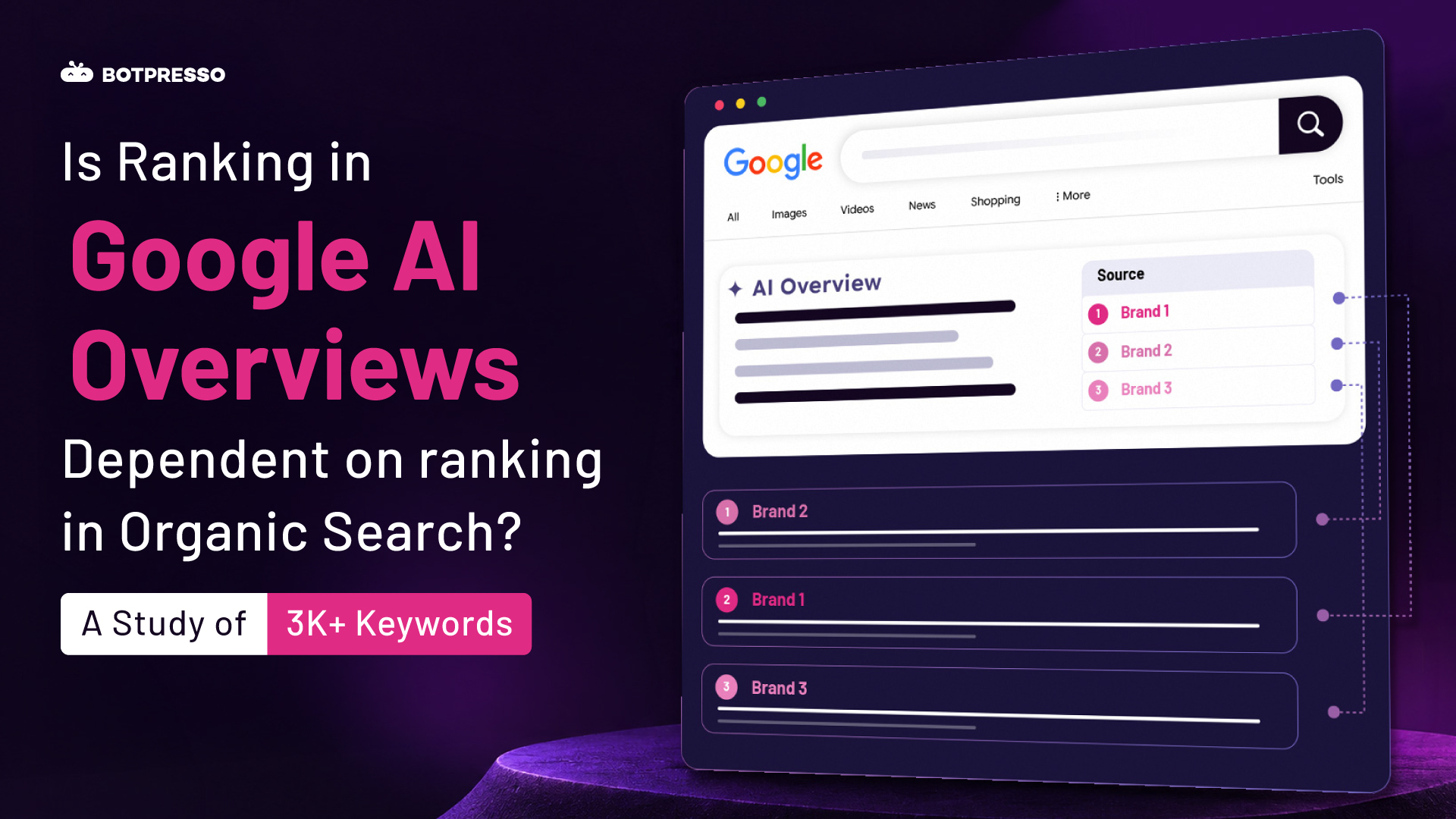
The old 1:1 assumption between rank and traffic broke when AI Overviews and SERP fragmentation arrived. Even a #1 organic result can now receive fewer clicks when an AI Overview addresses the query before the traditional listings. An Ahrefs analysis of 300,000 keywords found a 58% lower CTR for the top-ranking result when an AI Overview was present. And in AI assistants, there is often no ranked list at all, only a synthesised answer that cites or mentions a handful of brands. If you’re not one of them, you’re invisible.
Organic visibility today requires establishing topical authority by covering a topic and its related subtopics in depth. Surfer SEO’s analysis reported a Spearman correlation of 0.77 between the number of fan-out queries for which a page ranks and its likelihood of being cited in AI Overviews. The study also found that pages ranking for fan-out queries were 161% more likely to be cited.
Do You Actually Need a Dedicated SEO Strategy?
A dedicated SEO strategy makes sense when organic search can meaningfully contribute to your business goals, and you have the resources and time to build it.
As more searches are answered by AI Overviews, AI Mode and assistants like ChatGPT, SEO becomes even more important for AEO and GEO visibility. These systems draw on pages they can crawl, index and trust, and Google’s own guidance on AI features states that the same SEO fundamentals apply to AI Overviews and AI Mode, with no separate optimisation required. A brand that skips SEO is usually also missing from AI answers.
The following six signals can help you assess whether SEO is the right investment for your business.
The Six-Signal Test
- Search Demand Exists: Target buyers actively search category-specific queries with verified monthly volume.
- Competitors Capture Demand: Established competitors already receive meaningful organic visibility for relevant commercial and informational queries, and often appear as the brands named in AI answers for the same topics.
- Information Advantage: You possess original data, domain expertise, proprietary research, or unique product knowledge that can support genuinely differentiated content.
- Viable Unit Economics: SEO is viable when expected qualified traffic × conversion rate × customer value supports an acceptable acquisition cost and return on investment after accounting for content, technical, and maintenance costs.
- Compounding Tolerance: Leadership accepts a 6- to 12-month runway before demanding organic revenue payback.
- Telemetry Readiness: Analytics cleanly separates organic conversions from paid, direct, and referral funnels.
When SEO Should Wait
- Category-Defining Products: With near-zero category search volume, prioritise demand generation (paid social, outbound, PR).
- Short Capital Runway: If runway is under six months, SEO may not generate measurable cash flow quickly enough to serve as the primary acquisition strategy.
- Hyper Local Services: Businesses driven primarily by immediate local demand should prioritise Google Business Profile and local SEO fundamentals before investing heavily in broad content hubs.
The Four SEO Work Buckets Mapped to Business Stage
| Business Stage | Primary Technical Focus | On-Page Focus | Content Strategy | Off-Page & Authority |
|---|---|---|---|---|
| New Site | Establish the technical foundation for crawling and indexing. Check indexation, canonicals, robots.txt (including AI crawler rules), XML sitemaps, and site architecture. Serve core content in the initial HTML. | Keyword-to-page mapping, titles, H1s, metadata, page structure, and basic schema. | Build foundational topic coverage around core products and services. Target relevant long-tail queries and bottom-of-funnel content. | Build initial authority through founder PR, startup directories, relevant listings, and guest contributions. |
| Established | Fix crawl errors, indexation issues, JavaScript rendering issues, and Core Web Vitals issues. Review faceted navigation and other elements that can create crawl or duplication problems. | Optimise existing pages for rankings and CTR, and improve alignment with search intent. | Scale topical coverage and depth by publishing commercial content and supporting informational content. | Develop legitimate relationships with relevant publications and partners, pursue digital PR, and reclaim relevant unlinked brand mentions where appropriate. |
| Scaling Brand | Optimise site architecture and manage migrations, international SEO, large-scale indexing issues, automation, and governance. | Scale useful content programmatically, improve templates, strengthen internal linking, and manage schema and indexation at scale. | Build scalable content systems using programmatic SEO, localisation, content governance, and optimisation based on first-party data. | Expand digital PR and relationships with relevant industry publications to build authority across new categories. |
Evaluate Whether Your Current Approach Is Working
SEO performance should be evaluated against the role organic search plays in the wider business strategy. Look at whether the current approach is reaching the right audience, supporting business goals, and generating meaningful results over time.
Start From Business Outcomes, Not Rankings
Evaluate organic visibility by connecting query clicks/impressions directly to pipeline revenue rather than celebrating isolated keyword movements. Start with the business outcome, then trace the organic conversions contributing to it, the landing pages generating those conversions, and the search queries bringing users to those pages. From there, examine impressions and clicks to understand how much search visibility those queries are generating.
Build a Scorecard
| Dimension | Primary Metric | Source |
|---|---|---|
| Visibility | Non-Branded Query Count | GSC |
| Traffic | Organic Traffic, Non-Branded Clicks | GA4 & GSC |
| SERP Visibility | Average Position | GSC |
| Conversions | Organic Goal Completions | GA4 |
| Technical Health | Valid Indexed Pages | GSC Coverage |
| AI Visibility | AI Referrals | GA4 |
Read Metric Combinations, Not Single Numbers
- Impressions Up + Clicks Up: Healthy topical expansion
- Impressions Up + Clicks Flat: Search result intent mismatch, weak titles, or AI Overviews resolving queries zero-click.
- Clicks Up + Conversions Down: Intent mismatch; traffic targets informational or non-commercial queries.
- Position Up + Clicks Flat: SERP feature compression; ads, video blocks, or AI answers absorb clicks.
- Non-Branded Impressions Up + Qualified Conversions Up: Ideal commercial execution among net-new audiences.
Track Zero-Click and AI-Citation Signals Alongside Clicks
Because modern search engines resolve intent directly on the SERP, monitor zero-click brand footprint:
- Branded Search Lift: Measure increase in brand query volume in GSC following zero-click impression spikes. This can help indicate whether users are becoming more familiar with your brand. It can also show whether they are searching for your brand after encountering it in AI-generated and other zero-click results.
- LLM Citation Share: Monitor citation frequency across ChatGPT, Perplexity, and Gemini.
- AI Referral Traffic: Track referral traffic from AI platforms in GA4 to understand whether users are reaching your site from AI-generated results.
- Brand and Topic Association: Check whether AI assistants connect your brand with your core topics, for example by asking which brands are associated with a topic and tracking how often yours appears over repeated runs.
The Five-Question Test
- Are we gaining visibility for the non-branded searches that matter to the business?
- Do organic sessions convert to pipeline at rates that compare favourably with relevant industry benchmarks?
- Do new URLs index within 72 hours of XML sitemap submission?
- Are we growing our share of voice over time against competitors?
- Are we building sustainable organic growth, rather than relying on a few pages or keywords?
The Technical Signals For SEO That Actually Matter
Technical SEO eliminates indexation blockers and crawl traps so search engines and AI crawlers discover, render, and evaluate critical pages without waste.
Crawlability, Indexation, and Canonicalization
- Robots.txt: Avoid blocking CSS, JavaScript, or other resources required for search engines to render and understand important pages. Use robots.txt selectively for URLs that should not be crawled, such as internal search results or certain parameter-driven URL patterns.
- Canonicalisation: Implement self-referential rel=”canonical” tags on primary pages; use canonical tags to indicate the preferred representative URL for duplicate or substantially similar pages.
- Indexing Gaps: Monitor submitted, crawled, indexed, and excluded URLs by template and page type. Investigate significant gaps rather than applying a universal indexing threshold.
- AI Crawler Access: Review robots.txt and any CDN or firewall bot rules for AI crawlers. Most AI platforms run separate bots for training, search and user-requested fetches. OpenAI, for example, uses GPTBot for model training and OAI-SearchBot for ChatGPT search, and sites that block OAI-SearchBot will not appear in ChatGPT search answers. Decide on each bot deliberately instead of relying on old blanket rules.
💡Pro-tip: Create a separate Google Search Console property for important subfolders when you want to isolate their performance from the rest of the site. This can make it easier to monitor indexing, search queries, impressions, and clicks for a specific section or category.
Site Architecture and Internal Linking
- Flat Architecture: Keep important products, services, and category hubs close to the site’s primary navigation structure and ensure they are discoverable through relevant internal links.
- Contextual Anchors: Link internally using descriptive, specific anchor text rather than vague “click here” labels.
- No Orphan Pages: Connect every published page directly to an active parent category hub.
Rendering, Core Web Vitals, and Structured Data
- Rendering: Keep important content available in the initial HTML where possible. Crawlers do not all handle JavaScript rendering equally well, so relying on JavaScript to render critical content can affect how effectively search engines discover and understand a page. This matters even more for AEO. Vercel and MERJ tracked over 500 million GPTBot fetches and found no evidence of JavaScript execution, and ClaudeBot and PerplexityBot also read only the initial HTML.
- Core Web Vitals: Maintain good CrUX thresholds (LCP, INP, CLS) to prevent user drop-off; treat Core Web Vitals as one component of Google’s page-experience and ranking systems, rather than as a standalone ranking factor.
- Structured Data: Use supported structured data to help search engines understand page content and qualify eligible pages for applicable search features; structured data does not guarantee rich results, rankings, or AI citations.
- Security & Infrastructure: Run HSTS over HTTPS, eliminate redirect chains exceeding two hops, and maintain TTFB under 800ms. Fast responses also help with AI crawlers, which tend to work with short timeouts and do not wait for slow pages.
Diagnosing “We’re Doing Everything Right But Can’t Be Found”
Systematically isolate indexing status, technical locks, format mismatch, and other potential causes of poor visibility before diagnosing the underlying issue.
Diagnostic Steps:
- Confirm Indexing: Use the GSC Pages report to check indexing status across the website or a specific subfolder to see if the visibility issue is due to the indexing problem.
- Review Real Impressions: Check whether the right pages are receiving impressions for the right search queries in GSC. Review performance by page and query to identify pages that are gaining visibility for relevant searches and those appearing for queries that do not match their intended audience or purpose.
- Audit Primary Culprits:
| Culprit | Diagnostic Test | Resolution |
|---|---|---|
| Technical Lock | Does the URL return a noindex directive, a non-200 status, or an invalid canonical? | Ensure pages intended for indexing return a 200 HTTP status and have valid canonical tags. Remove internal links to URLs returning non-200 status codes where appropriate. |
| Intent Mismatch | Do the SERPs feature tools or calculators while your URL provides only informational content? | Align the page format and content with the prevailing search intent and SERP features. |
| Architecture Void | Is the page more than three clicks deep or lacking internal links? | Add relevant contextual internal links from authoritative, relevant pages. |
| Authority Deficit | Do competitors have significantly stronger backlink profiles? | Build authority through targeted digital PR and relevant industry citations. |
| AI Crawler Blind Spot | Is key content missing from the raw HTML, or are AI crawlers blocked by robots.txt or the firewall? | Server-render critical content and allow the AI search crawlers you want to access your content for potential citation. |
- Consider Whether the Real Problem Is Search Fragmentation: Your rankings and impressions may remain stable while organic clicks decline as search behaviour shifts toward AI Overviews and other SERP features. Compare changes in impressions, CTR and clicks before and after the expansion of AI-generated results for your key query groups. The key question: Are we losing clicks because we’re less visible, or because search itself is changing?
Adapting SEO When Your Brand Expands Into a New Category
Expanding into a new category requires more than adding a new set of product pages. The new category needs its own topical coverage, a clear connection to existing site authority, and a technical structure that allows search engines to discover and understand it.
Build the Category as Its Own Topic Cluster
Treat the new category as a distinct topic cluster within the existing site. Start with a central category page and build related guides, comparisons, FAQs, and product pages around it. Connect these pages through relevant internal links to establish a clear topic structure.
Research the Category, Not Just the Products
Research the questions, problems, specifications, and comparison terms associated with the new category. Understand how customers discover, evaluate and compare this new category before deciding what pages to create. Also test how AI assistants answer common category questions today and which brands and sources they cite.
Establish Category Authority Before Scaling Product Pages
Build supporting content before publishing product pages at scale. Buying guides, comparisons, FAQs, and original data can establish broader coverage and provide useful context around the products.
Connect New Territory to Existing Authority
Create internal links from relevant, established pages to the new category and its key content. This connects the new section with the existing site’s authority instead of leaving it as an isolated mini-site.
Get the Technical Architecture Launch-Ready
Add the new category to the navigation and make it discoverable and crawlable through internal links, XML sitemaps, and merchant feeds where applicable. Implement relevant Product, ProductGroup, and merchant listing structured data to help search engines understand products and their variants.
Earn Credibility in an Unfamiliar Category
Bring original expertise, first-hand testing, and transparent sourcing into the new category. Avoid publishing large volumes of generic content simply to increase page count. This also aligns with Google’s current guidance on site reputation abuse.
Phase the Rollout
Move through four phases: foundation, authority, scale, and optimisation. Establish the technical structure first, build category depth next, then expand product coverage and optimise based on search data.
Measure the Expansion Separately From the Core Business
Set a baseline and dedicated dashboard for the new category before launch. Track its impressions, clicks, rankings, and conversions separately from the core business so category performance remains visible in overall reporting.
Aligning SEO to a Seasonal Campaign
Seasonal SEO works best when the site is prepared before search demand peaks. The timing and type of seasonality determine how much preparation is needed, while the right URL structure, technical setup, and cross-channel promotion help preserve the value built around the campaign.
Planning for Two Kinds of Seasonality
Time-based seasonality follows a recurring calendar cycle, such as Christmas shopping or back-to-school searches. Event-based seasonality is tied to a specific date or short window, such as Black Friday or a major sporting event. The two need different planning because event-driven demand can rise and disappear within a much shorter period.
The Lead-Time Rule
Competitive seasonal terms can take 3–6 months to build visibility for. If the campaign is already inside that window, focus on actions that can still have an impact. Refresh an existing relevant URL, strengthen internal links, improve the content, and support the campaign through other channels rather than waiting for a new page to rank.
Build Once, Refresh Annually
Use a permanent URL for recurring campaigns and refresh it each year. Creating a new year-specific URL can split links and historical signals across multiple pages and create competing pages for the same search intent.
Establish a Seasonal Baseline
A large year-over-year drop does not always indicate an SEO problem. Seasonal demand changes naturally. Build a baseline using the same period from previous years so normal demand patterns are clear before the next campaign begins.
Technical and Structural Readiness Before the Spike
Test page speed and mobile performance before demand rises. Check crawlability, internal links, and relevant structured data. Promote the seasonal page through important internal links 1–2 months before peak demand. Event structured data can help eligible event pages appear in Google’s event search experience.
Coordinate Across Channels
Paid, email, and social campaigns can support the SEO push around the same period. Align the messaging and landing pages so increased demand across channels leads users to the same seasonal destination.
Where Seasonal Campaigns and Category Launches Overlap
A new category launched around a seasonal peak needs both category preparation and seasonal timing. Build the supporting category content early, connect it to the seasonal hub, and introduce product pages before demand peaks. This gives the new category time to establish relevance while the seasonal campaign creates additional demand.
Building a Measurement System That Ties It All Together
A complete SEO measurement framework maps raw SERP impressions to AI visibility and downstream commercial pipeline.
One Scorecard, Three Layers
| Layer | Focus Area | Core Metrics | Primary Data Source |
|---|---|---|---|
| Layer 1: Foundations | Classic Search Metrics | Non-branded clicks, impressions, CTR, and rankings | Google Search Console & rank trackers |
| Layer 2: Surface Share | Modern SERP & AI Visibility | Citation share, share of voice, and AI referral traffic | AI tracking tools, GA4, Peec AI |
| Layer 3: Economics | Business Impact | Pipeline value, CAC, organic ARR, and conversion rate | GA4, HubSpot, Salesforce |
What to Do When Search Console and a Third-Party Visibility Tool Disagree
Teams often run into discrepancies between Google Search Console and third-party tools like Semrush or Ahrefs.
- The Root Cause: Google Search Console logs actual, server-side search impressions and user clicks across real devices. Third-party platforms, by contrast, estimate traffic based on sampled keyword sets multiplied by static, estimated click-through rate models.
- The Solution: Treat Search Console as your definitive source of historical user interaction, while using third-party tools to analyse broader competitor market share and find keyword gaps.
Monthly Reporting Template
A monthly SEO report should focus on visibility, organic traffic, conversions, AI-search signals, and technical health. It should also explain changes and their causes. Translate the numbers into business implications.
For example, rising impressions with flat clicks may indicate stronger visibility without stronger engagement. Or, higher organic conversions with stable traffic may indicate better traffic quality or landing-page performance. This helps senior management understand the impact of SEO activities, rather than seeing the metrics in isolation.
FAQs
Is the average position still worth tracking?
Ads and AI overviews push results further down the page, separating ranking from clicks. Use average position as a trend directional indicator, with impressions, clicks, and query-level performance.
Do Core Web Vitals matter for ranking?
Yes. Core Web Vitals are used by Google’s ranking algorithms, but good scores don’t always mean good rankings. Other ranking systems still count, and so do the quality and relevance of content.
How long does SEO take to show results?
SEO typically takes 3 to 6 months to show meaningful movement, though competitive markets and major technical changes can take longer. Early signals may appear sooner, but sustainable results usually require consistent optimisation, content, authority building, and time.
Should we use one URL every year for a recurring campaign, or a new one?
For repeat campaigns with essentially the same search intent, choose a consistent evergreen URL. Creating a new-year URL every year can break up accumulated links and historical signals across multiple pages.
Why are my impressions rising while clicks fall?
Either your pages are ranking for broader, unclicked top-of-funnel queries, or zero-click SERP features like AI Overviews and Featured Snippets are satisfying search intent on the results page.
How do I separate branded from non-branded organic performance?
Add a Query filter to the Performance report in Google Search Console. Select Custom (regex) > Doesn’t match, and type in your brand names, product lines and common misspellings. For example, (?i)(brandname|productname|brand-name) filters out queries containing those terms.
Do sitemap changefreq and priority affect rankings?
No. Google ignores sitemap priority and changefreq values explicitly. If lastmod accurately and consistently reflects meaningful changes to a page, it can be useful.
What should I do with a seasonal landing page in the off-season?
HTTP 200 status keeps the URL alive. Update page copy to say the promotion has ended, collect email signups for next year & link to evergreen catalogue pages.
Does my brand need a dedicated SEO team?
Not every brand needs a dedicated SEO team. Early-stage brands can often manage SEO through a capable generalist, agency, or cross-functional team. A dedicated SEO team becomes more useful as organic search grows in complexity, scale, and business importance.
How do I measure whether we appear in AI Overviews and ChatGPT answers?
Track brand mentions and citations across AI search platforms using tools such as Semrush, Ahrefs, or Peec AI. These tools can help monitor visibility across AI Overviews and other LLMs. Referral traffic from platforms such as ChatGPT and Perplexity can also be analysed in GA4.
How do Search Console and GA4 fit together for organic visibility measurement?
Search Console measures pre-click actions on the SERP (impressions, queries, CTR); GA4 measures post-click user actions (engagement, pipeline conversions). Now it’s possible to correlate raw search visibility with commercial revenue, using both datasets together.