Google’s Gary Illyes said that normal SEO is enough to rank in AI Overviews. But how closely do AI Overviews actually follow the organic search results? We analysed a dataset of 3,000+ keywords from the banking and finance industry across credit cards, insurance and loans for which AI Overviews showed up in SERPs. Our goal was to analyse the relationship between traditional organic rankings and its correlation to getting cited in AI overviews. Rather than observing whether a ranking page gets cited, we looked at whether it gets cited, what position it ranks in AIOs, and how often AIO cites pages that don’t rank in the top 10 ranking positions in Google. The result: AI Overviews show similar ranking patterns as organic SERPs, but they are not an exact representation of the SERPs.
Key Takeaways
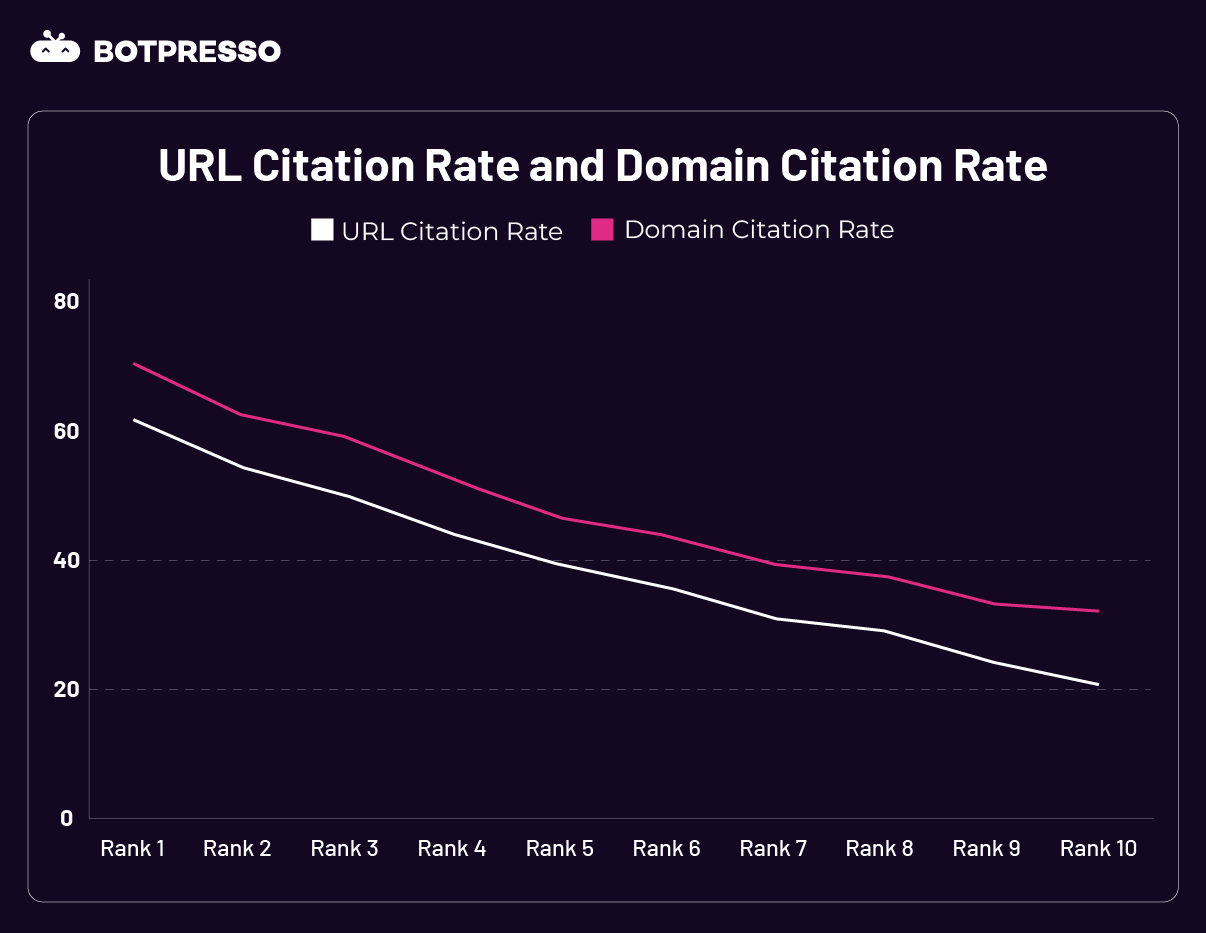
- Higher organic ranking strongly correlated with getting cited in AI Overviews: Pages that rank on position 1 for a keyword are cited 62.2% of the time on the same SERP, whereas pages that rank on position 10 get cited 20.1% of the time. Citation probability declines consistently from position 1 to position 10 and beyond.
- Ranking higher in SERPs has a strong correlation with getting cited earlier in AI Overviews: When cited, rank 1 pages appear at an average citation position of 2.40, versus 5.70 for Rank 10.
- 7 of the 10 most visible organic domains from our dataset also appear among the top 10 most cited domains in AIOs. Which means sites that are winning in SERPs are showing a similar ranking and citation behaviour in AIOs.
- Only 40.4% of AIO citations are from URLs ranking in Top 10 in traditional search, while 54.4% citations come from domains outside the Top 10 for that query. This tells us that there is a fairly high probability of your content getting citations in AIOs even if your page isn’t ranking on the first page in Google.
- When AIO does cite multiple organic winners, it usually preserves their organic ranking order: Their relative ordering matches the organic ranking 73.9% of the times.
- If multiple pages are cited from the top 10 organic pages, a rank 1 result becomes the first AIO citation 65.5% of the times, whereas a page ranking in position 10 gets cited as the first source in AIOs only 2.0% of the times. Ranking in position 1 gives a significant edge in most cases in AIOs too.
- Pages ranking on the top 2 ranks on the SERP are more likely to be cited earlier in AI Overviews than their organic position. Rank 3 pages are cited at almost the same position as their organic rank. Rank 4 onwards, pages are cited later than their Organic ranks.
Methodology
We used Semrush to build a universe of approximately 200,000 US banking and finance keywords where AI Overviews were present. To create a representative sample, we selected 4,000 unique keywords that reflected the topic distribution of the larger dataset while maintaining variety in keyword phrasing and modifiers. Search volume was not used as a selection criterion, helping avoid overrepresentation of popular head terms. We collected organic search results and AI Overview citations using the DataForSEO SERP API. Since AI Overview presence can change between keyword selection and data collection, the final analysis included the 3,320 keywords found in both datasets. What we analyzed Citation likelihood and position: How often pages at each organic rank were cited, and where they appeared in AI Overviews.
- Citation likelihood and position: How often pages at each organic rank were cited, and where they appeared in AI Overviews.
- Domain overlap: How many of the most visible organic domains also appeared among the most cited domains in AI Overviews.
- URL and domain citation overlap: Whether AIOs cited the exact URLs ranking in organic search, another page from the same domain, or a domain outside the organic Top 10.
- Domain level correlations: Whether the number of keywords a domain ranked for was associated with its AIO citation count, and how its average organic rank related to its average citation position.
- Citation order and position: How often AIOs preserved the relative organic ranking of pages cited from the same SERP.
We used descriptive statistics and Spearman rank correlations to examine relationships between organic visibility and citation coverage or position. We also measured pairwise ordering agreement and compared citation positions with a random ordering benchmark, using confidence intervals and statistical tests.
Limitations
The findings reflect a sampled set of US banking and finance keywords where AI Overviews were present at the time of data collection. Because AIO presence can fluctuate, the results may differ across collection dates or other industries. The study measures search rankings and citations, not clicks or traffic, and identifies associations rather than proving that organic rankings directly cause AI Overview citations.
AIO Citation Probability Drops From 62.2% To 20.12% Across The Top 10, Average Citation Position Drops Too
Ranking on SERPs in the top 10 strongly correlated with getting cited in AI Overviews. A rank 1 page has its exact URL cited 62.2% of the time. A rank 8 page, 28.6%, a 2.17x decline. The largest drop is from rank 1 to rank 2. 7.53 percent, larger than any other adjacent step, and larger than the 4.76 percent from rank 2 to rank 3.
Rank |
No. of Org Results |
No. of Cited Results |
Citation Rate |
Mean Best Citation Rate |
Rank 1 | 3320 | 2065 | 62.2% | 2.40 |
Rank 2 | 3320 | 1815 | 54.67% | 3.28 |
Rank 3 | 3320 | 1657 | 49.91% | 3.93 |
Rank 4 | 3319 | 1456 | 43.87% | 4.48 |
Rank 5 | 3287 | 1284 | 39.06% | 4.87 |
Rank 6 | 3154 | 1116 | 35.38% | 5.28 |
Rank 7 | 2897 | 885 | 30.55% | 5.54 |
Rank 8 | 2430 | 695 | 28.6% | 5.56 |
Rank 9 | 1572 | 373 | 23.73% | 5.99 |
Rank 10 | 497 | 100 | 20.12% | 5.70 |
Ranking higher in search also means being cited higher up in AIOs. A page cited in rank 1 appears at mean position 2 in AIOs. A cited rank 8 page appears at 5.56; which means that good SEO performance gets rewarded in AIO overviews. Ranking higher in organic results does not only suggest whether you are cited, it also suggests how prominently you are cited in AIOs.
7 Of The Top 10 Domains Winning On SERPs Also Win In AI Overviews
For the same keywords and SERPs, we asked whether the top 10 domains by number of keywords and average rank winning on SERPs overlap with top performers on AI Overviews or not. Seven of the top ten domains win on both, SERPs and AI Overviews. Reddit, NerdWallet, Bankrate, Experian, Fidelity, progressive and IRS appear in both the top ten organic list and the top ten AI Overview list. Three domains hold a top ten organic position but not a top ten citation position: Chase, Bank Of America and USA Bank. All three are transactional brand sites. The three that replace them are youtube.com, cnbc.com and investopedia.com. All three are publishers. However, this limited dataset does not prove that AI Overviews favour information-heavy websites over commercial ones.
Top 10 Domains on SERPs for Banking & Finance Keywords 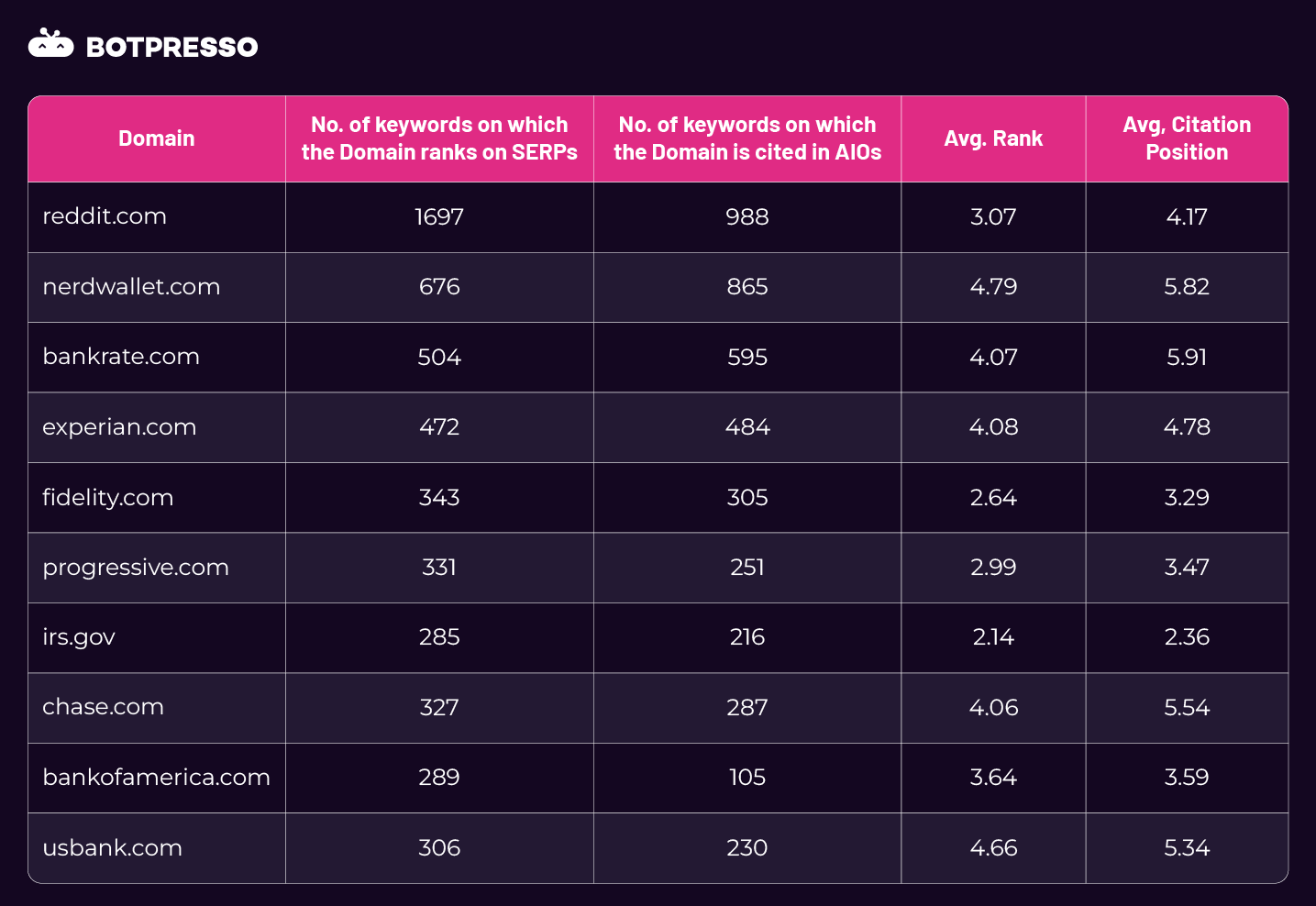
Top 10 Domains on AI Overviews for Banking & Finance Keywords 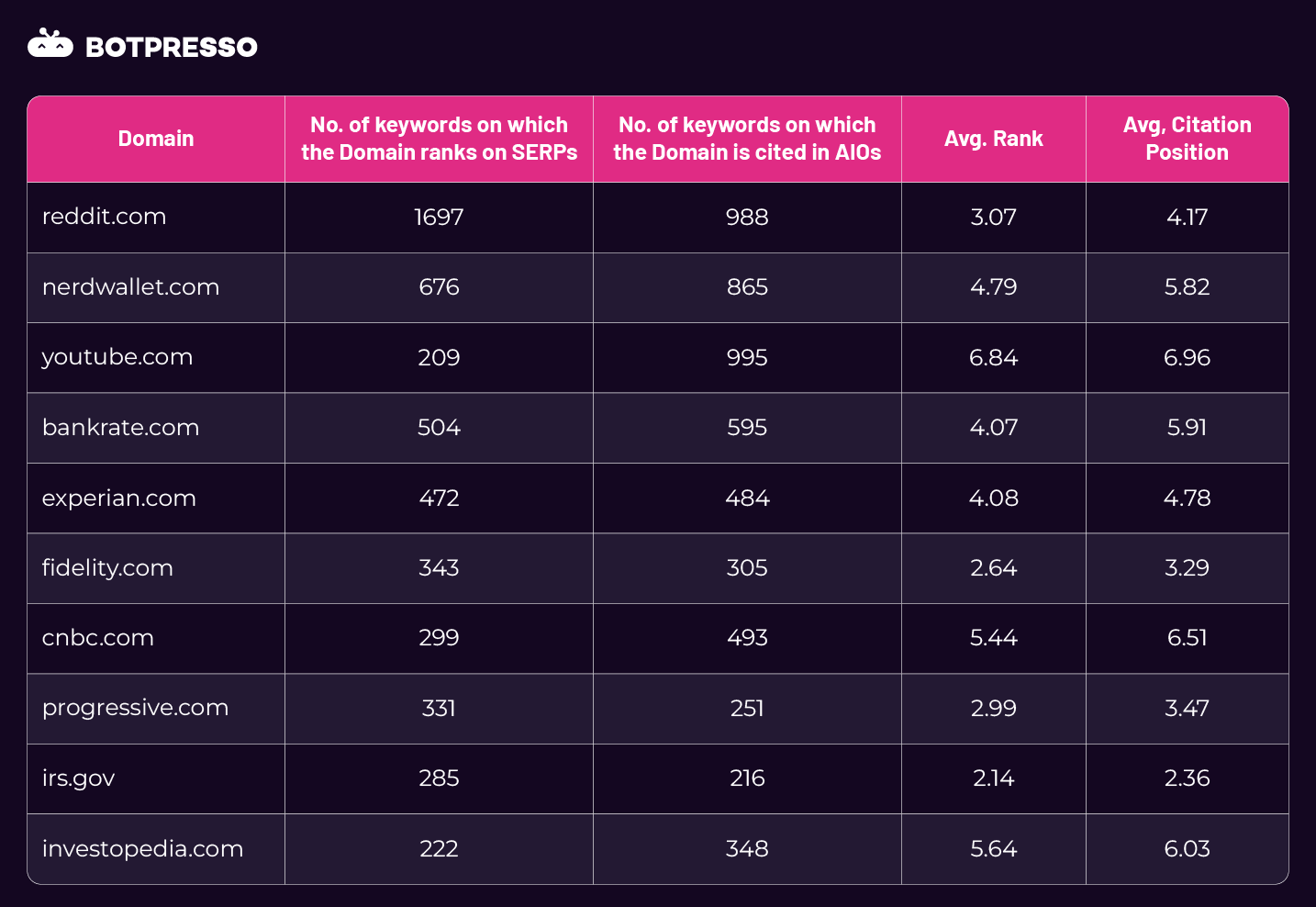
Looking at Reddit which is the only UGC platform in this study, it ranks for 1000+ more keywords compared to the second top performing domain NerdWallet. It performs significantly better in SERPs than AI Overviews. Every publisher from our dataset ranks for more keywords in AI Overviews than organic SERPs. Across 472 domains, the number of keywords a site ranks for strongly correlates with how many it gets cited for in AIO (Spearman ρ = 0.793). The relationship between organic rankings and citation positions is also positive, but weaker (ρ = 0.485). In simple terms, domains with broader organic visibility tend to earn more AI citations, while those ranking higher also tend to appear earlier in AI Overviews.
Only 40% URLs Ranking In The Top 10 Are Cited In AI Overviews
Of 27,448 unique keyword-domain citations across the corpus: 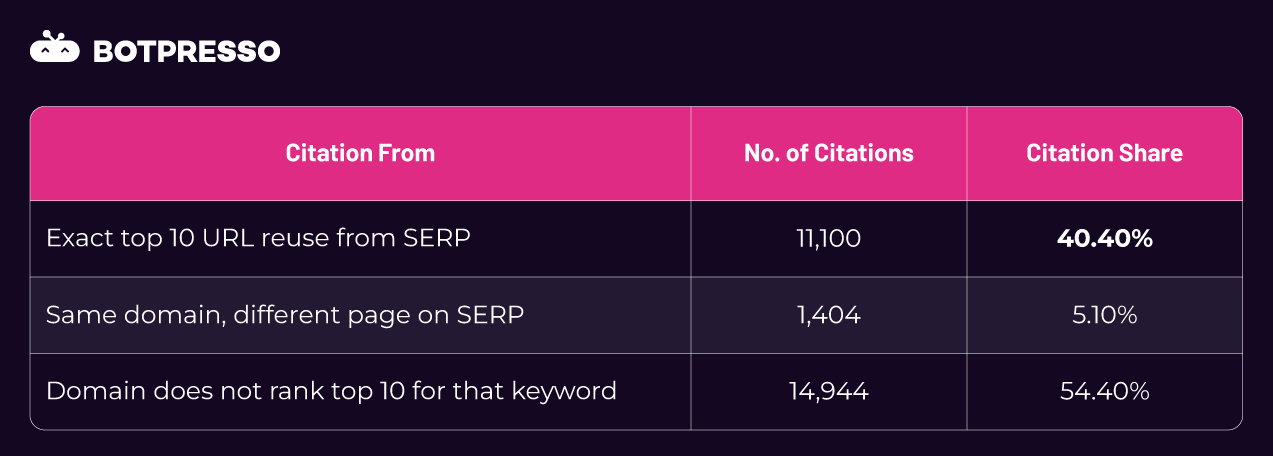
More than half of the URLs an AI Overview cites were not in the organic top 10 results ranking for that query. Which tells us that page-level substitution is rare. When a ranking domain does get cited, the AI Overview uses the exact URL that ranks in SERPs 88.8% of the time. A different page from the same site only shows up for 5.1% of all citations. 54.4% of citations come from domains that were not in the top 10 for that query, which means slightly under half of AI overviews visibility is achievable by doing better SEO alone. What accounts for the other half should be investigated further. Also, this doesn’t mean that doing basic SEO will help you increase your brand mentions in AIOs which is an aspect of GEO work.
Organic Ranking Position Correlates Strongly With AI Overview Citation Position
To see how closely AI Overview citations follow organic search rankings, we grouped each result in Google’s top 10 by whether it was not cited or appeared in one of four citation positions: first, second, third, or fourth and later. This makes it possible to compare both how often a page is cited and where it appears when cited.
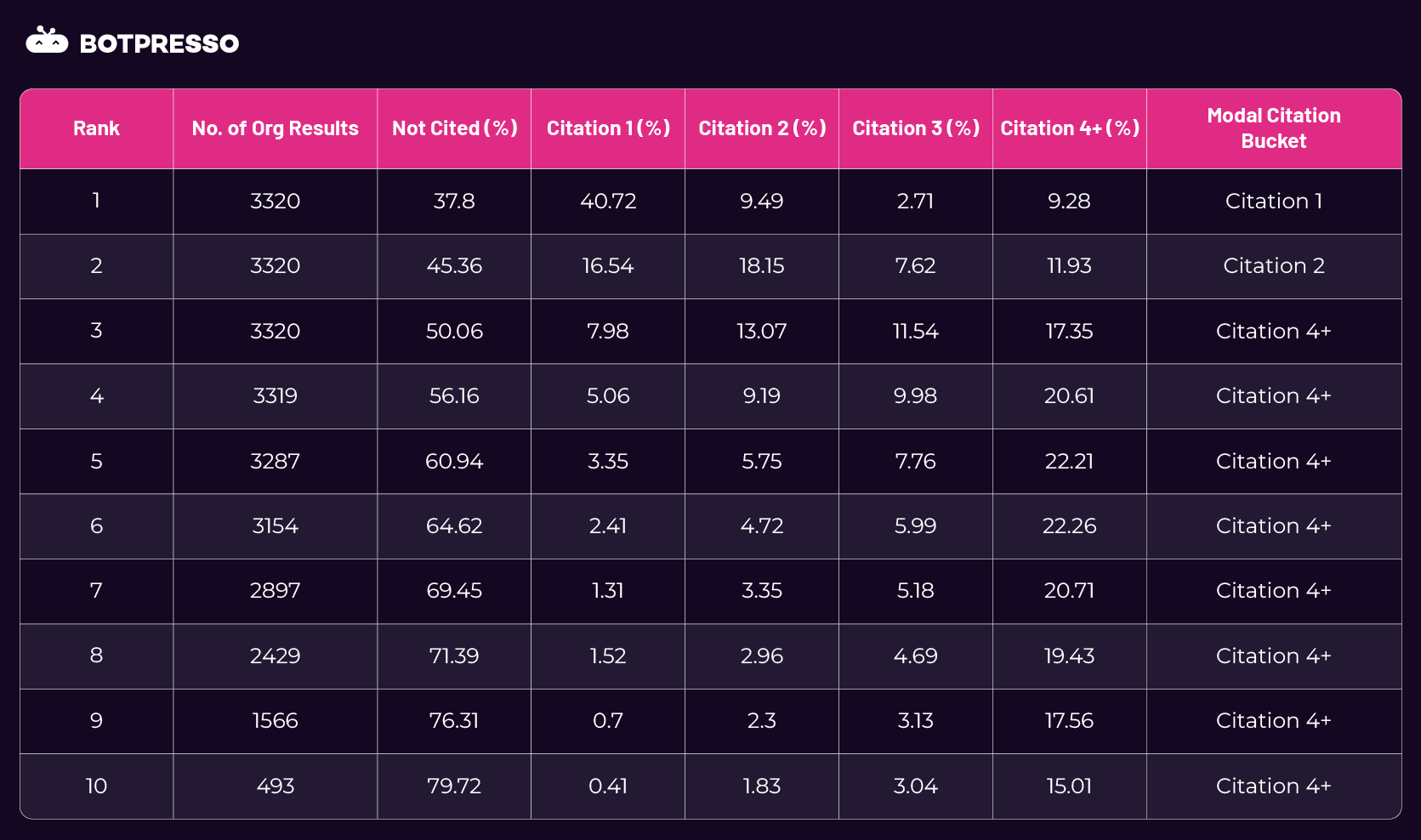
Rank 1 is much more likely to be cited first, and that advantage drops quickly for lower-ranked results. If a source is cited, the following table displays the chance of holding the first slot: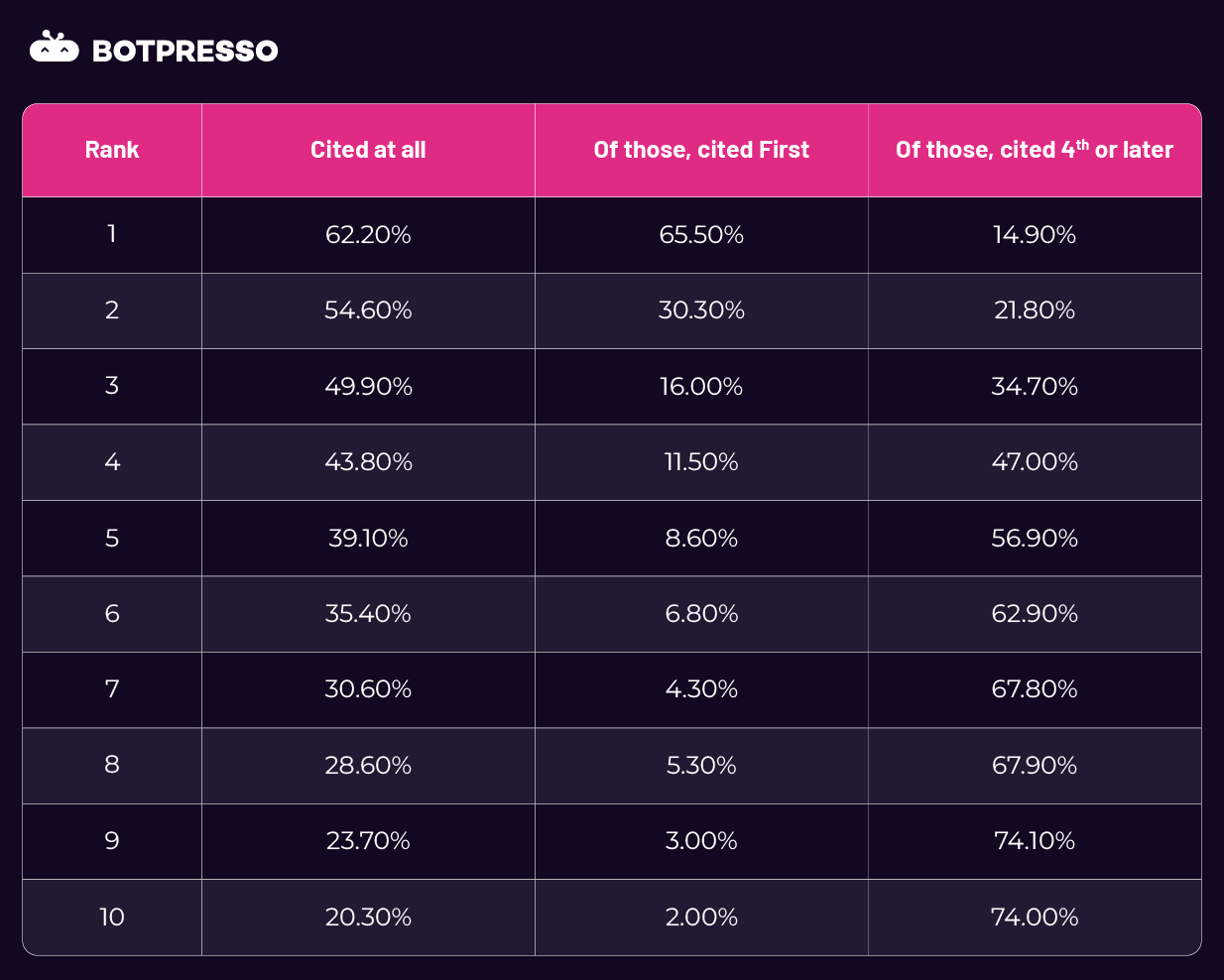
Pages ranking first in Google were cited in AI Overviews about 62.2% of the time. By rank 8, that had fallen to 28.6%, less than half as often. The difference is even larger for the first citation: among cited pages, rank 1 appeared first 65.5% of the time, compared with just 5.3% for rank 8. Much of that drop happens immediately between the first and second organic results, where the chance of being cited first falls from 66% to 30%.
AI Overviews Keep Google’s Order, But Only Down To Position Three
To understand whether AI Overviews simply repeat Google’s organic results in the same order, we compared pages that appeared in both places. We focused on keywords with at least two pages that ranked in the organic Top 10 and were also cited in the AI Overview. This allowed us to compare the order of multiple shared sources for the same keyword, rather than treating a single citation as evidence of an ordering pattern. The analysis covered 2,959 keywords, or 89.1% of the corpus, and 11,159 pages. We observed that when two pages both ranked organically and appeared in an AI Overview, the page with the better organic rank appeared earlier in the AI Overview 73.9% of the time (95% CI: 72.9% to 74.9%). In other words, AI Overviews generally follow the organic order, although not every time. The pattern is strongest for the top two organic results. To compare citation placement across rankings, we measured where each page appeared in the AI Overview’s source list relative to where it would be expected under a random ordering. A value of 0.5 represents the middle of that expected range. Values below 0.5 indicate an earlier position, while values above 0.5 indicate a later one.
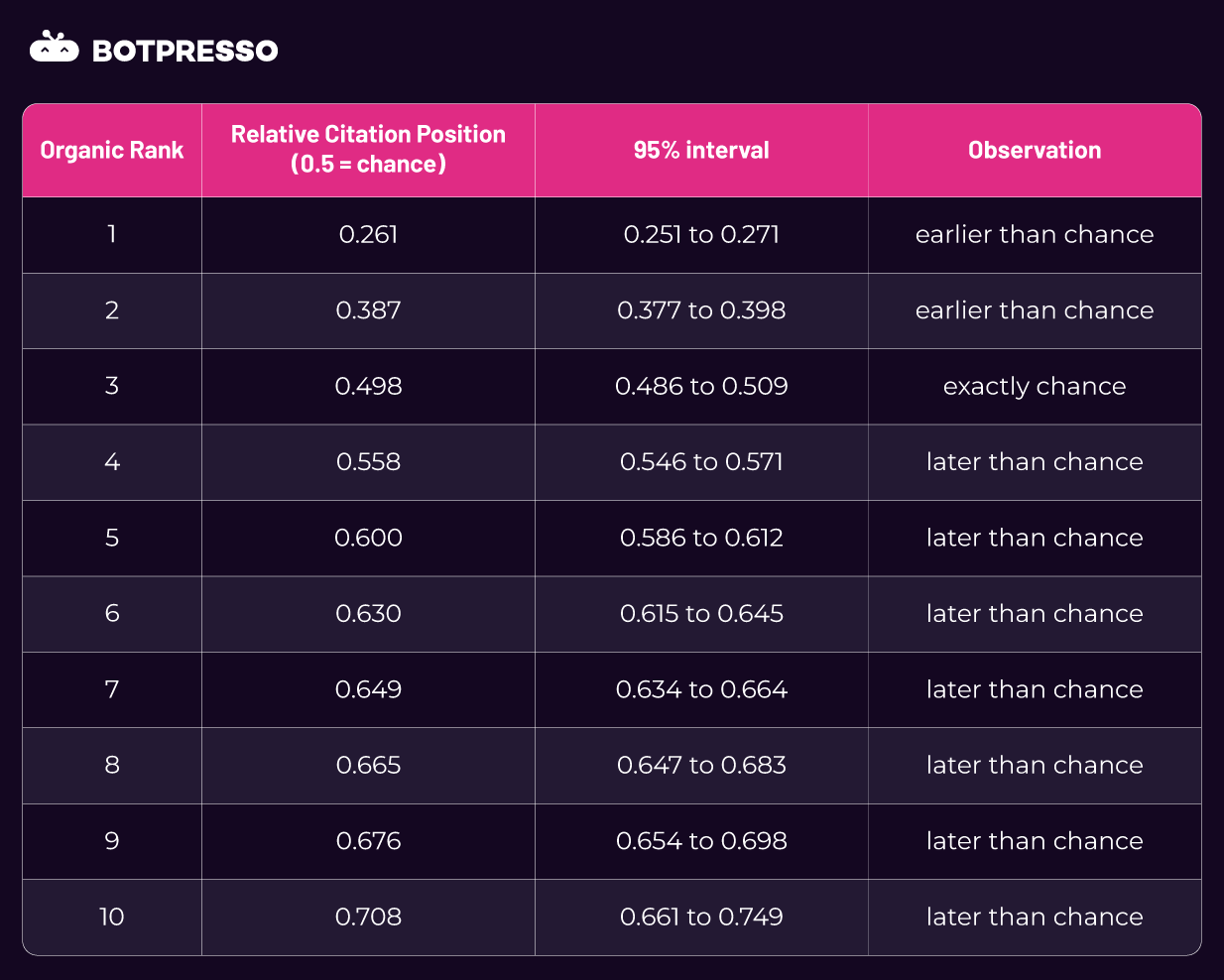
The first and second organic results tend to appear earlier in the AI Overview source list than random ordering would suggest. The third result is close to the random benchmark. Results ranked fourth through tenth generally appear later. For rank three, the measured value was 0.4976 across 1,623 keywords, with a 95% interval from 0.486 to 0.509. The result was not statistically different from the random benchmark (p = 0.91).
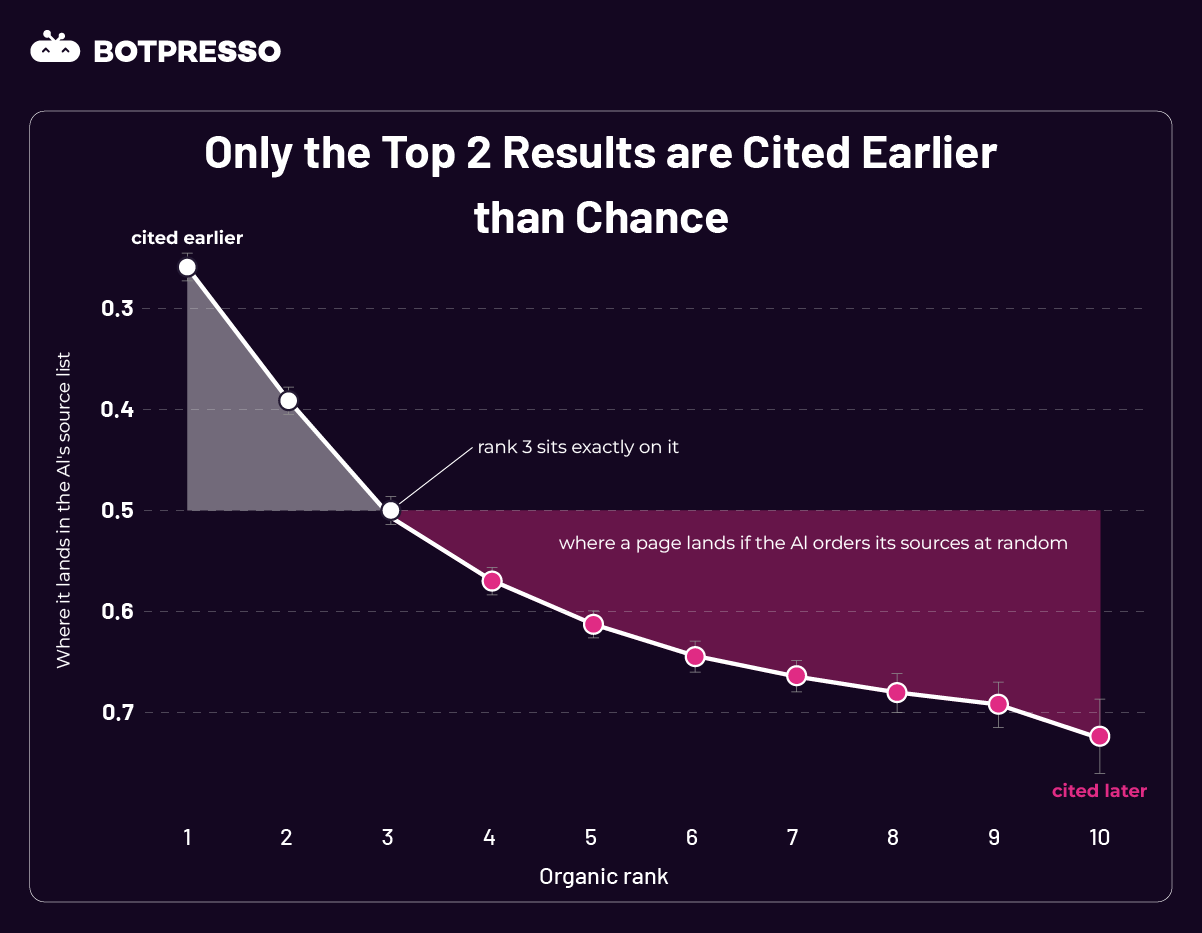
This adds an important distinction to the previous finding that higher ranking pages are more likely to be cited at all. Ranking well is associated with both getting cited and appearing earlier, but the relationship with citation position is clearest for the top two organic results. For lower ranked pages, a better organic position is still associated with a greater chance of being cited, but it does not consistently translate into an earlier place in the AI Overview. Taken together, the findings suggest that organic ranking matters for AI Overview visibility, especially near the top of the search results. However, the order of citations is not simply a copy of the organic rankings.
Conclusion
Our findings suggest that Google’s AI Overviews are closely connected to traditional organic search, but they do not simply reproduce the organic results. Pages with higher organic rankings are more likely to be cited in AI Overviews and, when cited, tend to appear more prominently. This relationship is strongest for the top organic results. When multiple organic results are cited for the same keyword, AI Overviews also tend to preserve their relative order, doing so in 73.9% of page pair comparisons. However, AI Overview citations extend well beyond the organic Top 10. Only 40.4% of citations were exact URL matches with pages ranking in the organic Top 10, while 54.4% came from domains that did not rank in the Top 10 for that query. At the same time, seven of the ten most visible organic domains also appeared among the ten most cited domains in AI Overviews. Together, these findings show that organic search visibility and AI Overview visibility overlap substantially, but not completely. However, the flip side is that with AI Overviews becoming a default SERP layout as part of Google’s zero-click search push, clicks from organic search results have significantly reduced. Which means that your best performing pages, even after getting prioritised on AI Overviews, might not receive the same number of clicks as before. The nature of search and user behaviour have fundamentally changed. If you are looking to build visibility for your brand in the age of zero click search, learn more about our GEO services and book a free strategy call with us.